

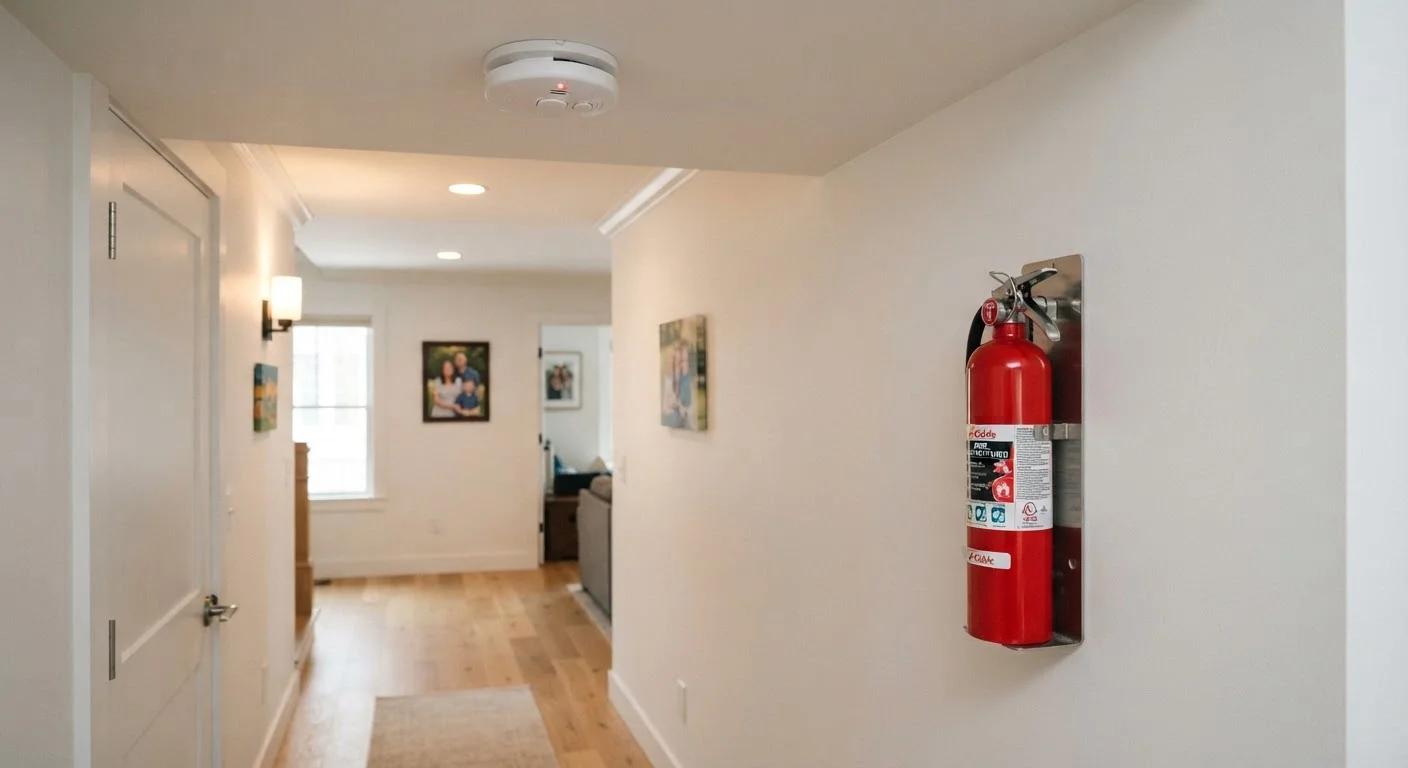
The Three Devices Every Home Should Have
Home safety starts with three core devices: smoke detectors, carbon monoxide (CO) alarms, and fire extinguishers. Each addresses a distinct hazard, and together they form a baseline safety net that every household - renter or owner - should maintain. Understanding where to place them, how they work, and when to replace them can meaningfully reduce risk.
Including these devices as part of a routine home review is a smart habit. See how they fit into a broader annual home audit that covers your home's systems and safety all at once.
Smoke Detectors: Placement, Testing, and Replacement
Smoke detectors save lives by providing early warning before a fire spreads. The U.S. Fire Administration recommends placing smoke alarms inside every bedroom, outside each sleeping area, and on every level of the home - including the basement. In multi-story homes, at least one alarm per floor is the minimum.
There are two main detector technologies:
- Ionization detectors respond faster to fast-flaming fires.
- Photoelectric detectors are better at sensing slow, smoldering fires.
Many fire safety authorities suggest using both types - or combination detectors that incorporate both technologies - for broader coverage.
Testing: Press the test button monthly. Replace batteries at least once a year, or use 10-year sealed-battery models that eliminate the need for regular battery swaps.
Replacement: Smoke detectors should be replaced every 10 years from the manufacture date, which is printed on the back of the unit. Sensors degrade over time regardless of how well the device is maintained.
Interconnected Alarms Add an Extra Layer
Many modern smoke and CO alarms can be wired or wirelessly linked so that when one sounds, all alarms in the home sound simultaneously. This is especially valuable in larger homes or when sleeping areas are far from a kitchen or basement. Check local building codes - some jurisdictions require interconnected alarms in new construction or during major renovations.
Carbon Monoxide Alarms: A Silent Hazard Requires Active Protection
Carbon monoxide is odorless and colorless, making it impossible to detect without an alarm. It is produced by gas furnaces, stoves, water heaters, fireplaces, attached-garage vehicles, and generators. CO poisoning can be fatal, and symptoms - headache, dizziness, nausea - are easy to mistake for illness.
Where to install: Place CO alarms on every level of the home, including the basement. Position them within 10 feet of each sleeping area so they can wake occupants if CO levels rise at night. Avoid placing them directly next to fuel-burning appliances, as minor fluctuations near those sources can cause nuisance alarms.
Combination alarms: Combination smoke/CO detectors are widely available and may simplify installation, though their placement must satisfy requirements for both device types - which sometimes differ.
Replacement: Most CO alarms have a lifespan of 5 to 7 years. Check the manufacture date on the label. Many models will emit an end-of-life chirp distinct from the low-battery chirp.
Ionization detector
A type of smoke alarm that uses a small radioactive source to detect fast-flaming fires. It reacts quickly to rapidly spreading fires with open flames.
Photoelectric detector
A smoke alarm that uses a light beam to sense smoke particles. It is generally more responsive to slow, smoldering fires before flames develop.
Carbon monoxide (CO)
An odorless, colorless gas produced by incomplete combustion of fuels. It is toxic at elevated concentrations and undetectable without a dedicated alarm.
ABC extinguisher
A multi-purpose dry-chemical fire extinguisher rated for Class A (ordinary combustibles), Class B (flammable liquids), and Class C (electrical) fires.
End-of-life chirp
A distinct alarm pattern emitted by CO detectors and some smoke alarms when the unit reaches the end of its functional lifespan and must be replaced entirely.
Fire Extinguishers: Type, Location, and How to Use One
A fire extinguisher gives you a brief window to suppress a small, contained fire before it grows or forces evacuation. It is not a substitute for calling emergency services - the general guidance is: if the fire is larger than a wastebasket, get everyone out and call 911.
Which type to choose: A multi-purpose ABC dry-chemical extinguisher handles the most common household fires: ordinary combustibles (paper, wood), flammable liquids, and electrical equipment. Kitchens may also benefit from a Class K extinguisher rated for cooking oils and fats.
Where to keep them: Mount at least one extinguisher in the kitchen, ideally near the exit - not directly above the stove where a fire would block access. Additional units in the garage and on each floor are recommended for larger homes.
The PASS technique:
- Pull the safety pin.
- Aim the nozzle at the base of the fire.
- Squeeze the handle steadily.
- Sweep side to side across the base of the flames.
Inspection and replacement: Check the pressure gauge monthly - the needle should sit in the green zone. Extinguishers should be professionally inspected annually. Rechargeable models can be refilled after use; disposable units must be replaced once discharged. Replace any extinguisher older than 12 years or showing visible corrosion or damage.
These maintenance tasks pair well with reviewing your homeowner's insurance coverage, since insurers often have requirements or discounts tied to working safety equipment. Also worth reading: common home maintenance myths that could be undermining your safety routines.