

Key Takeaways
Our Verdict
No single insulation type wins outright - the right choice depends on your climate zone, attic geometry, and whether you're starting fresh or upgrading existing insulation. Blown-in cellulose or fiberglass is the most versatile option for most homeowners topping off existing attics, while batt insulation suits straightforward open joist bays, and spray foam excels in hard-to-seal areas or unvented attic assemblies. Always match your chosen type to the R-value target for your specific climate zone.
| Best for | Recommended |
|---|---|
| Homeowners upgrading over existing insulation | Blown-in (cellulose or fiberglass) |
| New construction or fully open joist bays | Batt insulation |
| Unvented attics or sealing air leaks simultaneously | Spray foam |
| Cold-climate homeowners needing maximum R-value | Blown-in combined with rigid board or spray foam |
Understanding R-Value and Why It Matters
R-value is the standard measure of thermal resistance - in plain terms, how well a material slows the transfer of heat. A higher R-value means more resistance to heat movement, which translates to a more energy-efficient home in both winter and summer.
For attics specifically, R-value matters more than almost anywhere else in the house because heat rises. In winter, warm interior air migrates upward and escapes through an under-insulated attic. In summer, radiant heat from the roof can bake down into living spaces if there isn't enough insulation to resist it.
R-value is additive: if you have R-19 of existing insulation and add R-25 on top, you achieve roughly R-44 total. This is important when planning upgrades rather than full replacements. However, compressed insulation loses R-value, so never pack materials tightly into an existing layer - air pockets within the material are what create thermal resistance.
Measure Before You Plan
Before purchasing any insulation materials, use a ruler or measuring tape to determine your current insulation depth in several spots across the attic floor. Multiply the depth by the approximate R-value per inch for your existing material type. This gives you a realistic baseline and helps you calculate exactly how much additional insulation is needed to hit your climate zone target - preventing both over-spending and under-insulating.
Climate Zones and Their Recommended R-Values
The U.S. Department of Energy uses an eight-zone climate map - Zone 1 being the hottest (parts of Hawaii and South Florida) and Zone 7-8 covering the coldest regions (northern Minnesota, Alaska). Each zone carries specific attic insulation recommendations.
- Zones 1-2 (Hot/Humid): R-30 to R-49 recommended for attics. Emphasis is on blocking summer heat gain.
- Zones 3-4 (Mixed/Marine): R-38 to R-49. Balanced performance for heating and cooling seasons.
- Zones 5-6 (Cold): R-49 to R-60. Heating dominates energy use; higher R-values pay off significantly.
- Zones 7-8 (Very Cold/Subarctic): R-49 to R-60+. Maximum attic insulation is essential for comfort and energy efficiency.
You can identify your zone using the DOE's publicly available climate zone map or by checking your local building code, which will reference the same zoning system. Many homes - especially those built before the 1980s - fall significantly short of current recommendations, making upgrades a high-impact project.
| Blown-In Cellulose | Blown-In Fiberglass | Fiberglass Batt | Mineral Wool Batt | Spray Foam (Closed-Cell) | |
|---|---|---|---|---|---|
| R-value per inch | R-3.2-3.8 | R-2.2-2.7 | R-3.0-3.8 | R-3.7-4.2 | R-6.0-7.0 |
| DIY-friendly | Yes, with rented blower | Yes, with rented blower | Yes | Yes | No - professional required |
| Best attic type | Vented, over existing | Vented, over existing | Open joist bays | Open joist bays | Unvented roof deck |
| Air sealing ability | Low | Low | Low | Low | High |
| Moisture resistance | Moderate | Good | Low | Excellent | Excellent |
| Relative cost | Low-Moderate | Low-Moderate | Low | Moderate | High |
Blown-In, Batt, and Spray Foam: How They Compare
Each insulation type has distinct characteristics that make it suited to particular situations. Understanding the trade-offs helps you plan realistically.
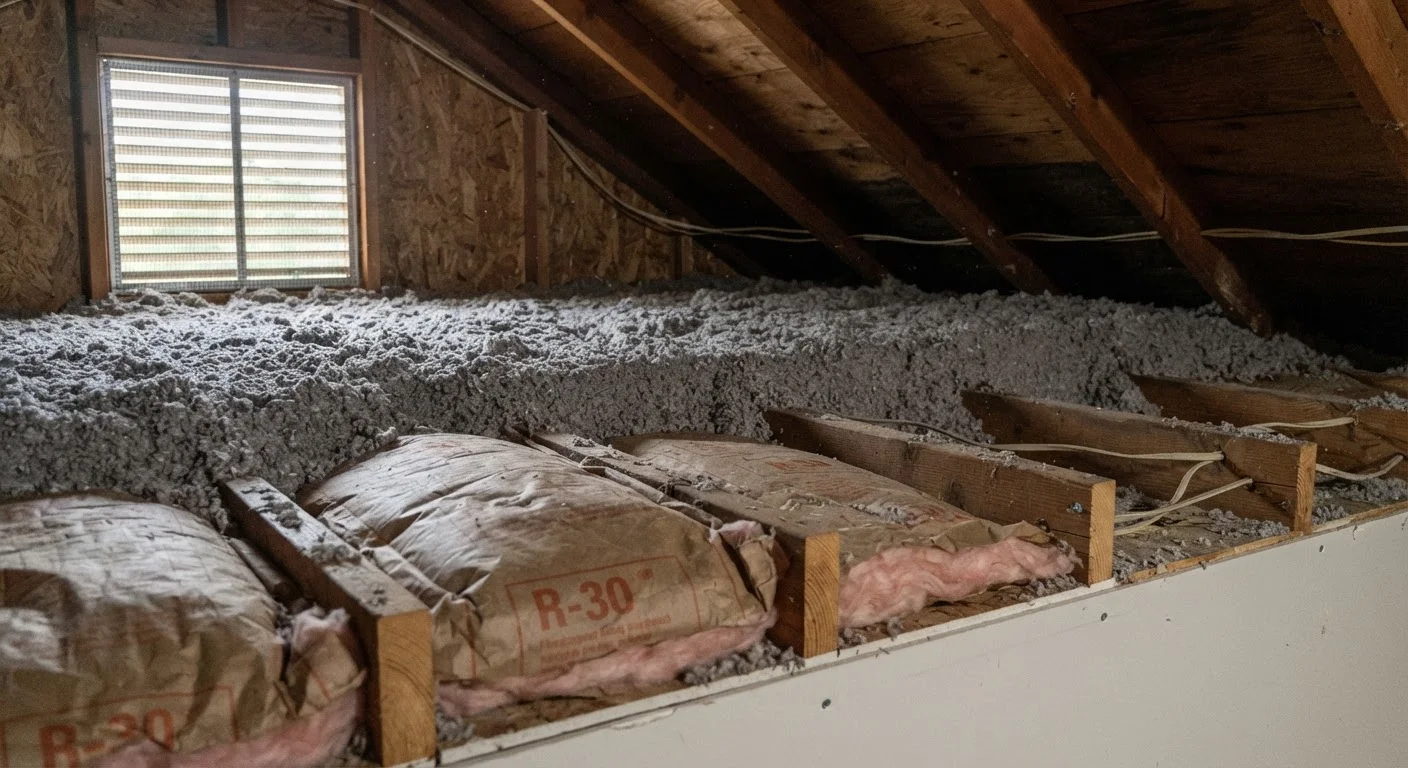
Blown-In Insulation (cellulose or fiberglass loose-fill) is applied using a blower machine and can fill irregular spaces, cover existing insulation evenly, and reach corners without cutting. Cellulose, made from recycled paper, offers around R-3.2 to R-3.8 per inch. Fiberglass loose-fill delivers approximately R-2.2 to R-2.7 per inch. Both are well-suited to attic floors with standard joist layouts and existing material underneath.
Batt Insulation (pre-cut fiberglass or mineral wool panels) installs between joists in open, unobstructed bays. Standard fiberglass batts run R-3.0 to R-3.8 per inch; mineral wool batts perform slightly higher and offer better moisture and fire resistance. Batts are cost-effective and DIY-accessible when the attic floor is clear, but fitting them around obstructions is labor-intensive.
Spray Polyurethane Foam (SPF) comes in two forms: open-cell (around R-3.5 per inch) and closed-cell (R-6 to R-7 per inch). Closed-cell foam is especially valuable in unvented attic assemblies - where insulation is applied to the roof deck rather than the floor - and excels at sealing air infiltration simultaneously. It is generally the most expensive option and typically requires professional installation due to handling requirements.
For more on how insulation choices interact with airflow and moisture control, see how attic insulation and ventilation work together before finalizing your plan.
Before You Add Insulation: What to Check First
Upgrading attic insulation is most effective when the attic is in good condition to start. A few checks before you begin can prevent wasted effort or trapped problems.
- Air sealing: Insulation slows heat transfer but doesn't stop air movement. Gaps around light fixtures, plumbing penetrations, and top plates should be sealed with caulk or foam before adding insulation. Air sealing is often the higher-impact step in older homes.
- Moisture and mold: Inspect the attic for signs of water intrusion, staining on sheathing, or existing mold. Adding insulation over a moisture problem traps it and accelerates damage. Address the source first.
- Ventilation pathways: Ensure soffit and ridge vents are not blocked. In a vented attic assembly, blocking these pathways with insulation causes moisture buildup and roof damage over time.
- Existing insulation depth: Measure what's already there and calculate your starting R-value. This tells you how much additional material you need to reach your climate zone's target.
Watch Out for Vermiculite Insulation
Homes built before 1980 may contain vermiculite insulation, which was sometimes contaminated with asbestos. If you see grayish, pebble-like granules in your attic, do not disturb or sample the material yourself. Contact a certified asbestos inspector before doing any attic work. Disturbing asbestos-containing materials without proper containment poses serious health risks and may require licensed abatement contractors.
If your attic contains older vermiculite insulation (common in homes built before 1980), do not disturb it before having it tested for asbestos by a certified professional. This is a regulated material and requires specialized handling.