

Key Takeaways
Parasitic Battery Drain
Parasitic battery drain is the slow, continuous draw of electrical current from your car's battery while the vehicle is off. Unlike normal standby functions - such as a car's alarm system or clock - parasitic drain occurs when a component draws more power than it should, gradually depleting the battery. It's one of the most common reasons a car battery dies without any obvious cause.
Measured in milliamps (mA), a healthy vehicle typically draws fewer than 50 mA in standby mode; readings significantly above this threshold suggest an abnormal drain source.
Why Your Battery Dies When Nothing Seems Wrong
Few things are more frustrating than a car that won't start after sitting in the driveway overnight - especially when the battery is relatively new. The temptation is to blame the battery immediately, but in many cases the battery itself is fine. The real problem is somewhere else in the electrical system.
Car batteries don't just store power - they work as part of a three-component system: the battery, the alternator, and the vehicle's electrical circuits. When any one of these fails or misbehaves, the result is often a dead battery. Understanding which part is to blame is the first step toward an accurate fix rather than an unnecessary replacement.
For a broader look at how electrical health fits into overall vehicle upkeep, see our complete vehicle maintenance guide.
3-5 years
Typical car battery lifespan
According to the Battery Council International, most conventional lead-acid automotive batteries reach end of life within this range under normal operating conditions.
~50 mA
Maximum healthy standby current draw
Automotive technicians generally use 50 milliamps as the threshold above which standby current draw is considered abnormal and worth investigating.
13.5-14.5 V
Normal alternator output voltage
A properly functioning alternator should maintain this voltage range at the battery terminals while the engine is running, ensuring the battery stays fully charged.
The Three Most Common Electrical Culprits
1. Parasitic Drain
Every modern car has systems that remain active when the ignition is off - the alarm, the key fob receiver, the clock, and various onboard control modules. Together, these typically draw a small, acceptable amount of current. Problems arise when a module gets stuck in an active state, a relay fails to close properly, or a recently installed aftermarket accessory isn't wired correctly.
Common sources of excessive parasitic drain include faulty trunk or glove box light switches (which leave interior lights on), malfunctioning body control modules, and aftermarket stereos or alarm systems installed without proper relay cutoffs. A parasitic draw test - performed with a multimeter placed in series with the battery's negative terminal - measures total current draw in standby. If it reads well above 50 milliamps after the vehicle's modules have had time to go to sleep (typically 30-60 minutes), a fuse-by-fuse elimination process can isolate the offending circuit.
2. Corroded or Loose Terminals
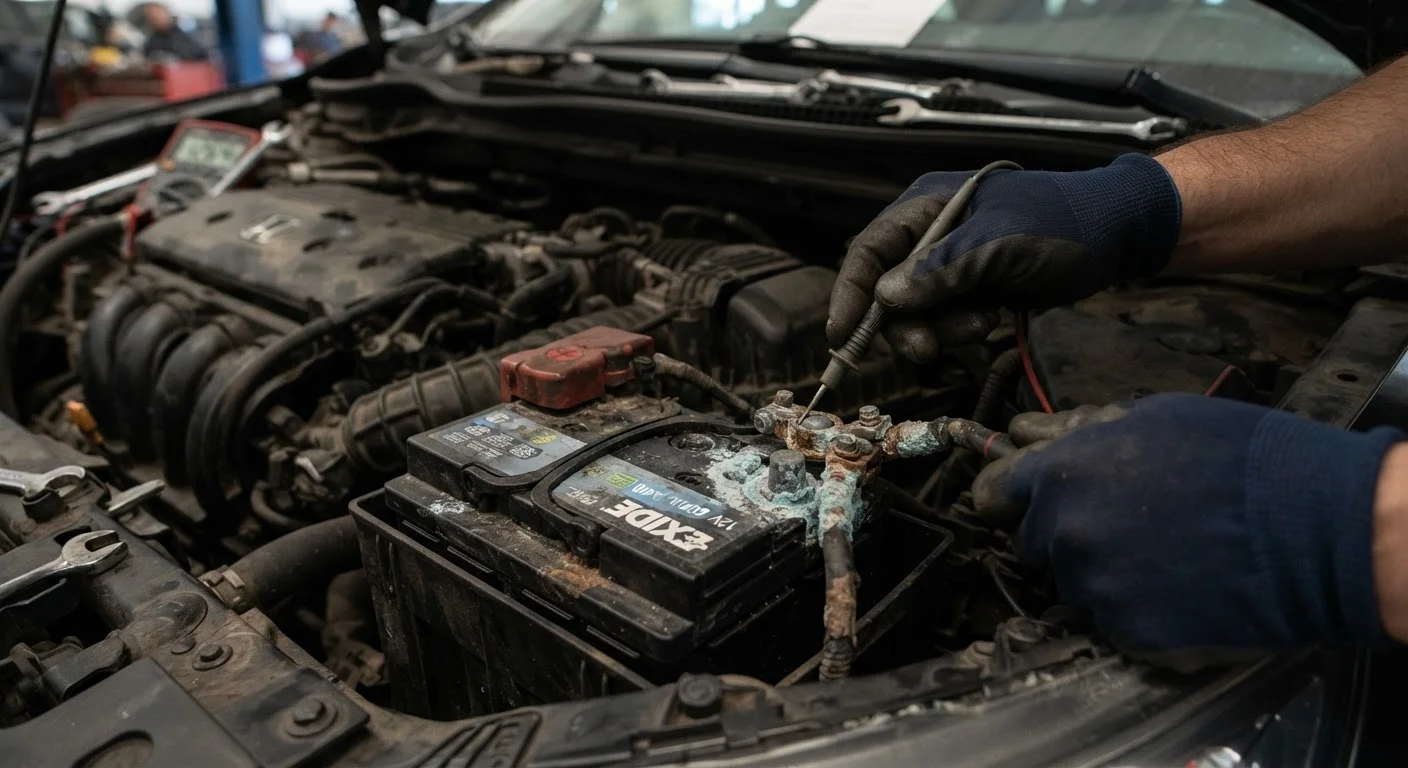
Battery terminals corrode over time due to outgassing from the battery itself and exposure to the engine bay environment. Even mild corrosion dramatically increases electrical resistance at the connection point. The result can look identical to a dead battery - slow cranking, no-start conditions, or intermittent electrical failures - even when the battery holds a full charge.
Inspecting terminals visually is easy; white, blue, or greenish crust is a clear indicator. Cleaning is straightforward but should be done carefully, as the material is mildly corrosive. Baking soda and water neutralize the buildup, followed by a thorough rinse and drying. Ensure the connection is tight afterward - a loose terminal causes the same resistance problem as a corroded one.
3. Alternator Failure
The alternator converts mechanical energy from the engine into electricity, keeping the battery topped off while you drive. A failing alternator may output insufficient voltage - typically the system needs 13.5 to 14.5 volts at the battery during operation - leaving the battery in a constant state of partial charge. Over days or weeks, the battery drops below the threshold needed to start the engine.
Warning signs include a battery warning light on the dashboard, headlights that dim at idle, and electrical accessories that behave erratically. A mechanic can test alternator output in minutes with standard shop equipment.
“The battery is usually the victim, not the cause. When a battery keeps dying, you have to ask what's killing it - and that answer is almost always somewhere else in the charging or electrical system.”
— National Institute for Automotive Service Excellence, ASE - Technical Guidance on Electrical Diagnosis
DIY Diagnosis vs. Professional Repair
Some electrical diagnosis tasks are approachable for a home mechanic - visually inspecting terminals, testing battery voltage with an inexpensive multimeter, or checking whether a dome light stays on. However, chasing a parasitic drain through a modern vehicle's complex wiring and module network can be time-consuming and technically demanding. Vehicles with advanced driver-assistance systems, multiple control modules, and software-managed power states add layers of complexity that are difficult to navigate without professional scan tools.
Our guide to DIY vs. shop repairs outlines where the line typically falls for home mechanics. Electrical diagnosis generally sits closer to the shop side of that line, particularly when the cause isn't immediately obvious.
Test Before You Replace
Before purchasing a new battery, have both the battery and alternator tested at a shop or auto parts store. Replacing a healthy battery without identifying the true culprit - whether a parasitic drain or a failing alternator - will result in the same dead-battery problem recurring within days or weeks.
Extending Battery Life and Avoiding Repeat Problems
Battery longevity is influenced by several manageable factors. Frequent short trips - those under 10 minutes - don't give the alternator enough time to fully recharge the battery after cranking, gradually lowering its state of charge over many cycles. Extreme heat accelerates chemical degradation inside the battery, which is why batteries in hot climates often fail earlier than the industry average.
Annual battery testing, especially as the battery approaches three years old, provides early warning before a failure strands you. Many auto parts stores offer free battery and alternator testing. Keeping terminals clean and connections tight is a low-effort habit that prevents a common and entirely avoidable failure mode.
If aftermarket electronics are installed in the vehicle, ensuring they're wired through a properly fused circuit that switches off with the ignition is essential - a detail that's sometimes skipped in quick installations and can become a chronic drain source.
This article is for general informational purposes only. For diagnosis and repair of vehicle electrical systems, consult a qualified automotive technician.