

Key Takeaways
Home Equity
Home equity is the portion of your home's value that you actually own - free and clear of what you still owe on your mortgage. It's calculated by subtracting your remaining mortgage balance from your home's current market value. If your home is worth $350,000 and you owe $200,000, your equity is $150,000. It represents a real financial asset that grows over time.
Equity is expressed in dollars, not percentages, though lenders often use a loan-to-value (LTV) ratio - your mortgage balance divided by the appraised value - to assess how much equity you hold relative to the home's worth.
What Home Equity Actually Means
Equity is one of the most frequently cited benefits of homeownership, yet it's often misunderstood. At its simplest, home equity is the dollar difference between what your home is worth today and what you still owe on it. It's your financial stake in the property.
Unlike other personal assets - a savings account or a stock portfolio - equity isn't immediately accessible. It exists on paper until you either sell the home or borrow against it. That distinction matters: equity is wealth, but it isn't cash in hand.
Understanding equity is foundational to making sound decisions as a homeowner. It affects your ability to refinance, your options if financial hardship strikes, and your net worth picture as you plan for the future. For a broader look at the true financial scope of owning a home, see the financial realities beyond the mortgage payment.
How Equity Builds Over Time
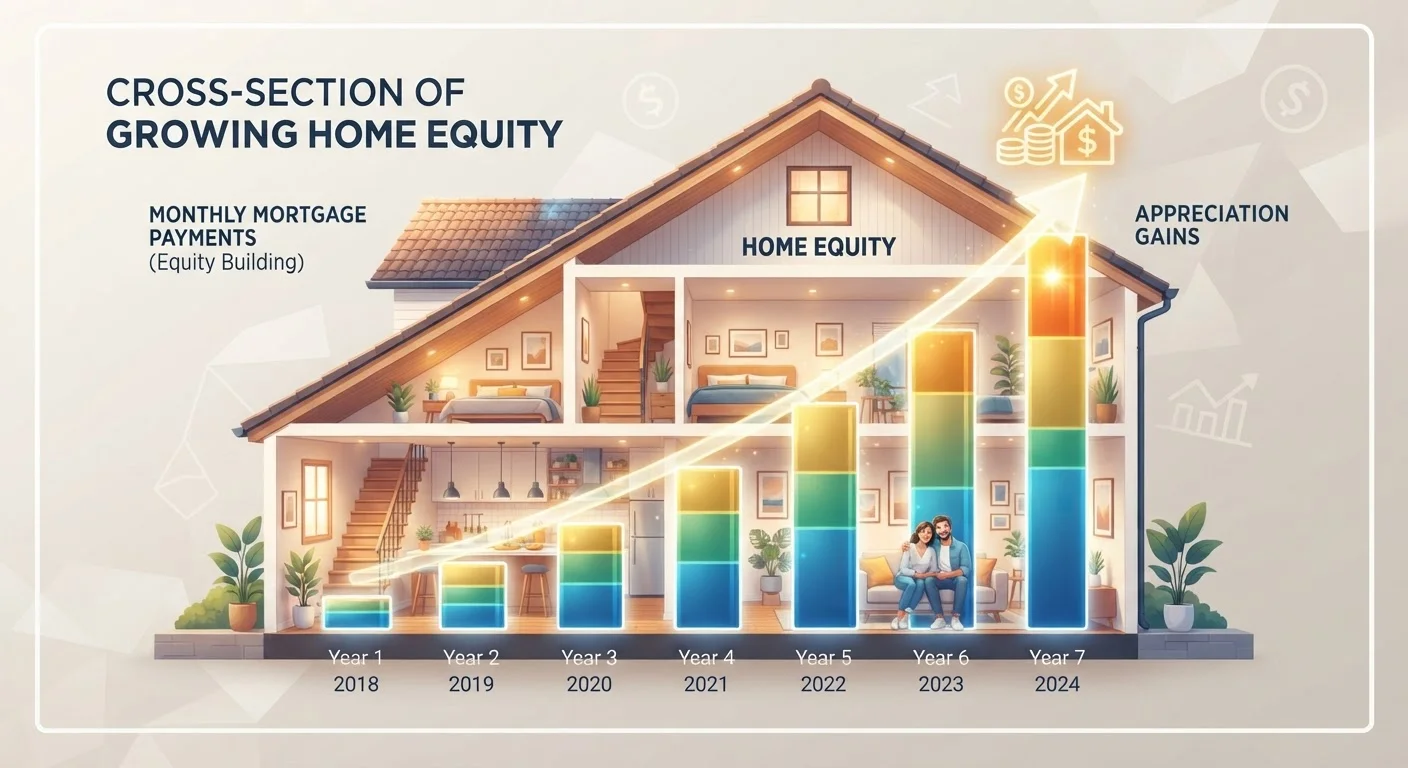
Equity accumulates through three main channels, and most homeowners benefit from all three simultaneously.
1. Mortgage Principal Payments
Every monthly mortgage payment includes both interest and principal. The principal portion reduces your loan balance, directly increasing your equity. In the early years of a standard 30-year mortgage, the split heavily favors interest - a phenomenon called amortization. Over time, the balance shifts: later payments apply more toward principal, accelerating equity growth.
2. Home Value Appreciation
If your home's market value rises, your equity rises with it - even without paying down a single additional dollar on your loan. Local market conditions, neighborhood development, and broader economic factors all influence appreciation. However, value can also fall, which is why equity should never be taken for granted.
3. Home Improvements
Strategic renovations - particularly those that increase livable square footage or modernize kitchens and bathrooms - can add to a home's appraised value. Not all improvements yield a dollar-for-dollar return, so it's worth researching which projects tend to add the most value in your local market before committing.
$298,000
Median homeowner equity in the U.S.
According to CoreLogic's Homeowner Equity Insights report, the median amount of equity held by U.S. mortgage holders reached record levels in recent years, reflecting cumulative appreciation and principal paydown.
~2%
Average annual long-run home appreciation
Historical data from the Federal Housing Finance Agency indicates U.S. home prices have appreciated at roughly 2% per year above inflation over the long run, though regional variation is significant.
20%
Minimum equity typically required to avoid PMI
Most conventional lenders require homeowners to hold at least 20% equity - either from the down payment or paydown - before removing private mortgage insurance (PMI) from a loan.
How Homeowners Can Access Their Equity
Once you've built meaningful equity, lenders may allow you to borrow against it. The two primary vehicles are a home equity loan - a lump sum with a fixed interest rate - and a home equity line of credit (HELOC), which works more like a revolving credit line. For a detailed comparison of how each is structured, see our guide on home equity loans vs. HELOCs.
Lenders generally require you to retain at least 15-20% equity in your home after any borrowing - this is known as a combined loan-to-value (CLTV) limit. The purpose is to protect both the lender and the borrower from being overextended.
Equity Is Collateral - Proceed Carefully
When you borrow against your home's equity, the property itself secures the debt. That means failure to repay could result in foreclosure. Only tap equity for needs that are financially sound and manageable within your monthly budget, and avoid using it to fund discretionary spending.
Using equity to consolidate higher-interest debt is a common strategy, but it converts unsecured debt into secured debt backed by your home. If you're exploring this approach, understanding debt consolidation in full context is an important first step. Always consult a qualified financial adviser before making decisions based on your individual situation.
Why Equity Matters Beyond Borrowing
Equity isn't just a borrowing tool - it's a core component of long-term financial health. When you sell your home, equity becomes the proceeds that fund your next purchase, retirement savings, or other goals. A strong equity position also gives you more negotiating room in a sale and reduces the risk of owing more than the home is worth if values dip.
Equity also plays a role in your overall net worth calculation, which is relevant for financial planning at every stage of life. While home equity shouldn't be viewed as a guaranteed savings vehicle - values can and do fluctuate - it often represents the largest single asset on a homeowner's balance sheet.
To further strengthen your financial foundation as a homeowner, consider pairing equity awareness with dedicated housing savings. Our guide on building a home-specific emergency fund outlines how to plan for unexpected repair and maintenance costs without relying on equity as a first resort.
This article is for informational and educational purposes only and does not constitute personalized financial, legal, or investment advice. Consult a licensed financial professional before making decisions specific to your situation.