

Key Takeaways
Property Tax Bill
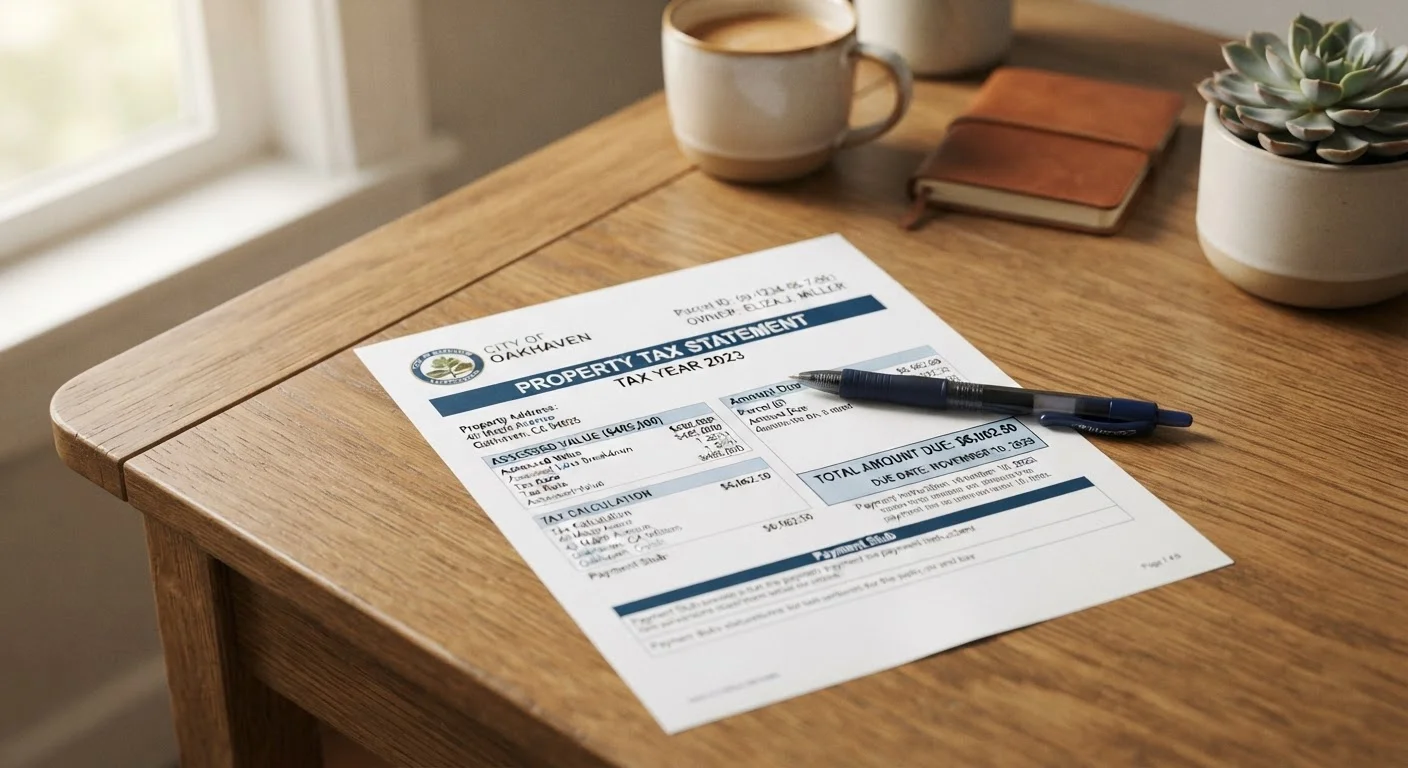
A property tax bill is an official notice from your local government stating how much you owe in taxes on your home or land for a given period. The amount is calculated by applying a tax rate to the assessed value of your property. Most homeowners receive this bill annually or semi-annually, and it funds local services like public schools, fire departments, and road maintenance.
The tax rate is typically expressed as mills (one mill equals $1 per $1,000 of assessed value) or as a percentage of assessed value, which itself may be a fraction of full market value depending on your jurisdiction.
What You're Looking at When the Bill Arrives
A property tax bill can look intimidating at first - multiple rows of figures, unfamiliar abbreviations, and due dates that don't always align with the calendar year. Breaking it down into its core parts makes it manageable.
At the top of most bills, you'll find your parcel number (a unique identifier for your property in county records) alongside your legal property description and mailing address. Below that comes the core financial information: the assessed value of your property, the applicable tax rates, any exemptions that have been applied, and the final amount due.
Property taxes are one of the most significant ongoing costs of ownership - a point worth understanding fully before purchase. See the hidden costs of owning a home for a broader look at what homeownership actually costs beyond the mortgage.
$3,901
Median annual U.S. property tax payment
According to the U.S. Census Bureau's American Community Survey, the national median annual property tax paid by homeowners with a mortgage was approximately $3,901.
Varies by state
Effective property tax rates across U.S. states
Effective property tax rates (tax paid as a percentage of home value) range from under 0.3% in some states to over 2% in others, reflecting wide variation in local funding structures.
Assessed Value: The Number That Drives Everything
Your assessed value is the dollar figure your local tax assessor assigns to your property. It is not necessarily the same as your home's market value - many jurisdictions assess properties at a fixed percentage of market value, sometimes called the assessment ratio. For example, if your home's market value is $400,000 and your county uses a 70% assessment ratio, your assessed value would be $280,000.
Assessors typically update values on a set schedule - sometimes annually, sometimes every few years - using mass appraisal methods that compare your property's characteristics against recent local sales. Individual circumstances, such as significant renovations or neighborhood market shifts, may not be captured immediately.
Check Your Property Record Card
Before assuming your assessment is accurate, request your property record card from the local assessor's office. It lists the physical details the assessor used - square footage, bedroom count, lot size, and condition rating. Errors here are more common than many homeowners realize, and correcting a factual mistake is typically simpler than a full valuation appeal.
Reading the Tax Rate Lines
Once your assessed value is established, the local government applies one or more tax rates to arrive at what you owe. Most bills list these rates separately by taxing body:
- County tax: Funds county-level services like courts, county roads, and local health departments.
- School district levy: Often the largest single line item; funds local public education.
- Municipal tax: Covers city or township services - police, parks, sanitation.
- Special districts: May include fire, library, hospital, or stormwater districts, each with a separate levy.
The rate is commonly expressed in mills. A rate of 25 mills means you pay $25 per $1,000 of assessed value. Add all the individual mill rates together to get your total combined rate, then multiply by your assessed value (divided by 1,000) to calculate your gross tax before exemptions.
Exemptions: What Can Reduce Your Bill
Many homeowners qualify for exemptions that directly lower the taxable portion of their assessed value. Common ones include:
- Homestead exemption: Available in most states for your primary residence, this reduces your assessed value by a fixed dollar amount or percentage before the tax rate is applied.
- Senior citizen exemption: Offered in many jurisdictions for homeowners above a certain age, sometimes with an income cap.
- Veterans and disability exemptions: Reduce taxable value for qualifying veterans or residents with documented disabilities.
Exemptions are not always applied automatically. In many counties, you must apply once - and sometimes renew annually. Check with your local assessor's office to confirm which exemptions you qualify for and whether your application is on file.
Understanding your tax bill is just one piece of the financial picture. Owning a home involves financial realities that extend well past property taxes alone.
What to Do If You Think Your Assessment Is Wrong
Assessments are not infallible. Errors in property records - incorrect square footage, wrong number of bathrooms, or a failure to reflect a demolition - can inflate your assessed value and your bill.
If you believe your assessment is too high, you have the right to appeal. The process varies by jurisdiction but generally involves:
- Reviewing your property record card at the assessor's office to check for factual errors.
- Gathering evidence - typically recent sales of comparable homes in your area.
- Filing a formal appeal within the stated deadline, which is often a short window after assessment notices are mailed.
- Attending a hearing before a local review board, where you present your evidence.
A successful appeal can reduce your assessed value and lower your tax bill going forward. Many jurisdictions handle informal corrections quickly if the error is clearly a data mistake rather than a valuation dispute.
This article provides general educational information about property taxes and is not a substitute for advice from a licensed tax professional or attorney familiar with your jurisdiction's specific rules.