

Key Takeaways
Option A
Month-to-Month Rental
The flexible, rolling agreement that renews automatically each month.
Best for: Renters who need mobility, face uncertain timelines, or are in transitional life situations.
Option B
Fixed-Term Lease
The structured, time-bound agreement that locks in rent and terms.
Best for: Renters who want predictable costs, stronger stability guarantees, and plan to stay put for a defined period.
If you're relocating for work or expect a major life change within months
Month-to-Month Rental
Rolling agreements let you exit with short notice, avoiding the penalties and legal complications that come with breaking a fixed-term lease early.
If you've found a home you love and plan to stay for a year or more
Fixed-Term Lease
Locking in your rent and terms protects you from mid-tenancy rent hikes and gives you a predictable housing cost to budget around.
If you're on a tight budget and rent stability is your top priority
Fixed-Term Lease
Fixed-term leases guard against rent increases during the agreement period, making monthly budgeting far more reliable.
If you're testing a new city or neighborhood before committing
Month-to-Month Rental
A rolling agreement lets you assess the area without being legally bound for 12 months if it turns out not to be the right fit.
How Each Agreement Type Works
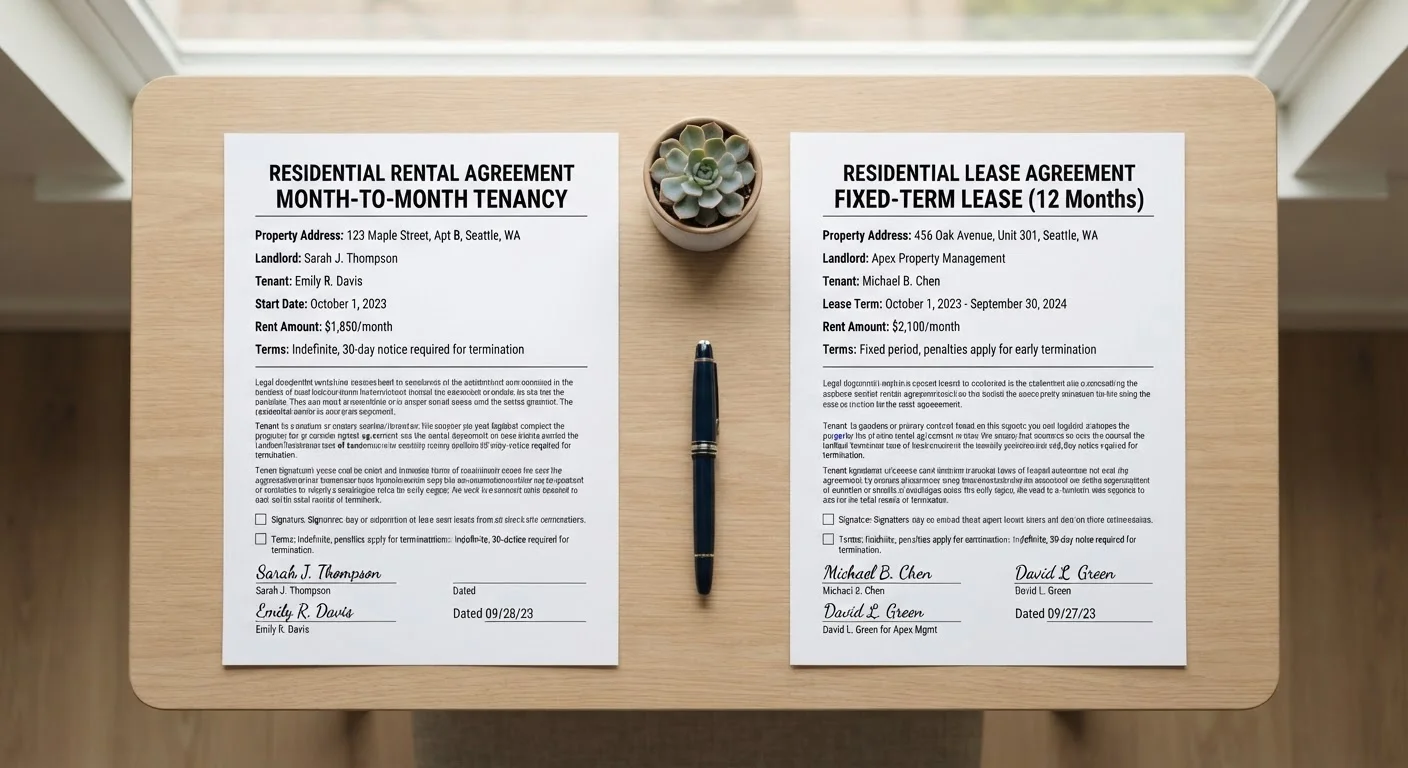
A month-to-month rental is a tenancy agreement that automatically renews each month unless either the landlord or tenant provides notice to end it. There is no predetermined end date. In most states, the required notice period is 30 days, though some jurisdictions require 60 days - particularly for longer-tenured renters. Because terms reset monthly, landlords can generally adjust rent or change conditions with proper notice.
A fixed-term lease - most commonly 12 months, though 6- and 24-month terms also exist - sets the tenancy conditions in writing for a defined period. During that term, neither party can unilaterally change the rent or vacate without legal consequence. At the end of the term, the lease typically converts to a month-to-month arrangement or is renewed with a new agreement. For a full breakdown of what lease clauses actually mean before you sign, see what's in a lease agreement.
| Criterion | Month-to-Month | Fixed-Term Lease |
|---|---|---|
| Lease duration | Ongoing, renews monthly | Set period (e.g. 12 months) |
| Typical rent cost | Higher - flexibility premium | Lower - market rate locked in |
| Rent increase exposure | Any renewal cycle with notice | Protected until lease end |
| Notice to vacate | 30-60 days (state dependent) | End of term (or cause required) |
| Early exit penalty | None - just give notice | Fees or rent liability may apply |
| Landlord termination risk | Higher - no-cause allowed in most states | Lower - cause typically required mid-term |
| Stability for long-term renters | Low | High |
Cost Differences Renters Often Overlook
Month-to-month rentals consistently command a premium. Landlords price flexibility into the rent - often charging 10% to 25% more per month than comparable fixed-term units, though this varies significantly by market. Over a full year, that premium can represent a meaningful sum.
Fixed-term leases, by contrast, protect renters from rent increases during the lease period. If market rents climb 8% mid-year, your landlord cannot pass that increase along until the lease expires. This predictability has real financial value, especially in competitive or rapidly appreciating rental markets.
10-25%
Typical month-to-month rent premium
Industry estimates suggest month-to-month tenants commonly pay a premium over fixed-term rates, though the gap varies by market and landlord.
30-60 days
Standard notice period to end tenancy
Most US states require 30 days' written notice for month-to-month terminations; some require 60 days for tenants who have lived there longer.
1-2 months
Typical early lease termination fee
Many fixed-term leases include an early termination clause requiring the tenant to pay one to two months' rent as a penalty for breaking the agreement.
There are also indirect costs to consider. Exiting a fixed-term lease before it ends can trigger early termination fees - often one to two months' rent - or leave you liable for rent until a replacement tenant is found. For guidance on navigating that scenario, see breaking a lease early. Month-to-month tenants avoid this risk but trade it for less housing certainty.
Tenant Protections and Legal Considerations
Both lease types are governed by state and local landlord-tenant law, but the protections differ in important ways. Fixed-term leases provide the strongest shield against displacement: a landlord generally cannot ask you to vacate mid-lease without cause (such as lease violation or non-payment). Month-to-month tenants in most states can be given a no-cause termination notice - they simply receive 30 or 60 days' notice and must leave.
Some cities with rent stabilization or just-cause eviction ordinances extend additional protections to month-to-month tenants, restricting no-cause terminations or limiting how often and by how much rent can increase. These local rules vary considerably - a tenant in San Francisco faces a very different legal landscape than one in a state with minimal landlord-tenant regulation. Always verify the specific rules in your jurisdiction before signing either type of agreement.
Local Law Can Change the Equation
Some cities and counties have enacted rent stabilization ordinances, just-cause eviction protections, or extended notice requirements that apply specifically to month-to-month tenants. These local rules can significantly strengthen tenant rights beyond what state law provides. Before signing any rental agreement, check with your city's housing authority or a local tenant rights organization to understand what additional protections may apply where you live.
Security deposit rules apply regardless of lease type. Landlords must follow state law on deposit amounts, return timelines, and what they can lawfully deduct. For more detail on that topic, see what landlords can and cannot keep from your deposit.
This article provides general information for educational purposes and does not constitute legal advice. Landlord-tenant law varies by state and locality. Consult a qualified attorney or tenant advocacy organization for guidance specific to your situation.
Choosing the Structure That Fits Your Situation
The right lease type depends on three core factors: how long you expect to stay, how much rent volatility you can absorb, and what happens if your plans change. Month-to-month arrangements suit renters in transition - those starting a new job, waiting on a home purchase, or exploring a city. If you're weighing whether renting long-term even makes sense, renting vs. buying is a decision worth thinking through carefully first.
Fixed-term leases reward renters who have stable plans and want to lock in favorable terms. If you find a unit you like at a fair price in a rising market, securing a 12-month lease insulates you from price increases and gives your budget a predictable foundation. For renters who anticipate the need to sublet - perhaps for a work assignment or extended travel - note that subletting rights and restrictions depend on the lease terms and local law. See subletting a rental for a balanced overview of that option.
Neither structure is universally superior. Your housing decision is one piece of a larger financial picture, and understanding the full rental landscape - from costs to rights to exit strategies - puts you in the strongest position to negotiate well and rent with confidence. For a comprehensive look at the entire renting experience, see the full picture of renting.