

| Correct inflation source | Driver's door jamb sticker or owner's manual - not the tire sidewall |
| Typical passenger car PSI range | 30-35 PSI (vehicle-specific; always verify) |
| PSI drop per 10°F temperature decrease | Approximately 1 PSI (National Highway Traffic Safety Administration (NHTSA)) |
| Legal minimum tread depth (U.S.) | 2/32 inch |
| Recommended replacement threshold (wet/winter driving) | 4/32 inch (NHTSA and major tire industry organizations) |
| Typical rotation interval | Every 5,000-7,500 miles (Varies by manufacturer; confirm in owner's manual) |
| Maximum recommended tire service life | 10 years from manufacture date (regardless of appearance) (Per many tire manufacturer guidelines) |
Tire Pressure: What the Numbers Mean
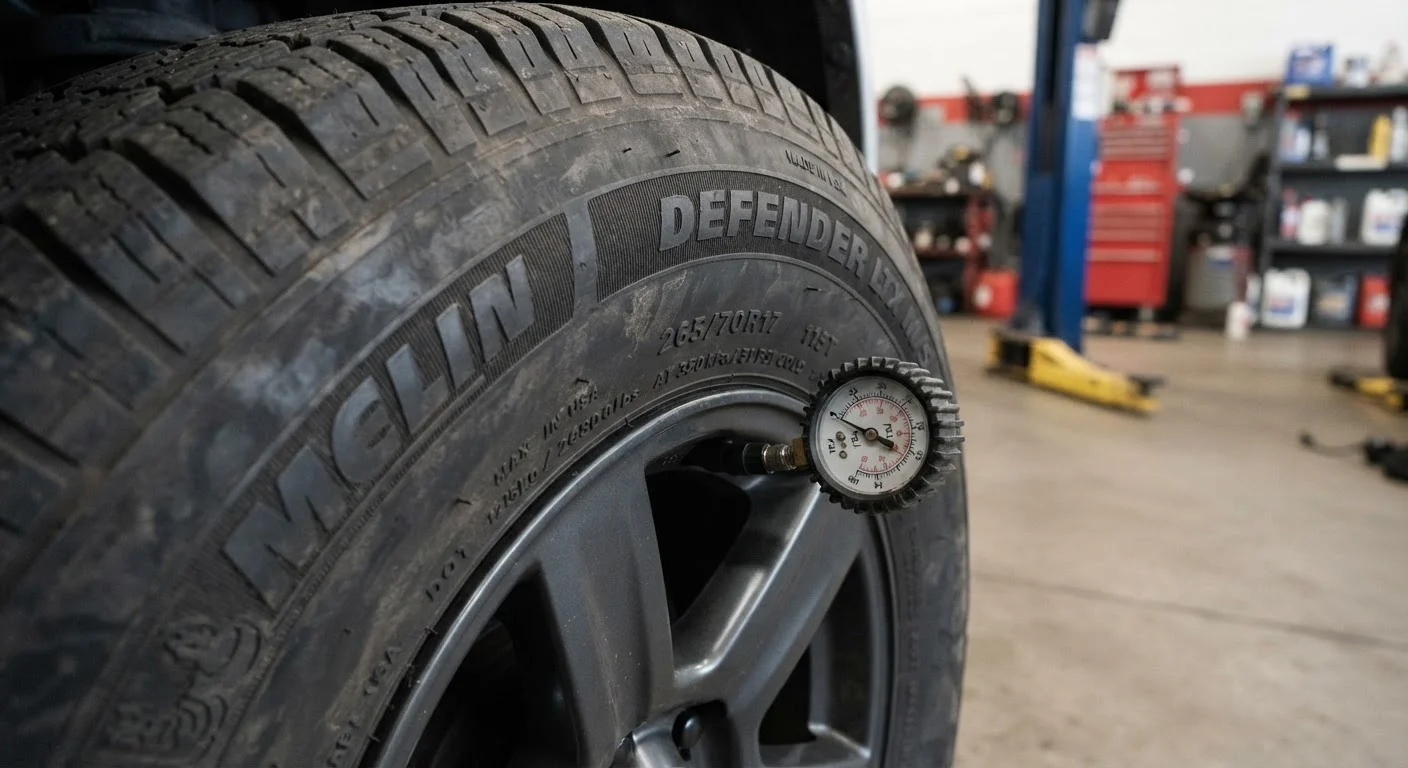
The correct inflation pressure for your tires is not the number molded into the tire sidewall. That figure is the tire's maximum rated pressure - not the target. The correct pressure for your vehicle is found on the driver's door jamb sticker or in your owner's manual. Your owner's manual is the authoritative source for vehicle-specific inflation specs that generic charts cannot match.
| Correct inflation source | Driver's door jamb sticker or owner's manual - not the tire sidewall |
| Typical passenger car PSI range | 30-35 PSI (vehicle-specific; always verify) |
| PSI drop per 10°F temperature decrease | Approximately 1 PSI (National Highway Traffic Safety Administration (NHTSA)) |
| Legal minimum tread depth (U.S.) | 2/32 inch |
| Recommended replacement threshold (wet/winter driving) | 4/32 inch (NHTSA and major tire industry organizations) |
| Typical rotation interval | Every 5,000-7,500 miles (Varies by manufacturer; confirm in owner's manual) |
| Maximum recommended tire service life | 10 years from manufacture date (regardless of appearance) (Per many tire manufacturer guidelines) |
Most passenger cars call for somewhere between 30 and 35 PSI, though trucks, SUVs, and performance vehicles vary. Always measure pressure when tires are cold - meaning the vehicle has been parked for at least three hours or driven fewer than one mile - because driving heats the air inside and temporarily raises the reading by 4-8 PSI.
Tire pressure drops roughly 1 PSI for every 10°F fall in ambient temperature, so a set of tires that reads correctly in October may be underinflated by late November. Check pressure at least once a month and before any long trip.
Tread Depth: Measuring Wear and Knowing When to Replace
Tread depth is measured in thirty-seconds of an inch (32nds). New passenger tires typically ship with 10/32" to 11/32" of tread. U.S. law requires replacement when tread reaches 2/32", but many safety organizations recommend considering replacement at 4/32" - especially if you drive in rain or snow - because stopping distances increase significantly as tread wears down.
PSI
Pounds per square inch - the unit used to measure tire inflation pressure in the United States. Your vehicle's recommended PSI is listed on the door jamb sticker, not on the tire itself.
Tread wear indicator (TWI)
Small rubber bars molded into tire tread grooves at the 2/32" depth mark. When the surrounding tread wears flush with these bars, the tire has reached the U.S. legal minimum and should be replaced.
Aspect ratio
The ratio of a tire's sidewall height to its section width, expressed as a percentage. A ratio of 65 means the sidewall height equals 65% of the tire's width.
Load index
A numerical code on the tire sidewall representing the maximum weight each tire can carry at its rated inflation pressure. Never replace tires with a lower load index than the vehicle manufacturer specifies.
Speed rating
A letter code indicating the maximum sustained speed a tire is designed to handle under its rated load. Replacing tires with a lower speed rating than specified can compromise vehicle safety.
DOT code
A Department of Transportation identification code molded into every tire sold in the U.S. The final four digits encode the week and year of manufacture, which is essential for determining a tire's age.
The Penny and Quarter Tests
Insert a penny into a tread groove with Lincoln's head pointing down. If you can see the top of his head, the tread is at or below 2/32" and the tire should be replaced immediately. Use a quarter the same way: if Washington's head is fully visible, tread is at or below 4/32" and replacement should be scheduled soon.
Wear Indicators
Tires have small rubber bars called tread wear indicators (TWIs) molded into the grooves at the 2/32" level. When the tread surface is flush with these bars, the tire has reached legal minimum depth. The triangle symbol (▲) on the sidewall points to where TWIs are located on that tire.
Uneven wear patterns - cupping, feathering, or center wear - usually signal an alignment, balance, or inflation problem. Address the root cause before installing new tires or the issue will repeat.
Rotation Intervals and Patterns
Rotating tires moves them between positions to equalize wear across all four. Front tires on front-wheel-drive vehicles carry the braking, steering, and primary drive load, so they wear faster than rears. Without rotation, you'd be replacing two tires while two others still have significant life remaining.
General interval: Most manufacturers recommend rotation every 5,000-7,500 miles, though some models specify different intervals. Check your owner's manual. A convenient habit is rotating tires at every other oil change if you change oil every 5,000 miles. For a broader view of how this fits into your overall upkeep schedule, see our guide on decoding your car's maintenance schedule.
Common Rotation Patterns
- Forward cross - Fronts move straight back; rears cross to opposite front positions. Standard for front-wheel-drive vehicles.
- Rearward cross - Rears move straight forward; fronts cross to opposite rear positions. Common on rear- and all-wheel-drive vehicles.
- X-pattern - All four tires cross to the opposite axle and opposite side simultaneously. Used on some front-wheel-drive vehicles to address aggressive wear.
- Side-to-side - Used only for directional tires that cannot be moved front-to-back without dismounting from the rim.
Directional tires (marked with an arrow on the sidewall indicating the required rolling direction) can only move front-to-back on the same side of the vehicle. Staggered fitments - where rear tires are wider than fronts - may not be rotatable at all without dismounting and remounting from the rim. Consult a tire professional if you're unsure.
Decoding Sidewall Markings
A tire sidewall carries a standardized code that tells you everything about its size and construction. Take the common example P215/65R17 98H:
- P - Passenger vehicle classification (LT = Light Truck)
- 215 - Section width in millimeters (the tire's widest point)
- 65 - Aspect ratio: sidewall height as a percentage of section width (65% of 215mm)
- R - Radial construction (the standard for virtually all modern passenger tires)
- 17 - Wheel diameter in inches
- 98 - Load index (the maximum weight each tire can safely support when properly inflated)
- H - Speed rating (H = rated to 130 mph; never install a tire with a lower speed rating than specified for your vehicle)
The DOT code, beginning with the letters "DOT," includes a four-digit week/year sequence at the end indicating when the tire was manufactured. A tire marked "2319," for instance, was made in the 23rd week of 2019. Age matters: rubber degrades even when a tire looks intact. Most manufacturers and safety bodies suggest having tires older than six years inspected regularly and replacing them by ten years regardless of appearance.
Keeping your tires properly maintained is part of the broader picture of vehicle safety. See our pre-trip safety walkthrough to build a quick routine that includes a tire check before every drive.