

| Typical school zone speed limit | 15-25 mph (Varies by state and local ordinance) |
| School bus stop-arm rule | All 50 states require stopping; divided-highway rules vary (National Conference of State Legislatures) |
| Unmarked crosswalks | Legally exist at all public road intersections (Uniform Vehicle Code (UVC)) |
| Pedestrian fatalities in U.S. | Approximately 7,500 per year (NHTSA, recent reporting years) |
| Turning vehicles vs. pedestrians | Turning drivers must yield even on a green light (Standard U.S. traffic law) |
School Zones: Speed Limits, Hours, and Common Misconceptions
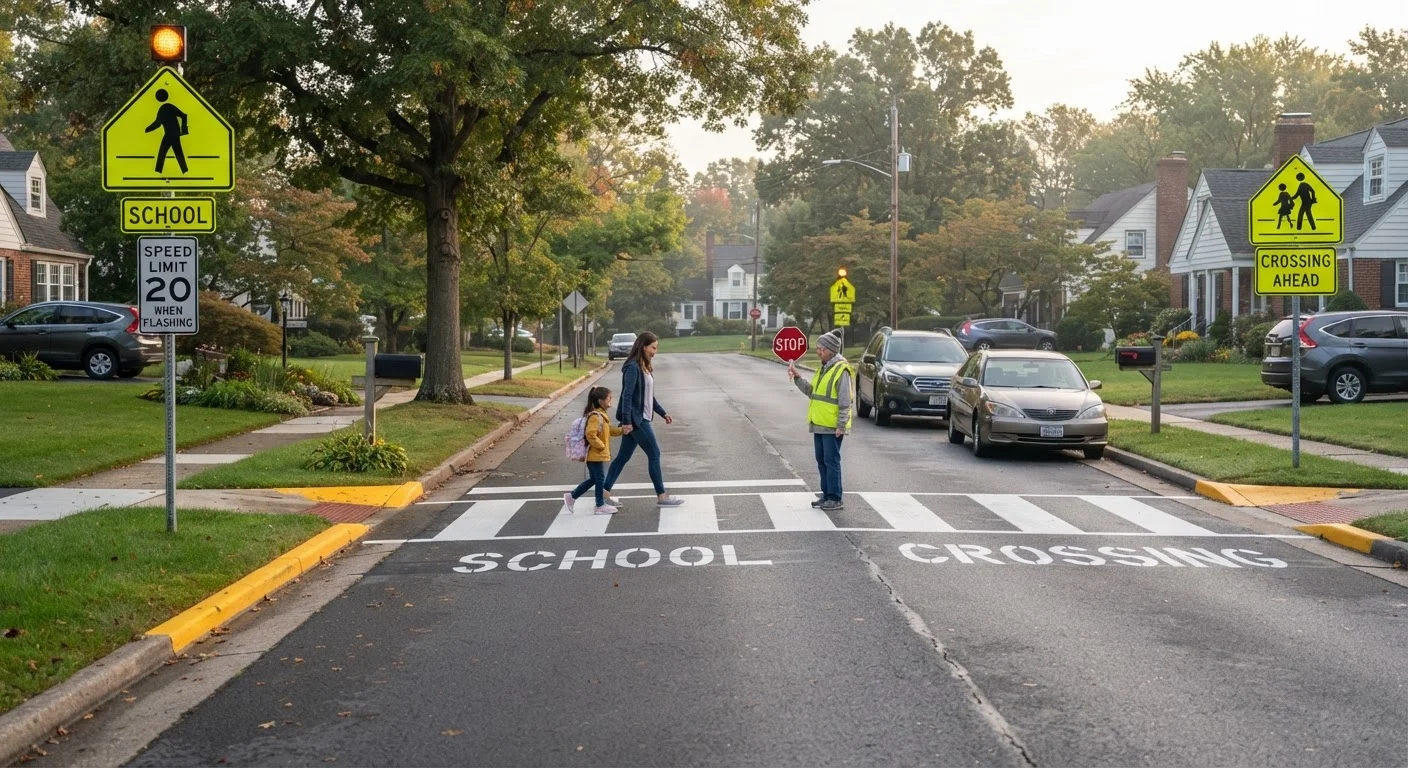
School zone speed limits in the United States typically range from 15 to 25 mph, depending on the state and local ordinance. These reduced limits are not suggestions - violations carry fines that are frequently doubled or tripled compared to standard speeding penalties, and some states add points to a driver's license.
A common misconception is that school zone rules only apply when children are visibly present. Most states specify that reduced speed limits are enforceable during posted hours or when warning lights are flashing - regardless of whether you can see a child nearby. When lights are not flashing and no hours are posted, standard speed limits apply, but drivers should still exercise heightened caution.
Stopping for a school bus with red lights flashing and a stop arm extended is required in all 50 states. On undivided roads, traffic in both directions must stop. On divided highways with a physical median, oncoming traffic may be exempt - but drivers should confirm their specific state's rule, as laws vary.
| Typical school zone speed limit | 15-25 mph (Varies by state and local ordinance) |
| School bus stop-arm rule | All 50 states require stopping; divided-highway rules vary (National Conference of State Legislatures) |
| Unmarked crosswalks | Legally exist at all public road intersections (Uniform Vehicle Code (UVC)) |
| Pedestrian fatalities in U.S. | Approximately 7,500 per year (NHTSA, recent reporting years) |
| Turning vehicles vs. pedestrians | Turning drivers must yield even on a green light (Standard U.S. traffic law) |
Crosswalk Rules: Marked, Unmarked, and Mid-Block
Many drivers don't realize that crosswalks exist whether or not paint is on the pavement. Under the UVC - the model traffic law that most state statutes follow - an unmarked crosswalk exists at every intersection where two public roads meet, formed by the extension of the sidewalk lines. Drivers are legally required to yield to pedestrians in both marked and unmarked crosswalks.
Mid-block crosswalks are marked crossings located between intersections. These are often controlled by a pedestrian-activated signal or flashing beacon. Drivers must yield to any pedestrian who has stepped off the curb and is within the crosswalk or adjacent lane. Simply waiting behind a stopped vehicle is not sufficient - if the vehicle ahead is stopped for a pedestrian, you may not pass it.
The "stop for pedestrians" rule does not mean a pedestrian can step into the street at any moment and demand traffic stop. Pedestrians also carry legal obligations: they must use crosswalks where available and obey applicable signals. However, the burden of preventing a collision rests primarily with the driver. For a broader look at how yielding rules interact, see our guide to merging and right-of-way concepts.
Marked crosswalk
A designated pedestrian crossing indicated by painted lines, signs, or pavement markings on the road surface. Drivers are legally required to yield to pedestrians within these areas.
Unmarked crosswalk
A legally recognized pedestrian crossing at an intersection that has no painted markings but is implied by the extension of sidewalk lines. Most state laws treat these the same as marked crosswalks.
School zone
A designated area near a school where reduced speed limits apply during specified hours or when warning lights are active, enforced to protect students traveling to and from school.
Right-of-way
The legal right to proceed first in a given traffic situation. Right-of-way is not absolute - drivers must still exercise care even when they have it, and it shifts based on signals, location, and conditions.
Stop arm
The retractable red-and-white arm extended from a school bus when it stops to load or unload students. When the stop arm is extended and red lights are flashing, most state laws require nearby traffic to stop.
Pedestrian Right-of-Way: What Drivers Are Actually Required to Do
Right-of-way is not a permanent privilege - it shifts based on location, signals, and conditions. At a signalized intersection, pedestrians with a walk signal have the right-of-way over turning vehicles. A driver making a left or right turn on green must yield to any pedestrian legally crossing in the crosswalk, even when the driver has a green light.
At unsignalized intersections and marked crosswalks, drivers in most states must stop and remain stopped until a pedestrian has completely crossed the lane the driver intends to use. Some states extend this to require yielding until the pedestrian has crossed the entire roadway. Always check your state's specific statute.
Visibility limitations don't excuse a driver from yielding responsibility. If a pedestrian is obscured by a parked vehicle or column, slowing to a speed that allows you to stop in time is required. This is a cornerstone of defensive driving practice - anticipating hazards before they become emergencies.
For a complete foundation in traffic safety rules, including pedestrian protections in the context of broader driver education, refer to the complete driver's education overview.
This article provides general educational information about U.S. traffic laws and is not legal advice. Traffic laws vary by state and locality. Consult your state's official driver's manual or a qualified legal professional for guidance specific to your situation.