

Key Takeaways
Drowsy Driving Impairment
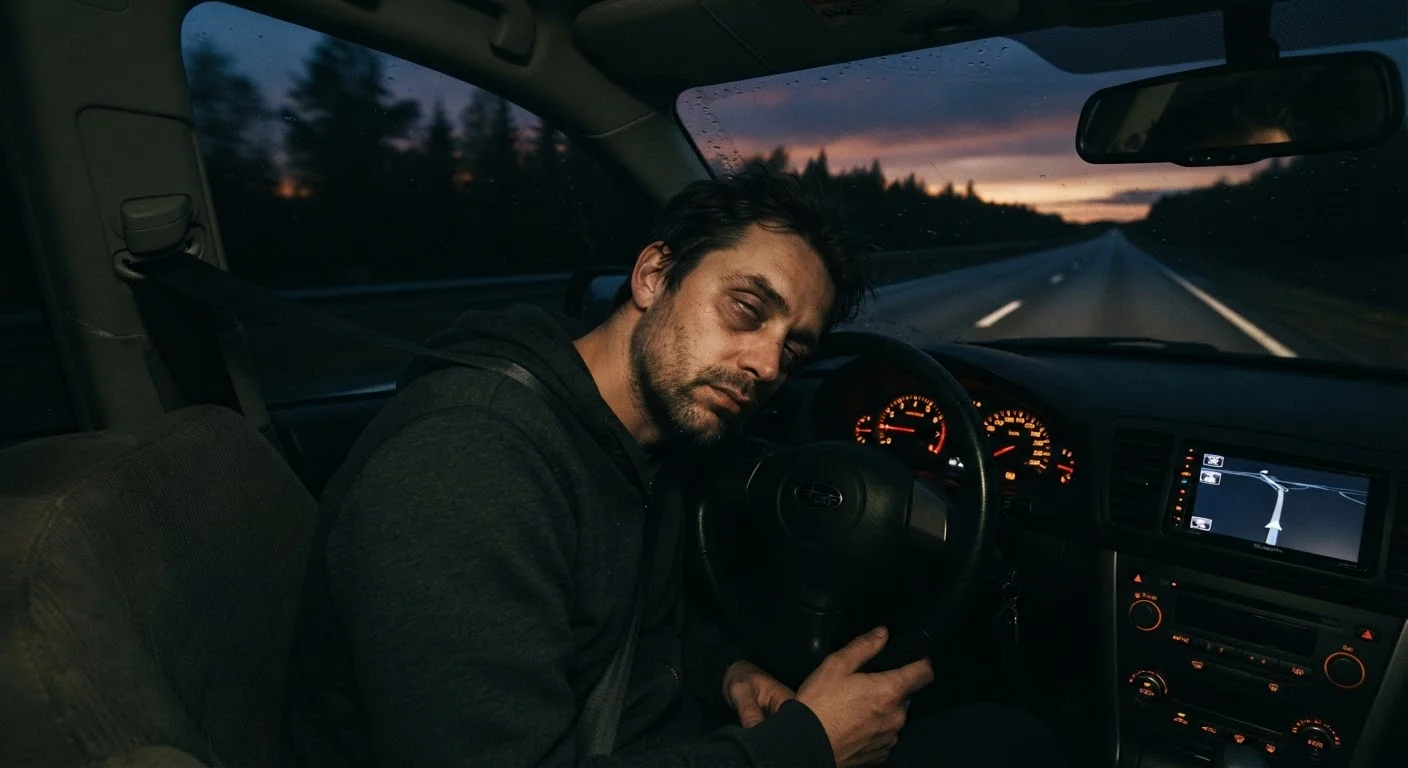
Drowsy driving refers to operating a vehicle while fatigued enough to impair cognitive function, alertness, and motor response. Even moderate sleep deprivation slows how quickly a driver can perceive a hazard and respond to it. These impairments closely parallel the effects of alcohol intoxication on driving performance.
Research has shown that being awake for 18 consecutive hours produces impairments comparable to a blood alcohol concentration (BAC) of approximately 0.05%, and 24 hours of wakefulness approaches the equivalent of a 0.10% BAC - above the legal limit in all U.S. states.
Why Fatigue Hits Reaction Time So Hard
Reaction time is made up of two distinct stages: perception time (how long it takes your brain to recognize a hazard) and movement time (how long it takes your body to respond). Fatigue degrades both. A rested driver typically reacts to a hazard in roughly 1.5 seconds under normal conditions. Sleep deprivation can stretch that response to 2.5 seconds or more - a difference that translates to additional car lengths of travel before the brake pedal moves.
The underlying mechanism is neurological. Sleep-deprived brains show reduced activity in the prefrontal cortex, the region responsible for attention, decision-making, and hazard anticipation. Fatigued drivers don't just respond more slowly - they are less likely to detect a hazard in the first place. This combination creates a compounded risk that goes well beyond simple slowness.
~100,000
Police-reported drowsy driving crashes annually (U.S.)
According to NHTSA estimates, drowsy driving crashes result in approximately 100,000 police-reported incidents each year in the United States.
0.10% BAC
Equivalent impairment after 24 hours awake
Research cited by the AAA Foundation for Traffic Safety suggests that 24 hours of wakefulness produces impairment levels comparable to a blood alcohol concentration of approximately 0.10%.
3x
Crash risk increase with less than 6 hours of sleep
AAA Foundation research found that drivers who slept six to seven hours were roughly twice as likely to crash as those who slept eight or more hours, with risk tripling for those sleeping under six hours.
Understanding these mechanics helps explain why drowsy driving is addressed in defensive driving frameworks as a primary risk factor rather than a minor inconvenience.
The Microsleep Threat: Crashes You Don't See Coming
Microsleep refers to involuntary episodes of sleep lasting between one and ten seconds. They occur without warning and, critically, without the driver's awareness during the episode. At 65 mph, one second of microsleep means a vehicle travels roughly 95 feet with no driver input. A five-second episode - still brief enough to miss entirely - covers nearly the length of a football field.
These episodes increase sharply after 17 to 19 hours of wakefulness, during circadian low points, and on long, monotonous road stretches like highways. Fatigue also compounds the risks already present in reduced-visibility conditions - a relationship explored in detail in night driving safety guidance.
The Caffeine Nap: A Practical Short-Term Strategy
If you must resume driving after feeling fatigued, consider drinking a cup of coffee immediately before taking a 20-minute nap at a rest stop. Caffeine takes approximately 20-30 minutes to reach peak effect, meaning you may wake with a modest alertness boost. This is not a substitute for adequate sleep, but research suggests it can improve short-term performance compared to either strategy alone.
There is no reliable physical sensation that announces an incoming microsleep episode. By the time a driver jerks awake, the lapse has already occurred. This is why self-assessment of alertness is notoriously unreliable when you are significantly fatigued.
What Actually Helps - and What Doesn't
Several common strategies are believed to counteract drowsiness behind the wheel, but the evidence for most of them is limited:
- Opening windows or turning up music: These provide modest, brief stimulation. Research does not support them as meaningful safety interventions for significantly fatigued drivers.
- Caffeine: A cup of coffee can temporarily reduce reaction time delays for a short window, particularly for mild fatigue. It takes about 20-30 minutes to take effect and does not reverse the cognitive impairment that accumulates with prolonged wakefulness.
- Pulling over and sleeping: The only genuinely effective immediate countermeasure. A 20-minute nap at a rest stop, ideally combined with caffeine beforehand so the caffeine takes effect as you wake, is supported by research as a practical short-term strategy for resuming driving more safely.
Planning ahead remains the most effective approach. Drivers making long trips - particularly those vulnerable to circadian disruption from travel across time zones - may find it useful to review how sleep timing affects alertness; the article on jet lag and circadian disruption covers these mechanisms in more depth.
This article is for general educational purposes only. Always use your own judgment and consult relevant safety authorities regarding driving decisions. If you feel unsafe to drive, pull over in a safe location.