

Key Takeaways
Our Verdict
Zero-based budgeting rewards detail-oriented planners who want precise control. The 50/30/20 rule suits those seeking a simple, low-maintenance framework. Envelope budgeting works best for people who overspend in specific categories and need firm, tangible limits. All three methods share one prerequisite: knowing where your money goes - and each provides a different tool to get there.
| Best for | Recommended |
|---|---|
| Those who want granular control over every dollar | Zero-Based Budgeting |
| Those who prefer a simple, flexible framework with minimal tracking | 50/30/20 Rule |
| Those who struggle with overspending in specific categories | Envelope Budgeting |
| Freelancers and gig workers with variable income | Zero-Based Budgeting |
Why Your Budgeting Method Matters
A budget is only as effective as the system behind it. Many people start with good intentions but abandon their budget within weeks - not because they lack discipline, but because the method they chose doesn't fit their lifestyle. Before comparing frameworks, it helps to understand what makes any budget work: clarity about income, honesty about spending, and a structure simple enough to sustain. If you're brand new to budgeting, the step-by-step beginner's guide walks you through the foundational steps before choosing a method.
The three frameworks covered here - zero-based, 50/30/20, and envelope budgeting - each take a distinct approach to the same problem: telling your money where to go. Understanding what each demands, and who it tends to suit, is the first step toward picking the right fit.
Zero-Based Budgeting: A Dollar for Every Purpose
Zero-based budgeting (ZBB) operates on a simple principle: income minus expenses equals zero. That doesn't mean spending everything you earn - it means every dollar is deliberately assigned, whether to rent, groceries, debt repayment, or savings. Nothing sits in a vague "leftover" pile.
Each month begins fresh. You list all expected income, then allocate amounts to every spending category until the balance reaches zero. If income fluctuates, as it does for freelancers and gig workers, the budget must be rebuilt monthly - which is also its strength: it forces an honest look at each month's actual reality. For more on adapting this approach to irregular income, see the guide to budgeting on an irregular income.
Demands: Regular tracking, category discipline, and willingness to plan before the month begins.
Best for: Detail-oriented people, those paying down debt aggressively, and anyone whose spending varies significantly month to month.
| Zero-Based | 50/30/20 Rule | Envelope Budgeting | |
|---|---|---|---|
| Time commitment | High - monthly rebuild required | Low - three categories only | Medium - category setup upfront |
| Tracking detail | Every dollar assigned | Broad category monitoring | Per-envelope limits tracked |
| Flexibility | Fully customizable monthly | Fixed percentage splits | Rigid per-category limits |
| Best income type | Variable or irregular income | Stable, predictable income | Any income type |
| Learning curve | Steep initially | Very gentle | Moderate |
| Debt payoff focus | Strong - assign to debt directly | Included in 20% bucket | Possible with dedicated envelope |
| Tools needed | Spreadsheet or app | Basic income awareness | Cash, envelopes, or app |
The 50/30/20 Rule: Simplicity by Design
Popularized by Senator Elizabeth Warren and her daughter Amelia Warren Tyagi in their book All Your Worth, the 50/30/20 rule divides after-tax income into three broad buckets: 50% for needs (housing, utilities, groceries, minimum debt payments), 30% for wants (dining, entertainment, subscriptions), and 20% for savings and debt payoff above minimums.
Its power is its low friction. There are no line-item categories to obsess over - just three numbers to monitor. That simplicity makes it approachable for budget beginners or those who find granular tracking exhausting. The tradeoff is precision: if your needs routinely consume 60% of income, the rule bends rather than guides, and the framework can mask problem areas within each broad category.
Demands: Knowing your after-tax income and a rough sense of which spending falls into needs versus wants.
Best for: Stable-income earners who want guardrails without micromanagement, and those building a first-time budgeting habit.
Start With One Month of Real Spending Data
Before committing to any budgeting framework, track your actual spending for 30 days without changing your behavior. This baseline reveals your real spending patterns - not idealized ones - and makes it far easier to choose a method that matches your life rather than one you'll abandon. Many free apps can automate this tracking step with minimal setup.
Envelope Budgeting: Hard Limits, Tangible Accountability
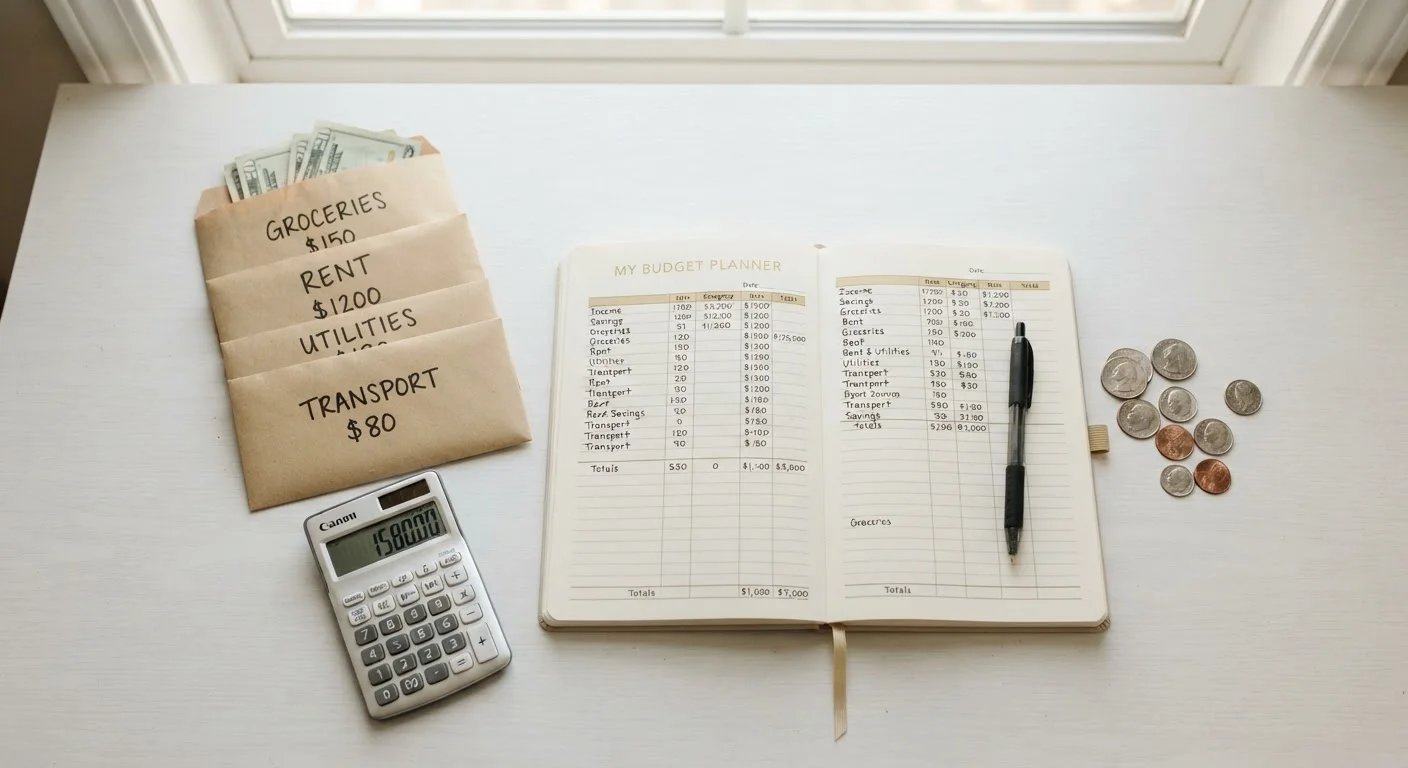
Envelope budgeting predates digital finance by decades. Traditionally, you withdraw cash at the start of the month and divide it into labeled envelopes - one for groceries, one for gas, one for dining out, and so on. When an envelope is empty, spending in that category stops for the month.
The physical act of handling cash creates psychological friction that card spending rarely does. Research in behavioral economics consistently finds that people spend less when using cash versus credit, because the loss feels more immediate. Digital versions of this method - using budgeting apps that assign virtual "envelopes" or spending limits by category - preserve much of this discipline without requiring cash withdrawals.
For those interested in the broader case for tangible, analog budgeting tools, the case for a paper budget explores how pen-and-paper methods compare to digital alternatives.
Demands: Upfront category planning and the willingness to stop spending when a limit is reached - no exceptions.
Best for: Overspenders in specific categories, visual learners, and those who benefit from concrete, immediate feedback on spending.
Comparing the Three Methods Side by Side
Each framework carries trade-offs in effort, flexibility, and effectiveness depending on your situation. The table above summarizes the key differences. For a plain-language reference on the spending categories that appear across all three methods, see the spending categories glossary.
Once you've chosen a method, a consistent monthly review process is what keeps it functional over time. The monthly budget reset routine provides a structured approach for catching overspending early and adjusting before small gaps become larger problems.
Whichever method you select, pairing it with a savings habit amplifies the results. The Saving & Investing hub provides foundational guidance on growing what your budget sets aside.
This article is for informational and educational purposes only and does not constitute personalized financial advice. Consider consulting a licensed financial professional for guidance tailored to your individual circumstances.