

Key Takeaways
Handwriting deepens engagement with your finances
Writing figures by hand activates stronger memory encoding than typing, meaning you are more likely to retain and act on what you record.
Intentional friction discourages mindless spending
The effort of manual entry creates a natural pause for reflection, making each purchase feel more deliberate before and after it happens.
No cost, no apps, no subscriptions required
A notebook and pen are the only tools needed, making paper budgeting the most accessible method regardless of income or tech comfort level.
Complete privacy - no linked bank accounts
Your financial data stays entirely offline and is never shared with third-party platforms, eliminating data-breach risk associated with account aggregation apps.
Fully customisable to any budgeting framework
Paper imposes no structural constraints, so you can design categories, layouts, and review rhythms that match your exact income and spending patterns.
Time-consuming to maintain accurately
Every transaction must be recorded and totals recalculated by hand, which can take significant time each week - time that digital tools largely eliminate through automation.
No real-time alerts or automatic updates
Without proactive check-ins, overspending in a category can go unnoticed for days, allowing small shortfalls to compound before they are caught.
Vulnerable to loss, damage, or disorganisation
A misplaced or damaged notebook means lost budget records with no recovery option, unlike cloud-synced digital tools that back up data automatically.
Difficult to scale for complex financial situations
Households managing multiple income sources, investment accounts, or shared finances may find manual tracking quickly becomes unwieldy and error-prone.
Our Verdict
A paper budget is not an outdated relic - it is a deliberate, low-tech tool with real cognitive and practical advantages. That said, it demands more time and discipline than most digital alternatives, and it cannot automate transaction tracking. Neither approach is universally superior; effectiveness depends entirely on the individual's habits, lifestyle, and commitment.
Paper budgeting is best suited to people who find digital notifications distracting, prefer tactile learning, want complete privacy from third-party apps, or are just starting out and need a simple, zero-cost way to build the budgeting habit.
What a Paper Budget Actually Looks Like
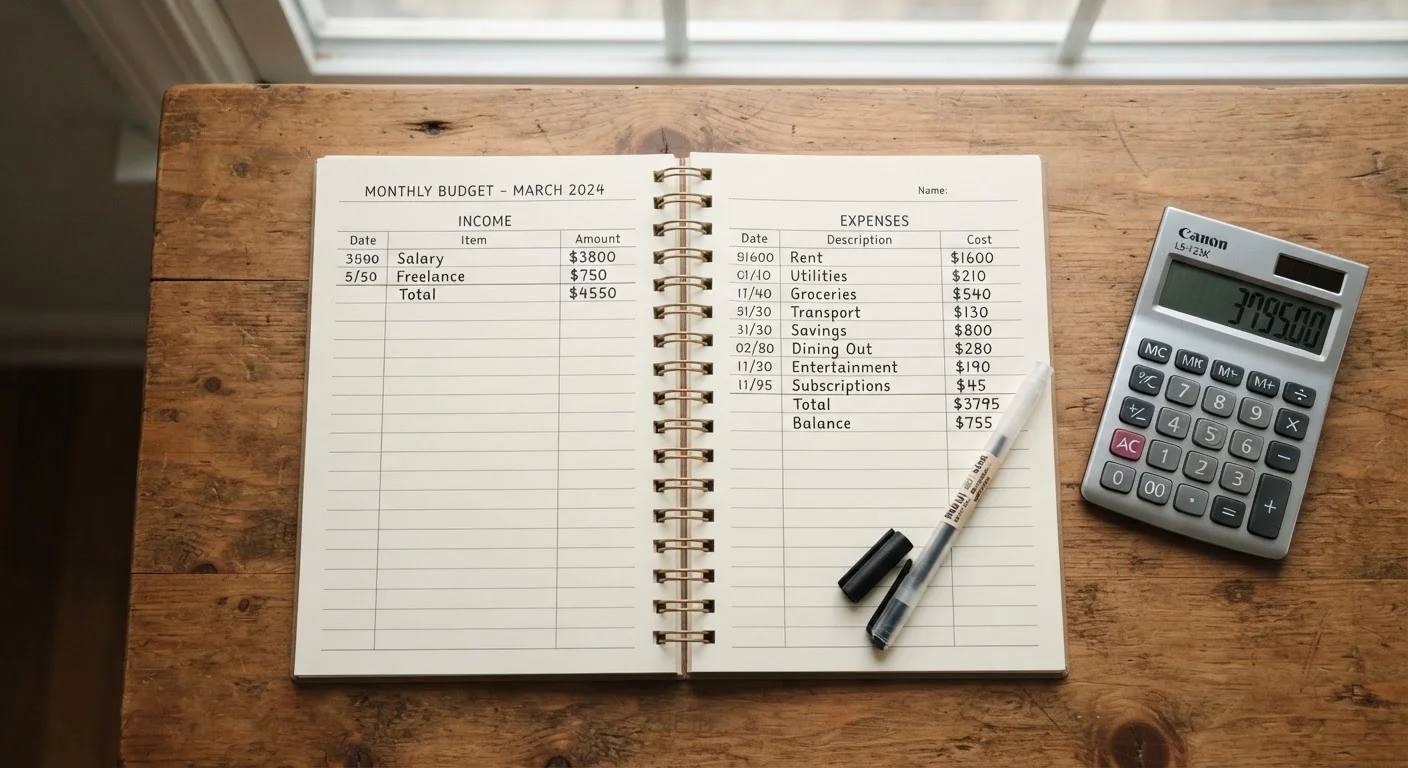
A paper budget is exactly what it sounds like: income, expenses, and spending categories written out by hand in a notebook, planner, or on a simple sheet of paper. It can follow any framework you prefer - a zero-based structure where every dollar is assigned a job, a 50/30/20 split, or a custom category system. The format is entirely up to you.
Some people use ruled notebooks; others prefer printable budget templates or dedicated budget planners sold at office supply stores. The envelope method - where cash is physically divided into labeled envelopes for each spending category - is a close cousin that adds a tangible, real-world constraint to the process. If you're exploring different frameworks, this breakdown of popular budgeting methods can help you match an approach to your situation.
Whatever the format, the core activity is the same: you sit down regularly, record what you earn, plan what you'll spend, and track what you actually spend - all by hand.
The Real Advantages of Going Analog
Handwriting deepens engagement with your finances
Writing figures by hand activates stronger memory encoding than typing, meaning you are more likely to retain and act on what you record.
Intentional friction discourages mindless spending
The effort of manual entry creates a natural pause for reflection, making each purchase feel more deliberate before and after it happens.
No cost, no apps, no subscriptions required
A notebook and pen are the only tools needed, making paper budgeting the most accessible method regardless of income or tech comfort level.
Complete privacy - no linked bank accounts
Your financial data stays entirely offline and is never shared with third-party platforms, eliminating data-breach risk associated with account aggregation apps.
Fully customisable to any budgeting framework
Paper imposes no structural constraints, so you can design categories, layouts, and review rhythms that match your exact income and spending patterns.
The case for paper budgeting goes beyond nostalgia. Research in cognitive science consistently suggests that handwriting activates different neural pathways than typing, promoting deeper processing and better retention of information. When you physically write "$340 - groceries," you are more likely to remember that figure and feel its weight than if a number auto-populates in a spreadsheet cell.
There is also the matter of friction - and here, friction is a feature, not a bug. Because entering data manually takes effort, many paper budgeters report becoming more intentional about each purchase before it is made. The act of writing it down later becomes a small moment of accountability.
Privacy is another underappreciated advantage. Most budgeting apps request access to your bank and credit card accounts. A paper budget shares your financial data with no one. For readers who are uncomfortable linking accounts to third-party platforms - a reasonable concern - paper removes that risk entirely.
Where Paper Budgets Fall Short
Time-consuming to maintain accurately
Every transaction must be recorded and totals recalculated by hand, which can take significant time each week - time that digital tools largely eliminate through automation.
No real-time alerts or automatic updates
Without proactive check-ins, overspending in a category can go unnoticed for days, allowing small shortfalls to compound before they are caught.
Vulnerable to loss, damage, or disorganisation
A misplaced or damaged notebook means lost budget records with no recovery option, unlike cloud-synced digital tools that back up data automatically.
Difficult to scale for complex financial situations
Households managing multiple income sources, investment accounts, or shared finances may find manual tracking quickly becomes unwieldy and error-prone.
Honesty requires acknowledging the genuine limitations. The most significant is the time cost. Manually recording every transaction, reconciling totals, and recalculating category balances can be tedious, especially for households with complex finances or variable incomes. Digital tools automate much of this, freeing mental energy for actual financial decisions rather than arithmetic.
Paper budgets also lack real-time feedback. If you overspend on dining out mid-month, your notebook will not alert you - you have to check it proactively. For people who struggle with consistent check-ins, this lag can allow small overages to become significant problems. Understanding why budgets collapse is often more about system design than willpower, and a paper system requires a particularly reliable personal routine to succeed.
Finally, there is no backup. A lost or damaged notebook means lost records. Digital tools, by contrast, sync automatically and store data securely across devices.
Digital Budgeting: The Trade-offs Worth Knowing
~1 in 3
Americans report not following a budget
Survey data from the National Foundation for Credit Counseling has consistently found that a significant share of U.S. adults lack a structured spending plan of any kind.
74%
Of budgeters say the method matters less than consistency
Consumer financial literacy research broadly supports the view that sustained habit - not tool sophistication - is the primary driver of budgeting success.
Spreadsheets and budgeting apps have genuine strengths that paper cannot match. Automated transaction imports, real-time balance tracking, and visual spending reports reduce the effort required to stay informed. For people managing multiple accounts, irregular income streams, or shared household finances, these features are not just convenient - they are practically necessary.
The downside is that automation can breed passivity. When a tool does the recording for you, it is easy to review numbers without truly engaging with them. Some users also report "app fatigue" - cycling through multiple budgeting tools without sticking to any. Practical methods for tracking every dollar, whether digital or otherwise, work only if they fit naturally into your daily life.
There is also the question of cost. Several capable budgeting apps carry monthly subscription fees, which can feel ironic when the goal is spending less money.
How to Decide What Works for You
The most effective budget is not the most sophisticated one - it is the one you will actually maintain. If you have never budgeted before, starting with paper has a practical appeal: zero cost, zero setup, and a simple feedback loop. A ground-up guide to building your first budget can walk you through the foundational steps regardless of which medium you choose.
Many financially organised people use a hybrid model: they plan and reflect on paper - writing monthly goals and reviewing spending patterns by hand - while using a bank's built-in transaction history or a simple spreadsheet for real-time tracking. This preserves the cognitive benefits of writing while reducing the manual data-entry burden.
Consistency Beats Complexity Every Time
The most common reason budgets fail is not the wrong tool - it is an unsustainable routine. Whether you use paper, a spreadsheet, or an app, build in a fixed weekly check-in of 10-15 minutes rather than relying on memory or motivation. Small, regular reviews are more effective than detailed monthly audits you never quite get around to completing.
Whatever method you choose, consistency matters far more than perfection. A budget reviewed weekly, even imperfectly, will serve you better than an abandoned app or a notebook filled only for January. The goal is a long-term habit, not a flawless system. For a comprehensive look at sustaining that habit over time, see the complete guide to building and sustaining a personal budget.
This article is for general informational and educational purposes only and does not constitute personalised financial advice. Consult a qualified financial professional for guidance specific to your circumstances.