

Key Takeaways
Credit Score
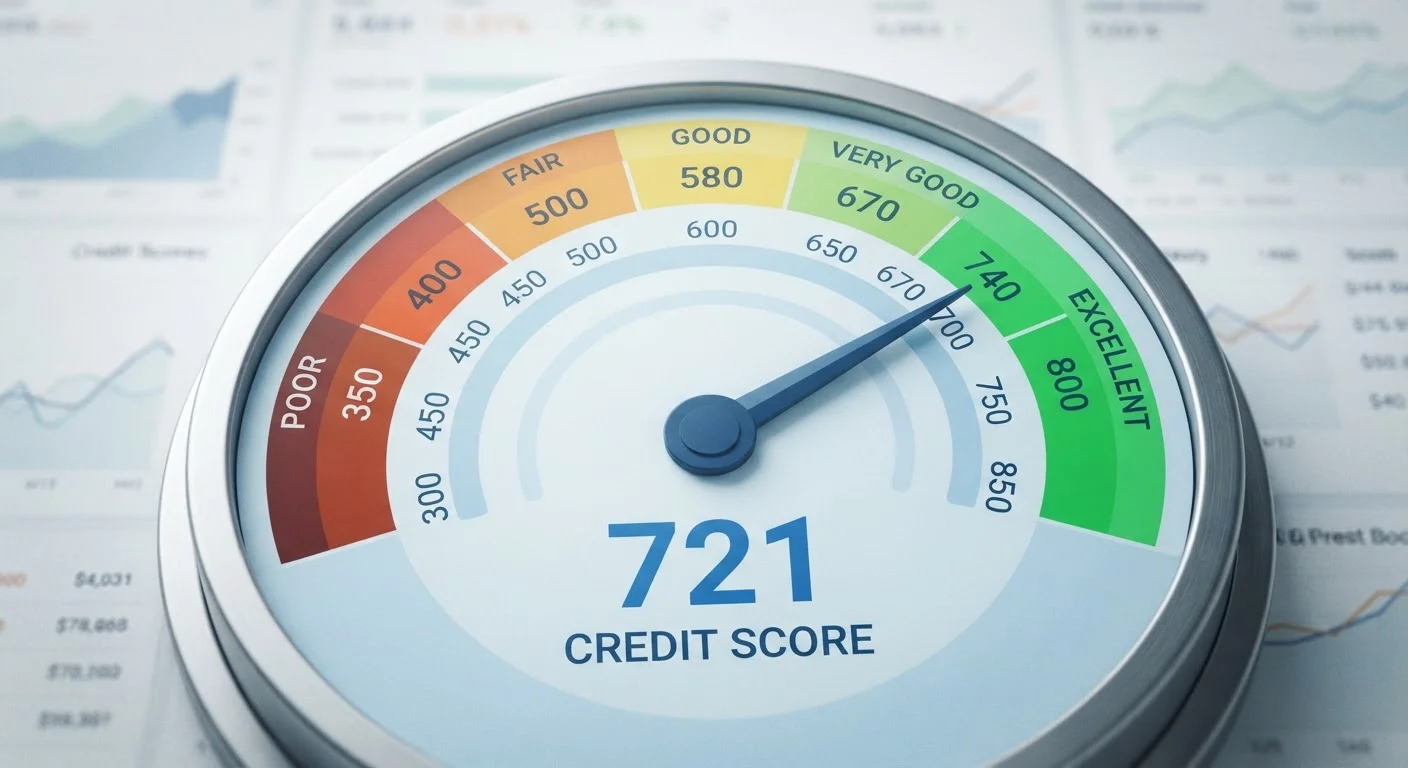
A credit score is a three-digit number, typically ranging from 300 to 850, that summarizes how reliably a person has managed borrowed money over time. Lenders use it to quickly assess how likely you are to repay a new loan or credit obligation. Higher scores indicate lower perceived risk, which generally translates to better borrowing terms.
The most widely used scoring models are FICO® Scores and VantageScores, both of which draw from data in your credit reports maintained by the three major bureaus - Equifax, Experian, and TransUnion. Scores can vary slightly across bureaus depending on which data each holds.
Where the Number Comes From
Your credit score is not a judgment of your worth as a person - it is a statistical prediction of future repayment behavior, calculated from the data in your credit file. Every time you open an account, make (or miss) a payment, or apply for new credit, that activity gets recorded by your creditors and passed to one or more of the three major credit bureaus: Equifax, Experian, and TransUnion.
Scoring models like FICO® and VantageScore then apply a formula to that raw data and produce a number. Because the bureaus can hold slightly different information, your score may vary depending on which bureau a lender pulls. Understanding what feeds the formula is the clearest path to understanding what the number really represents.
For a line-by-line look at the underlying data, reading your credit report is a logical next step.
The Five Factors That Shape Your Score
FICO® - the model most lenders rely on - weighs five distinct categories of credit behavior. Each carries a different share of your total score:
35%
Weight of payment history in FICO® Score
According to FICO®'s published scoring factor breakdown, on-time payment history is the single largest component of a standard FICO® Score.
300-850
Full range of standard credit scores
Both FICO® and VantageScore 3.0/4.0 use a 300-850 scale, making scores comparable across the two most common models used by U.S. lenders.
~200M
Americans with scoreable credit files
The Consumer Financial Protection Bureau (CFPB) has reported that the vast majority of U.S. adults have enough credit file data to generate a score.
- Payment history (≈35%): Whether you pay on time is the single largest input. Even one missed payment can meaningfully reduce a high score. Consistently on-time payments build the foundation of a strong profile.
- Amounts owed / credit utilization (≈30%): This measures how much of your available revolving credit you are using. Carrying high balances relative to your limits signals potential financial strain. Credit utilization deserves its own close look - it is one of the most actionable factors you can influence.
- Length of credit history (≈15%): Longer histories give scoring models more data to work with. The age of your oldest account, newest account, and the average across all accounts all factor in.
- Credit mix (≈10%): A blend of account types - installment loans like auto or student loans alongside revolving credit like credit cards - can be a mild positive signal, though it is far less important than payment history.
- New credit / recent inquiries (≈10%): Applying for several new accounts in a short window can suggest financial stress. Each hard inquiry creates a small, temporary dip that typically fades within a year.
Focus on the Highest-Weight Factors First
Payment history and credit utilization together account for roughly 65% of a standard FICO® Score. If you are working to improve your score, consistent on-time payments and reducing revolving balances will generally produce the most meaningful results. The remaining factors - history length, mix, and inquiries - matter, but they are harder to change quickly and carry less weight.
What a Credit Score Does Not Measure
A credit score is narrowly focused on credit behavior - it does not capture income, savings, net worth, employment status, or your ability to afford a specific payment. This is why lenders typically review a second key metric alongside your score.
Your debt-to-income ratio (DTI) - the percentage of your gross monthly income that goes toward debt payments - fills that gap. Understanding your debt-to-income ratio explains why a strong credit score alone does not guarantee loan approval.
It is also worth noting that a credit score reflects reported behavior, not effort or intent. Honest mistakes on a credit report - a misreported late payment, an account that isn't yours - can quietly pull down a score. That makes periodic report review genuinely important, not just a formality.
This article is for general informational and educational purposes only and does not constitute personalized financial or credit advice. Consult a qualified financial professional for guidance specific to your situation.
Putting the Number in Perspective
Knowing your score is a starting point, not a finish line. The real value is understanding which of the five factors represents your biggest opportunity - and avoiding the habits that quietly erode progress over time. Some damaging credit habits are less obvious than others, and recognizing them early matters.
It is also worth questioning conventional wisdom. Several widely circulated beliefs about how scores work - about closing accounts, carrying balances, or avoiding credit entirely - are simply inaccurate. Credit score myths can hold people back just as much as actual credit mistakes.
A credit score is ultimately a tool - one that reflects your financial history and influences your options. Treating it as informative rather than intimidating is the most productive frame.