

Key Takeaways
Our Verdict
No single cardio format is universally superior. Walking, running, cycling, swimming, and rowing each offer meaningful cardiovascular benefits while differing significantly in impact level, equipment needs, and muscle engagement. Matching the format to your physical condition and lifestyle is far more important than choosing the 'hardest' option.
| Best for | Recommended |
|---|---|
| Those with joint pain or mobility limitations | Swimming or Cycling |
| Beginners seeking low-barrier entry to cardio | Walking |
| Those wanting time-efficient, high-calorie-burn sessions | Running |
| Those seeking full-body cardiovascular conditioning | Rowing |
Why the Format You Choose Matters
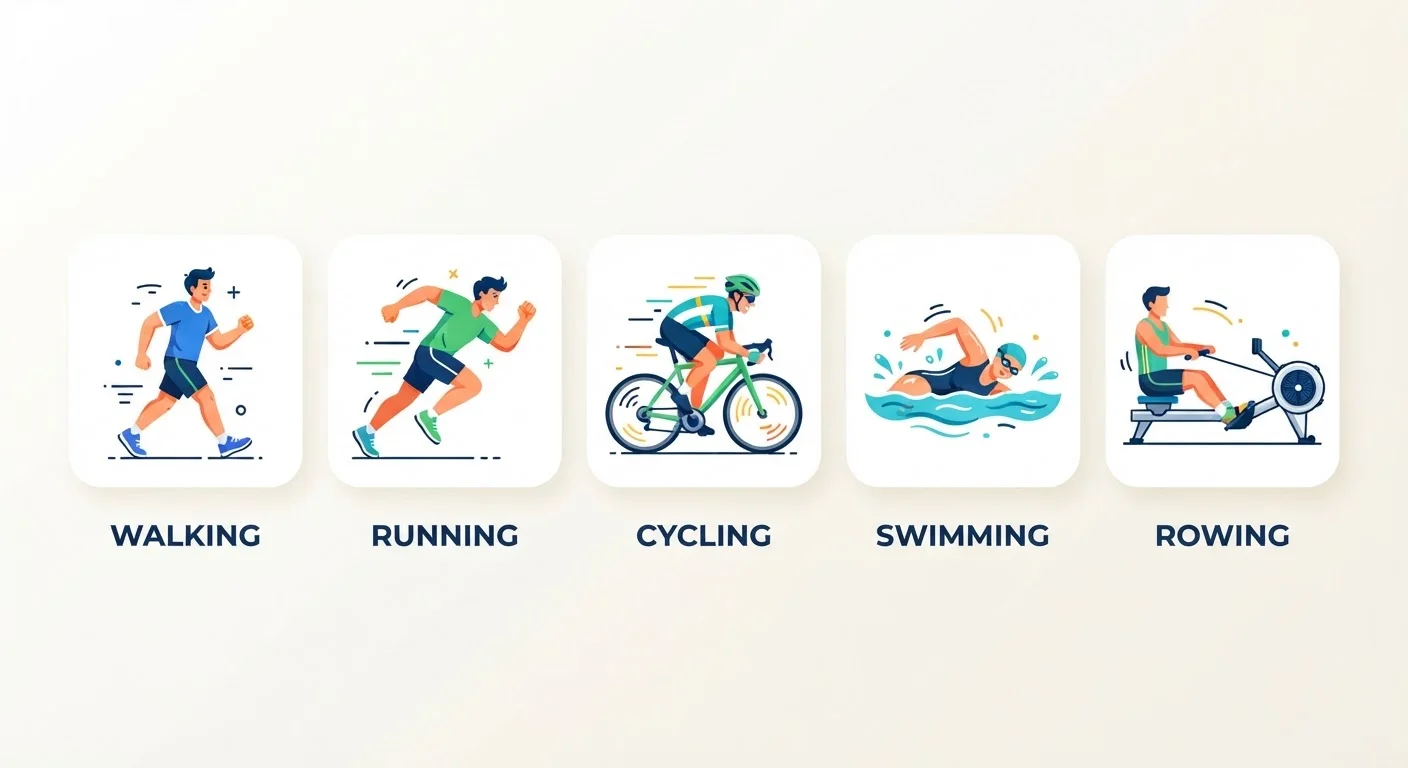
Aerobic exercise - commonly called cardio - strengthens the heart, improves circulation, supports mood, and contributes to overall metabolic health. But not all cardio formats place the same demands on your body. Impact level, muscle recruitment, equipment access, and skill requirements vary considerably across the five most common formats: walking, running, cycling, swimming, and rowing.
Choosing a format that fits your current fitness level and physical condition matters for two reasons: it reduces injury risk and increases the likelihood you'll stick with it. As the exercise needs vary across life stages, so too should your approach to cardio. Understanding what each format actually does to your body is a practical starting point.
This article is for general informational purposes only and is not a substitute for personalized advice from a qualified healthcare or fitness professional.
Format-by-Format Breakdown
Here's how each of the five formats compares across the criteria most relevant to everyday exercisers.
| Walking | Running | Cycling | Swimming | Rowing | |
|---|---|---|---|---|---|
| Impact Level | Low | High | Low | Very Low | Low |
| Equipment Needed | Footwear only | Footwear only | Bike required | Pool access required | Ergometer or water access |
| Primary Muscles | Lower body | Lower body | Lower body | Full body | Full body |
| Skill Requirement | Minimal | Minimal | Basic balance | Swimming ability | Technique important |
| Injury Risk | Low | Moderate-High | Low | Low | Low if form correct |
| Accessibility for Beginners | Very High | Moderate | High | Moderate | Moderate |
| Calorie Burn (relative) | Lower | Higher | Moderate | Moderate-High | Moderate-High |
Walking
Walking requires no equipment beyond supportive footwear and can be done almost anywhere. It is classified as low-impact because one foot remains on the ground at all times, reducing the force transmitted through joints. It is an excellent entry point for beginners, older adults, or those returning to activity after injury or illness - though people with specific conditions should consult a healthcare provider before starting any new exercise routine.
Running
Running is a high-impact activity: both feet leave the ground with each stride, and landing forces can reach two to three times body weight per step. This makes it an efficient calorie-burning format, but it also carries a higher risk of overuse injuries, including stress fractures and knee problems. Proper footwear, gradual mileage increases, and adequate rest are important considerations for runners at all levels.
Cycling
Whether on a stationary bike or outdoors, cycling is low-impact because the bike supports body weight, eliminating most of the ground-reaction force that stresses joints. It primarily targets the lower body - quadriceps, hamstrings, glutes, and calves - and is widely used in rehabilitation settings. Outdoor cycling adds a navigation and balance component, while stationary cycling offers controlled, weather-independent sessions.
Swimming
Water buoyancy offloads nearly all body weight, making swimming one of the most joint-friendly cardio options available. It engages the upper body, core, and lower body simultaneously, and the resistance of water provides muscular conditioning alongside cardiovascular benefit. Access to a pool and basic swimming proficiency are necessary prerequisites, which limits its accessibility compared to walking or cycling.
Rowing
Rowing - whether on the water or on an ergometer (rowing machine) - is a full-body format that engages legs, core, back, and arms within each stroke. It is low-impact in the sense that it is non-weight-bearing, but it demands meaningful technique to avoid lower-back strain. Beginners are advised to seek instruction before training at intensity. For those seeking cardio that also builds muscular endurance across the whole body, rowing is a strong option. It complements other forms of training well - see what cardio and strength training each do to your body for broader context.
Intensity, HIIT, and Format Interactions
Each of these five formats can be performed at a range of intensities - steady-state moderate effort, tempo work, or interval training. Running, cycling, and rowing adapt well to high-intensity interval approaches, while walking is generally better suited to sustained moderate effort. Swimming intervals are possible but require a higher baseline skill level to execute safely.
If you're considering whether to push intensity within any of these formats, it's worth understanding what interval training actually involves. High-intensity interval training isn't right for every situation, and some populations - including those with cardiovascular conditions - should consult a physician before training at high intensities in any format.
Start Where You Are, Not Where You Think You Should Be
If you're new to exercise or returning after a break, beginning with walking - even short sessions - is a medically sound and evidence-supported approach. Gradually increasing duration or intensity over several weeks reduces injury risk significantly. There's no need to start with the most demanding format to get meaningful health benefits.
Choosing Based on Your Situation
Rather than asking which format is objectively best, it helps to ask which format is best suited to you right now. Key factors to consider include:
- Joint health: If you have knee, hip, or ankle issues, low-impact formats like swimming or cycling may be more appropriate. Always consult a healthcare provider for guidance specific to your condition.
- Equipment and access: Walking requires the least; swimming requires pool access; rowing machines may not be available at every gym.
- Time availability: Running and rowing tend to produce measurable cardiovascular stimulus in shorter sessions compared to walking at moderate pace.
- Physical enjoyment: Research consistently shows that enjoyment and perceived effort both influence long-term exercise adherence. A format you find tolerable - or better yet, enjoyable - is more valuable than one you dread.
It's also worth noting that mixing formats over the course of a week can distribute mechanical load, reduce overuse risk, and maintain engagement. There is no rule that says cardio must come from a single source.