

Key Takeaways
Option A
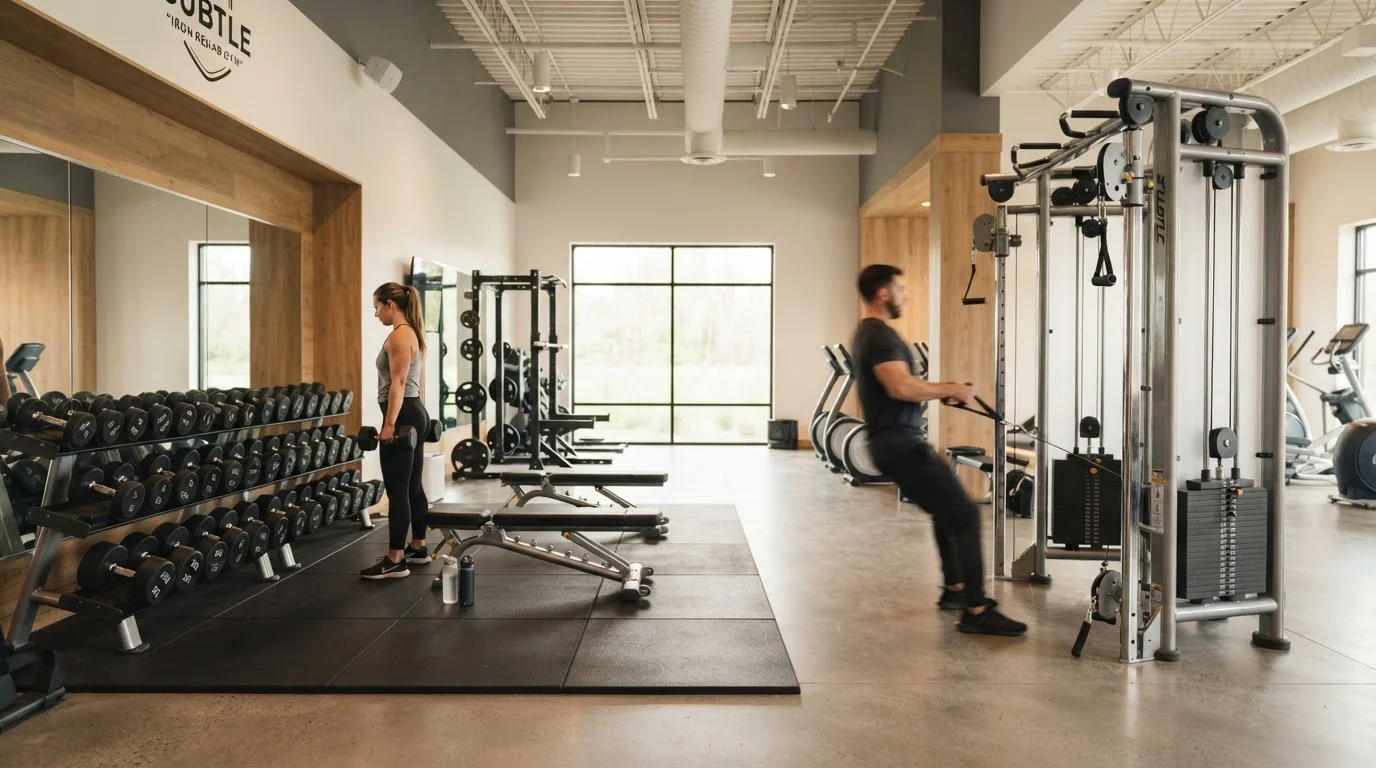
Free Weights
The versatile, functional strength builder.
Best for: Lifters who want to develop coordination, balance, and real-world functional strength across multiple muscle groups simultaneously.
Option B
Resistance Machines
The guided, accessible option for targeted training.
Best for: Beginners learning movement patterns, or anyone isolating specific muscles during rehabilitation or structured hypertrophy programs.
If you are new to strength training
Resistance Machines
Machines control your range of motion, making it easier to learn basic pushing and pulling patterns with lower injury risk before advancing to free weights.
If you want to build functional, real-world strength
Free Weights
Dumbbells and barbells engage stabilizing muscles and demand coordination, which supports movement quality in daily life and sport.
If you are recovering from an injury
Resistance Machines
Machines allow targeted muscle loading with controlled, predictable movement - but always follow a plan designed by a qualified rehabilitation professional.
If you want balanced muscle development at an intermediate level
Free Weights
Free weights expose and correct bilateral strength imbalances that machines can mask by compensating with the stronger side.
If you train alone and prioritize safety
Resistance Machines
Machines reduce the risk of a failed lift causing injury, making solo training sessions safer without a spotter.
What Sets Free Weights and Machines Apart
Free weights - including dumbbells, barbells, and kettlebells - allow movement through multiple planes. There is no fixed path; your muscles and joints must work together to control the load. That demand for coordination is what makes free weights particularly effective at building functional strength.
Resistance machines, by contrast, guide your movement along a predetermined arc or track. This reduces the coordination requirement and isolates specific muscles more reliably. For that reason, machines are a staple in physical therapy settings and beginner gym programs alike.
Understanding these core mechanical differences is the starting point for making an informed choice. As our guide on what strength training does to your body explains, resistance training of any kind drives meaningful physiological adaptations - the tool matters less than consistent, progressive effort.
| Criterion | Free Weights | Resistance Machines |
|---|---|---|
| Muscle activation | Broad - includes stabilizers | Targeted - primary muscles only |
| Learning curve | Higher - technique is critical | Lower - guided movement path |
| Injury risk for beginners | Higher without proper coaching | Lower due to fixed range of motion |
| Functional carry-over | Strong - mirrors real-world movement | Limited - isolated, fixed plane |
| Solo training safety | Lower - spotter often needed | Higher - no spotter required |
| Versatility | High - many exercises per tool | Low - typically one movement per machine |
| Cost and space | More affordable and compact | Expensive and space-intensive |
| Rehabilitation suitability | Variable - depends on movement | Often preferred under professional guidance |
The Case for Free Weights
Research in exercise science consistently shows that multi-joint, free-weight movements - such as the squat, deadlift, and overhead press - activate a broader network of muscles than their machine equivalents. This includes smaller stabilizing muscles that rarely get direct attention on machines.
Free weights also tend to be more adaptable. A single set of adjustable dumbbells can support dozens of exercises, and they transfer well to athletic performance and everyday activities like carrying groceries or lifting from the floor.
A key principle underlying effective free-weight training is progressive overload - gradually increasing the demands placed on your muscles over time. Our article on progressive overload and how to apply it explains how this principle drives adaptation whether you are training with barbells or bodyweight.
The main limitation of free weights is the learning curve. Poor form under load increases injury risk, and beginners often benefit from professional instruction before lifting heavy.
The Case for Resistance Machines
Machines are not a lesser option - they are a different tool with genuine advantages. Because they constrain your movement to a fixed path, they let you load a muscle more directly with less technical demand. For isolating the quadriceps, targeting the lats, or pressing safely without a spotter, machines are hard to beat.
For those returning to exercise after time away, machines can provide a confidence-building entry point. Our article on starting exercise after a long break outlines how rebuilding tolerance gradually - exactly what machines support - is key to sustainable progress.
Machines are also particularly useful at the end of a workout when fatigue might compromise form on free-weight exercises, or when training around a specific injury under professional guidance.
~58%
Adults who cite injury fear as a gym barrier
A commonly cited deterrent to gym use, particularly among beginners, is concern about performing exercises incorrectly and getting hurt - an area where machines offer meaningful reassurance.
2-3x
Weekly resistance training recommended
The U.S. Department of Health and Human Services Physical Activity Guidelines recommend adults perform muscle-strengthening activities involving all major muscle groups at least two days per week.
~20%
Greater stabilizer activation in free-weight squats
Studies in peer-reviewed exercise science journals have observed meaningfully higher activation of stabilizing muscles during free-weight compared to machine-guided squat variations.
How to Build a Balanced Approach
For most people, the most effective resistance training program is not built exclusively around one tool. A practical approach uses free weights for foundational compound movements - squats, rows, presses - and machines for accessory or isolation work targeting specific muscles.
Beginners may choose to start primarily on machines to learn basic push-pull mechanics before transitioning toward free weights as confidence and coordination improve. Experienced lifters often cycle between both depending on their training phase and recovery needs.
If equipment access is a concern, it is worth knowing that bodyweight training is a legitimate alternative: see our guide on building a home workout routine without equipment for a structured approach requiring no gym at all.
Whatever tools you choose, the fundamentals remain consistent: learn movements correctly, progress gradually, and allow adequate recovery. If you are unsure where to start, a certified personal trainer or exercise physiologist can help you design a program suited to your specific goals and health history.
This article is for general informational and educational purposes only and does not constitute medical or professional fitness advice. Consult a qualified healthcare or fitness professional before beginning any new exercise program, particularly if you have existing health conditions or injuries.