

Key Takeaways
Why Primer Confusion Is So Common
Walk into any paint aisle and you'll find conflicting signals: cans labeled "paint and primer in one," salespeople advising a full prime coat regardless, and online forums passionately divided on the topic. It's no wonder homeowners aren't sure what to do.
The confusion largely stems from treating primer as a single, unchanging product with a single purpose. In reality, primer is a category of preparatory coatings, each formulated to solve a specific problem - adhesion, stain blocking, porosity sealing, or bonding to slick surfaces. Understanding what primer actually does makes it much easier to decide when you truly need it. As we cover in our surface prep and application guide, most paint failures trace back to preparation decisions, not the topcoat itself.
Myth
You should always apply primer before any paint job, no exceptions.
Fact
Primer is essential in specific situations, but repainting an already-sealed, properly painted surface in good condition often doesn't require it.
This blanket rule persists partly from older paint technology and partly from cautious advice that got repeated until it became doctrine. Modern latex topcoats bond well to existing painted surfaces that are clean, dull (lightly sanded), and structurally intact. Using primer in this scenario adds a step without adding meaningful protection. Save the primer for when the surface genuinely calls for it.
Myth
"Paint and primer in one" products mean you never need separate primer.
Fact
Self-priming paints work well for repainting in similar colors on sound surfaces, but they cannot replace dedicated primer on new drywall, stained surfaces, or slick substrates.
These combination products are thicker, higher-solids formulations - useful for light coverage upgrades and color refreshes. But they lack the specialized chemistry that a shellac-based stain blocker or a PVA drywall primer delivers. When the job calls for true sealing or adhesion promotion, a dedicated primer followed by a topcoat remains the more reliable approach.
Myth
Primer is only necessary when going from a dark color to a light one.
Fact
Color change is just one scenario where primer helps. New drywall, stained surfaces, bare wood, and previously glossy finishes are equally important candidates.
The color-change case for primer is real - a gray primer tinted close to your topcoat color reduces the coats needed to achieve full coverage. But framing primer as a color-change tool misses the other jobs it does: sealing the chalky, porous face of new drywall, blocking water and smoke stains from bleeding through, and giving topcoats something to grip on slick or bare surfaces. These problems exist regardless of color direction.
Myth
Skipping primer just means you might need an extra coat of paint.
Fact
On problematic surfaces, skipping primer can cause adhesion failure, stain bleed-through, and uneven sheen that extra topcoat layers cannot fix.
An extra coat of paint can compensate for thin pigment coverage, but it cannot solve a bonding or contamination problem at the substrate level. Tannin from bare wood, nicotine from smoke, and mineral compounds from water stains will migrate through multiple layers of paint if an appropriate stain-blocking primer wasn't applied first. The result is a surface that looks worse after painting than before - and requires stripping back to start over correctly.
Myth
Any primer will work for any surface.
Fact
Primers are formulated for specific substrates and problems; using the wrong type can be as ineffective as using no primer at all.
A latex primer applied over a smoke-damaged ceiling will likely fail to block the stain. An interior drywall primer applied to a glossy cabinet offers minimal adhesion benefit. Each primer category - PVA, shellac, oil-based, bonding - addresses a different surface condition. Selecting the right primer requires identifying what the surface actually needs, not defaulting to whatever product is available.
When Skipping Primer Is Actually Fine
There are real-world scenarios where applying primer adds cost and labor with little practical benefit. If you're repainting a previously painted wall in good condition - no peeling, no stains, no dramatic color shift - and you're staying within a similar color family, a quality latex topcoat over a clean, lightly sanded surface is typically sufficient.
The same logic applies when repainting recently painted walls that were originally primed and sealed correctly. The existing finish already provides the bonding foundation. Adding primer here is often redundant, not protective.
Don't Skip Primer on New or Repaired Drywall
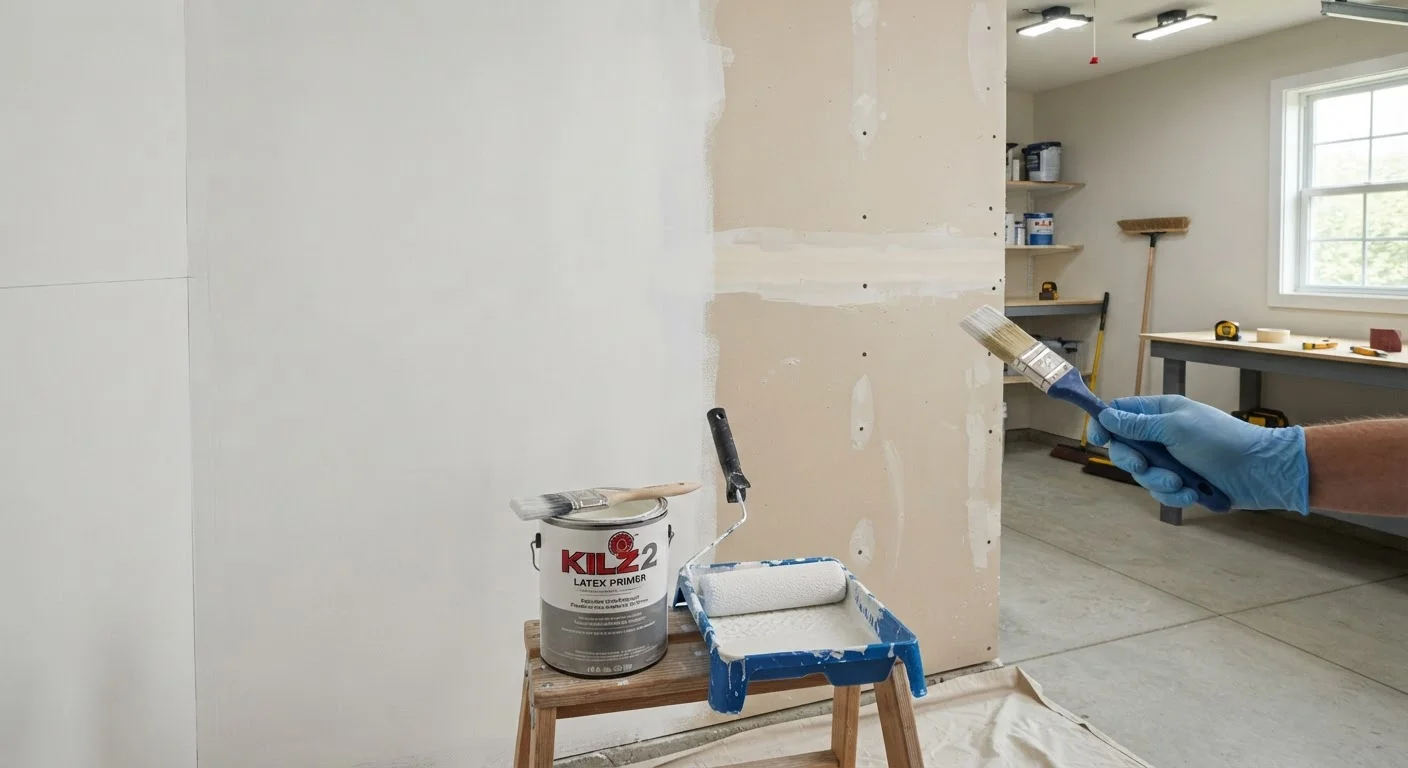
Bare drywall - whether new construction or patches - is one of the most common places homeowners skip primer, often with poor results. The paper face is highly porous and absorbs topcoat paint unevenly, leaving a blotchy, flat finish even after multiple coats. A PVA drywall primer seals this porosity first, creating a consistent base that allows the topcoat to perform as intended. This is not an optional step on new drywall.
For a broader look at how skipping necessary prep steps affects your home's value and upkeep costs, see our article on home maintenance myths that cost homeowners money.
80%+
Paint failures linked to inadequate surface prep
Industry painting professionals consistently attribute the large majority of premature paint failures to surface preparation issues rather than topcoat quality.
2-3x
More topcoat layers needed without primer on new drywall
Unprimed new drywall absorbs paint unevenly, typically requiring significantly more topcoat applications to achieve uniform sheen and color depth.
Choosing the Right Primer When You Do Need It
Not every primer is interchangeable. PVA (polyvinyl acetate) primer is the go-to for new drywall - it seals the porous paper face and prevents uneven sheen in the final coat. Shellac-based primer is the most powerful stain blocker and handles smoke damage, water stains, and marker bleed-through that latex primers can't reliably stop. Oil-based primer excels on bare wood, tannin-rich species like cedar, or previously glossy surfaces needing maximum adhesion. Bonding primer is designed for slick or non-porous substrates - think tile, glass, or melamine cabinetry.
Matching the primer to the problem, rather than grabbing whatever is on the shelf, is what separates a durable paint job from one that needs redoing in two years. If you're unsure which category fits your surface, a detailed conversation with a paint professional at a full-service paint supply store - not just a big-box retailer - is worth the time.