

Key Takeaways
Option A
Fixed-Rate Mortgage
The predictable, long-term stability choice.
Best for: Buyers who plan to stay in their home long-term and want consistent monthly payments regardless of market movement.
Option B
Adjustable-Rate Mortgage (ARM)
The flexible, lower-entry-cost alternative.
Best for: Buyers who expect to sell or refinance within a few years and can tolerate some payment variability in exchange for a lower initial rate.
If you plan to own the home for 10 or more years
Fixed-Rate Mortgage
Rate predictability becomes more valuable the longer you hold the loan. You're insulated from any future rate increases throughout the full term.
If you expect to sell or refinance within 5-7 years
Adjustable-Rate Mortgage (ARM)
A 5/1 or 7/1 ARM lets you benefit from the lower introductory rate without staying long enough to face significant adjustments.
If your income is fixed or tightly budgeted
Fixed-Rate Mortgage
Payment stability makes monthly budgeting straightforward and eliminates the risk of a sudden increase you can't absorb.
If rates are currently high and expected to fall
Adjustable-Rate Mortgage (ARM)
An ARM may let you start at a lower rate and potentially benefit if the index rate drops - though this outcome is never guaranteed.
If you're a first-time buyer prioritizing simplicity
Fixed-Rate Mortgage
The straightforward structure of a fixed loan is easier to understand and plan around during an already complex homebuying process.
How Each Loan Structure Works
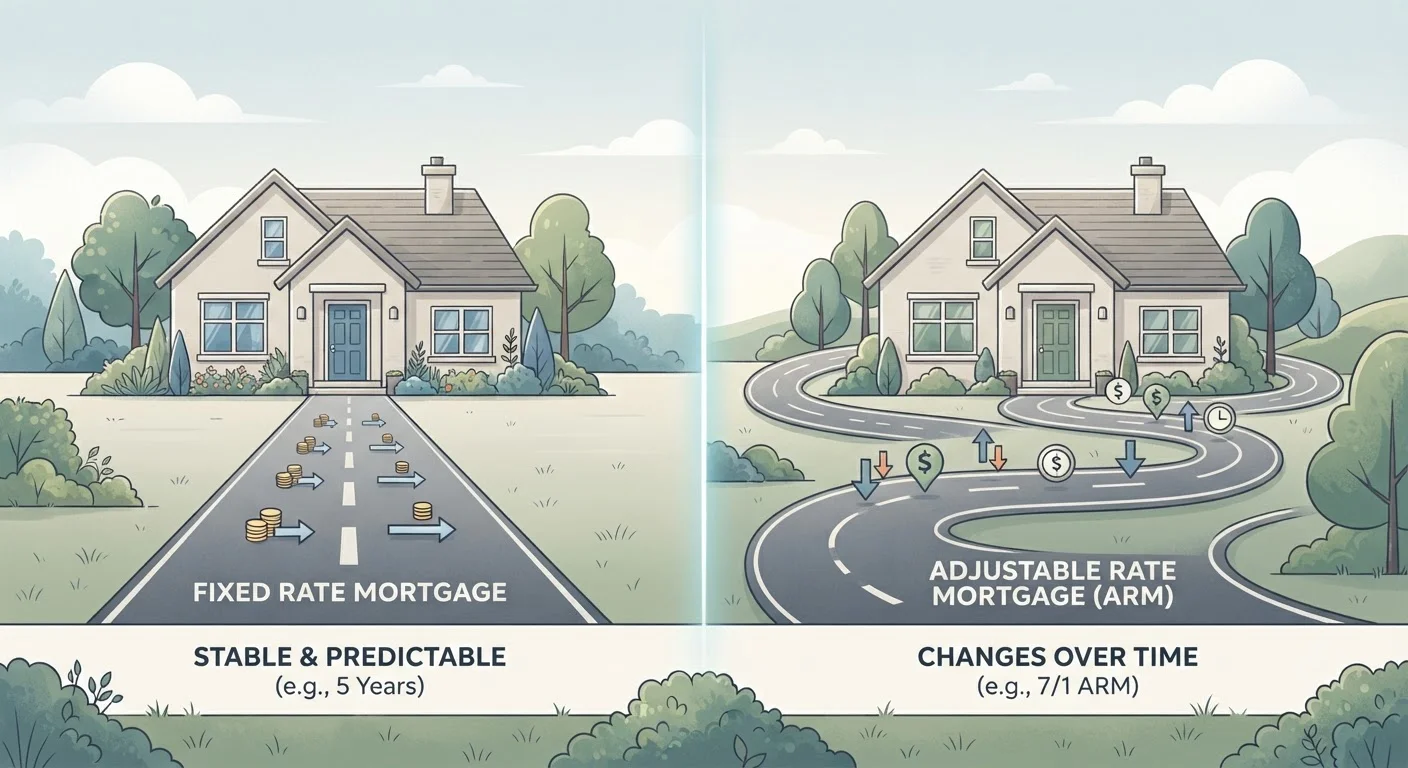
A fixed-rate mortgage sets one interest rate at closing that applies for the entire repayment period - typically 15 or 30 years. Your monthly principal and interest payment never changes, regardless of what happens in financial markets. This makes long-range budgeting straightforward, since you know exactly what you owe each month from day one to payoff.
An adjustable-rate mortgage (ARM) works differently. It starts with a fixed introductory rate for a set period - commonly 3, 5, 7, or 10 years - then adjusts at regular intervals based on a benchmark interest rate index, such as the Secured Overnight Financing Rate (SOFR). The loan name reflects this structure: a 5/1 ARM is fixed for 5 years, then adjusts once per year afterward. ARMs include rate caps that limit how much the rate can move per adjustment and over the loan's lifetime, which provides some protection against extreme swings.
Understanding how fixed and variable costs behave in a household budget is a useful frame here - see our piece on fixed vs. variable expenses for context on why predictability matters in financial planning.
| Criterion | Fixed-Rate Mortgage | Adjustable-Rate Mortgage (ARM) |
|---|---|---|
| Interest rate | Locked for full loan term | Fixed intro period, then adjusts |
| Monthly payment stability | Consistent throughout | Can rise or fall after intro period |
| Initial rate level | Typically higher than ARM intro rate | Usually lower at the start |
| Rate risk | Borne entirely by lender | Partially borne by borrower |
| Best loan length | Long-term holds (10+ years) | Shorter holds (3-7 years) |
| Budgeting simplicity | Very straightforward | Requires planning for adjustments |
| Rate caps | Not applicable | Per-adjustment and lifetime caps apply |
The Real Trade-Off: Certainty vs. Cost
Fixed-rate mortgages typically carry a slightly higher starting rate than ARMs because lenders are absorbing the risk that market rates might rise over time. You pay a premium for the guarantee of stability. For buyers who remain in their home long enough, that premium often pays for itself through the avoidance of rate increases.
ARMs transfer some of that interest-rate risk to the borrower. In exchange, lenders offer a lower introductory rate - which translates to lower initial monthly payments and potentially more purchasing power. The catch is that once the fixed period ends, your rate and payment can rise, sometimes meaningfully.
30 years
Most common fixed-rate mortgage term in the US
The 30-year fixed-rate mortgage has historically been the dominant home loan product for American buyers, according to Freddie Mac market data.
~1-2%
Typical ARM introductory rate discount vs. fixed
ARMs commonly open at rates roughly 0.5 to 2 percentage points below comparable fixed-rate loans, though the gap varies with market conditions.
5/1, 7/1
Most common ARM structures in the US market
According to the Consumer Financial Protection Bureau, the 5/1 and 7/1 ARM configurations are among the most frequently offered adjustable products by US lenders.
For a deeper look at how these two structures are calculated month by month, our guide on how fixed and adjustable mortgage rates work walks through payment mechanics in detail.
If you're still weighing whether homeownership makes sense at all, renting vs. buying a home covers the broader financial and lifestyle factors involved.
Choosing the Right Fit for Your Situation
Neither loan type is universally superior. The better choice depends on how long you intend to stay in the home, your current financial cushion, and your tolerance for payment variability.
If you're buying what you expect to be a long-term home and your income is steady, a fixed-rate mortgage offers peace of mind that compound market shifts cannot disrupt. If you're purchasing a starter property, relocating for a time-limited job, or plan to trade up within a decade, an ARM's lower initial rate could reduce your costs during the window you actually own the home.
It's also worth considering the broader rate environment. When prevailing mortgage rates are elevated, an ARM may offer meaningful short-term savings. When rates are relatively low, locking in a fixed rate becomes more attractive because you're securing favorable terms for the long haul - though predicting rate movements is inherently uncertain, and no lender or analyst can guarantee future direction.
Once you own a home, you may also encounter decisions about leveraging your equity. Our comparison of home equity loans vs. HELOCs explains two common borrowing structures built on homeownership equity.
This article is for general informational and educational purposes only and does not constitute personalized financial, mortgage, or legal advice. Mortgage products, rates, and eligibility requirements vary by lender and individual circumstances. Consult a licensed mortgage professional or financial adviser before making borrowing decisions.