

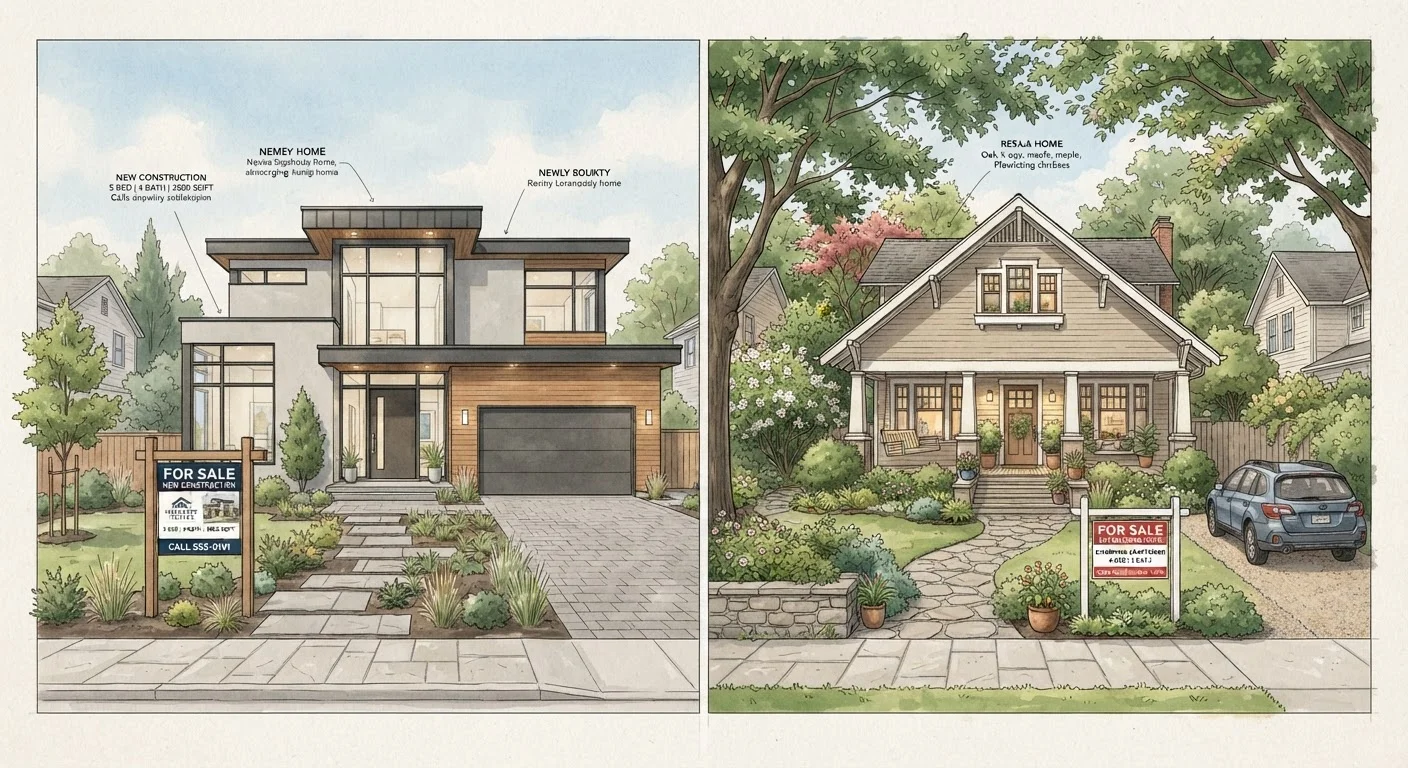
Key Takeaways
Option A
New Construction Home
The customizable, builder-controlled path to homeownership.
Best for: Buyers who want modern finishes, energy-efficient systems, and builder warranties with no immediate repair needs.
Option B
Existing (Resale) Home
The established, negotiation-friendly choice with faster timelines.
Best for: Buyers who want an immediate move-in date, a known neighborhood character, and room to negotiate on price and repairs.
If you need to move within the next 60 days
Existing (Resale) Home
Resale homes close on conventional timelines and eliminate the construction delays and phased completion uncertainty common with new builds.
If you want modern systems and minimal early maintenance
New Construction Home
Brand-new HVAC, roofing, plumbing, and electrical systems - plus builder warranties - typically mean fewer costly surprises in the first several years.
If negotiating price and repair credits matters to you
Existing (Resale) Home
Resale sellers are often motivated to negotiate, and buyers can request repairs or price reductions based on inspection findings.
If customizing finishes and layout is a priority
New Construction Home
Buying early in the build phase lets you select flooring, cabinetry, fixtures, and sometimes structural options directly from the builder's design center.
If you want a mature neighborhood with established amenities
Existing (Resale) Home
Established communities offer known school performance, mature trees, walkable streets, and nearby retail that new developments may take years to replicate.
The Contract: Who Wrote It, and Why That Matters
The first major difference buyers encounter is the contract itself. In a resale transaction, both parties typically negotiate using a standard form approved by the state's real estate commission, with terms open to back-and-forth offers. In new construction, the builder presents their own purchase agreement - a document their attorneys drafted to protect their interests.
Builder contracts often limit the buyer's ability to cancel without forfeiting a deposit, lock in arbitration for disputes, and include clauses allowing construction timelines to shift. Before signing, buyers should strongly consider having a real estate attorney review the contract. Unlike a resale negotiation, you're not bargaining with another individual homeowner - you're entering an agreement with a professional development company.
Upgrades and selections also happen at a builder's design center, often before construction begins. Costs for countertops, flooring, and appliances add up quickly and are typically folded into the purchase price - which affects your loan amount and down payment calculation. For context on how the new-vs-used dynamic plays out in another major purchase category, see our analysis of new vs. used car trade-offs.
Timeline and Closing: Fast Track vs. Long Runway
A resale purchase typically moves from accepted offer to closing in 30 to 60 days, depending on financing and inspection timelines. New construction timelines vary significantly based on where the home is in the build cycle when you sign.
Buying a spec home - one the builder has already completed or nearly completed - can close on a similar timeline to resale. Buying a home early in the development phase, however, can mean a 6-to-18-month wait before you receive keys. Delays from weather, supply chain disruptions, or permitting can extend that window further.
| Criterion | New Construction | Existing (Resale) Home |
|---|---|---|
| Typical closing timeline | 6-18 months (build phase) | 30-60 days |
| Contract author | Builder's legal team | State-approved standard form |
| Inspection approach | Multiple phase inspections | Single post-offer inspection |
| Negotiation leverage | Upgrades and incentives | Price, repairs, and credits |
| Financing complexity | May require construction loan | Standard mortgage process |
| Warranty coverage | Builder warranty included | Negotiated or none |
| Condition certainty | All-new systems and materials | Varies; inspection-dependent |
That waiting period has financial implications. Buyers must manage their current housing costs (rent, or carrying their existing mortgage) while also keeping their financial profile stable enough to qualify for a loan at closing - a process called mortgage approval, where a lender verifies your income, credit, and assets. Any major credit changes during the build period can jeopardize your financing.
Inspections: New Doesn't Mean Problem-Free
Many buyers assume a brand-new home doesn't need an independent inspection. That assumption carries risk. Construction errors - improperly installed insulation, grading issues that direct water toward the foundation, HVAC ductwork problems - do occur and may not be obvious to an untrained eye.
For new construction, buyers should consider scheduling inspections at multiple build stages: during framing (before drywall covers the structure), after mechanical systems are installed, and again at final walkthrough. Builders typically conduct their own quality checks, but an independent inspector serves the buyer's interests exclusively.
Builder Warranties Have Defined Limits
Most new construction homes come with a structural warranty (often 10 years), a systems warranty covering HVAC, plumbing, and electrical (typically 2 years), and a workmanship warranty (commonly 1 year). Coverage terms and exclusions vary by builder and state law. Review the warranty document carefully before closing and ask what the process is for filing a claim - you'll want to know this before any issues arise.
Resale buyers conduct a single inspection after going under contract. The findings can then be used to negotiate a price reduction, request repairs, or - depending on contract terms - exit the deal if issues are significant. That leverage doesn't exist in the same form with new construction, where the builder controls the process and repair commitments are governed by warranty terms rather than negotiated concessions.
Once you close on either type of home, the real learning begins. Our guide on what to expect in your first year of homeownership covers maintenance priorities and early financial habits worth building.
Financing Differences Buyers Should Anticipate
Financing a resale home follows a familiar path: you apply for a conventional, FHA, VA, or other mortgage, the lender appraises the property, and you close. New construction introduces additional complexity.
If you're buying a completed spec home, financing resembles a standard mortgage. But if construction hasn't started or is ongoing, you may need a construction-to-permanent loan - a product that funds the build in phases and then converts to a traditional mortgage at completion. These loans have different qualification requirements and interest structures than standard mortgages.
Builders frequently partner with preferred lenders and may offer rate buy-downs or closing cost credits if you use their financing. Those incentives can be genuine, but buyers should still compare offers independently. Using a builder's lender without comparison shopping may mean accepting less favorable terms overall. This is general educational information - consult a licensed mortgage professional about financing options suited to your specific situation.
This article is for informational purposes only and does not constitute financial, legal, or real estate advice. Consult a licensed real estate professional, attorney, and mortgage adviser for guidance tailored to your circumstances.