

Key Takeaways
Option A
DSL (Digital Subscriber Line)
The legacy landline option with wide rural reach.
Best for: Households already served by telephone infrastructure who need a low-cost, predictable connection for basic browsing and streaming.
Option B
Fixed Wireless Internet
The modern over-the-air alternative with growing rural coverage.
Best for: Rural homes within line-of-sight of a wireless tower who need faster speeds than DSL can reliably deliver.
If you live in a remote area with existing phone service but no tower nearby
DSL (Digital Subscriber Line)
DSL relies on copper telephone lines already in place, making it the more accessible option where fixed wireless towers haven't been deployed.
If you need faster speeds for video calls, remote work, or multiple devices
Fixed Wireless Internet
Fixed wireless generally delivers higher download speeds than DSL, provided you have clear signal access to a local tower.
If you prioritize cost predictability on a tight monthly budget
DSL (Digital Subscriber Line)
DSL plans tend to have lower monthly costs and don't typically require expensive equipment installations on your property.
If terrain or heavy tree cover limits your line-of-sight to a tower
DSL (Digital Subscriber Line)
Fixed wireless performance drops sharply when the signal path is obstructed; DSL is unaffected by those physical barriers.
If you're in a newly expanded rural coverage area and tower access is confirmed
Fixed Wireless Internet
Where fixed wireless infrastructure is available, it consistently outperforms DSL in speed and is less prone to the distance-based degradation DSL suffers.
How Each Technology Actually Works
Understanding the mechanics behind DSL and fixed wireless helps explain why each performs the way it does in rural settings.
DSL transmits data over the copper telephone lines that already connect millions of American homes. A modem at your location converts those signals into usable internet. The critical limitation: signal quality degrades with distance. The farther your home sits from a provider's central office or remote terminal, the weaker and slower your connection becomes. In dense suburbs, this rarely matters. In rural areas where distances routinely stretch several miles, it matters a great deal.
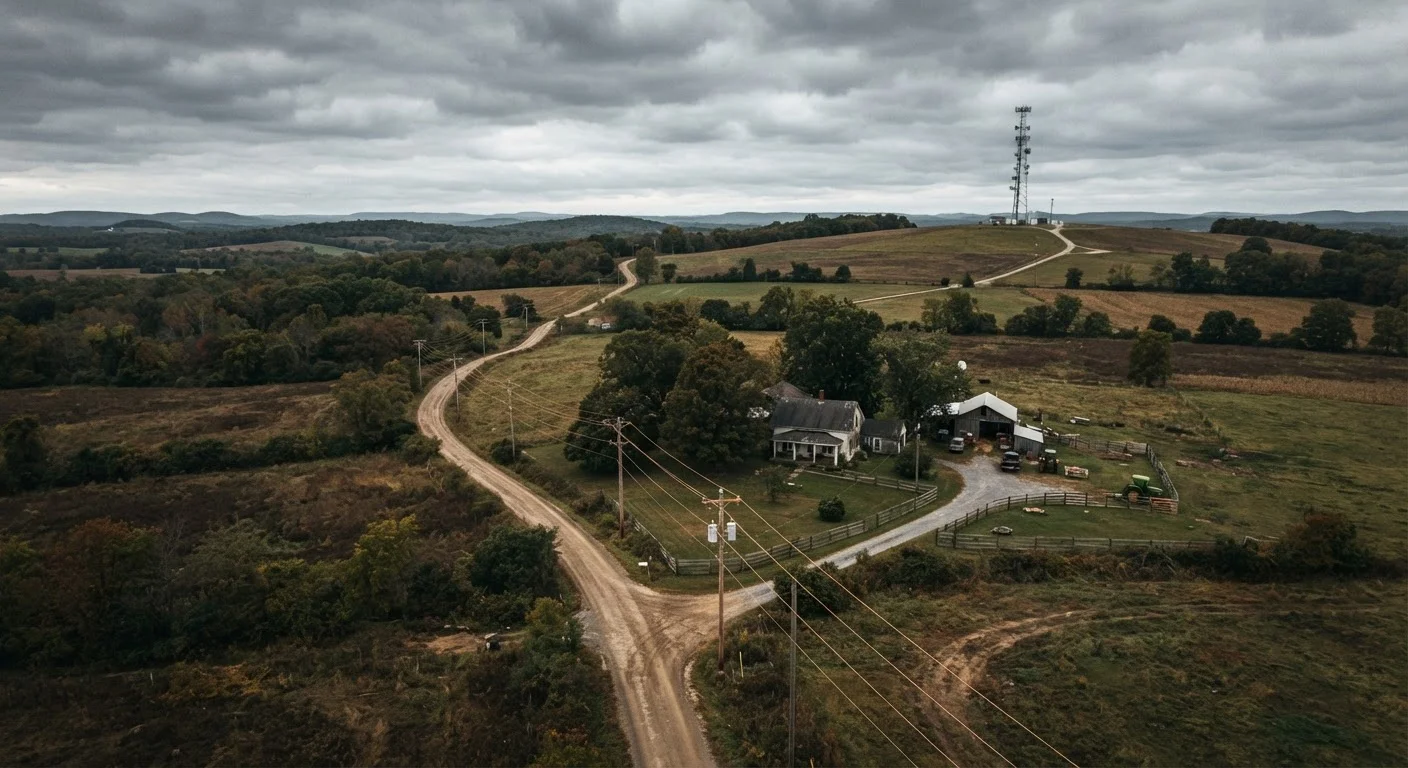
Fixed wireless works differently. A provider installs a radio transmitter on a tower, water tower, or elevated structure. A small antenna or dish is mounted on your home, receiving that signal over the air. Data travels wirelessly between your home and the tower - no buried cable required. The tradeoff is that this signal generally needs a clear path. Significant hills, dense forest, or other obstructions between your home and the tower can weaken or block the connection entirely.
For a broader grounding in how these and other connection types compare, see our plain-language guide to home internet connection types.
| Criterion | DSL | Fixed Wireless |
|---|---|---|
| Infrastructure required | Copper telephone lines | Radio tower within range |
| Typical download speed (rural) | 1-25 Mbps | 25-100+ Mbps |
| Typical latency | 20-50 ms | 20-70 ms |
| Distance sensitivity | Degrades with distance from central office | Requires line-of-sight to tower |
| Weather impact | Low to moderate | Moderate (rain, ice on antenna) |
| Installation complexity | Low - modem only | Moderate - external antenna required |
| Rural availability | Broad (where phone lines exist) | Growing but patchier |
Speed, Latency, and Real-World Performance
Speed is where the gap between DSL and fixed wireless tends to be most pronounced - but the picture is more nuanced than headline numbers suggest.
DSL download speeds in rural areas commonly fall between 1 Mbps and 25 Mbps, depending heavily on how far the home is from provider infrastructure. The FCC has historically set a basic broadband threshold at 25 Mbps download and 3 Mbps upload - speeds many rural DSL users cannot reliably reach. Latency (the delay in data transmission) on DSL is typically low, usually in the 20-50 millisecond range, which is suitable for video calls and real-time applications when speeds are adequate.
Fixed wireless can deliver download speeds ranging from roughly 25 Mbps to well over 100 Mbps on modern networks, depending on the provider and local tower capacity. Latency is generally comparable to DSL, often between 20-70 milliseconds - meaningfully better than traditional satellite internet. However, fixed wireless speeds can vary based on how many users share a given tower, weather conditions, and signal path quality.
~21%
Rural Americans lacking fixed broadband access
According to FCC broadband mapping data, roughly one in five rural Americans still lacks access to fixed broadband at the FCC's minimum speed threshold.
25 Mbps
FCC minimum broadband download speed threshold
The FCC has defined 25 Mbps download / 3 Mbps upload as the baseline for broadband; many rural DSL connections fall below this benchmark.
3-5x
Speed advantage fixed wireless can hold over rural DSL
Industry analyses of rural connectivity options consistently find fixed wireless delivering materially higher speeds than copper-based DSL where both are available.
If you're weighing whether satellite might fill a gap where neither DSL nor fixed wireless reaches, our analysis of satellite internet's advantages and real limitations offers a balanced comparison.
Availability, Installation, and Practical Considerations
In many rural situations, the decision between DSL and fixed wireless isn't really a choice at all - it's determined by what's actually available at your address.
DSL availability is tied to the reach of telephone infrastructure. Most rural households that have had a landline phone have at least the possibility of DSL service, though providers may not offer it in all areas even where lines exist. No specialized external equipment is required beyond a modem, and installation is generally straightforward.
Fixed wireless requires a provider to have a tower within reasonable range - typically several miles - and your home to have a viable line-of-sight path to that tower. Installation involves mounting an antenna on your roof or an exterior wall, which means a technician visit and some hardware on your property. Providers typically conduct a site survey before confirming service is feasible at a given location.
Weather is a more significant factor for fixed wireless than for DSL. Heavy rain, ice buildup on equipment, and high winds can temporarily degrade performance. DSL, running through buried or aerial copper lines, is somewhat more insulated from weather disruption - though ice storms and physical line damage remain risks.
Check Availability Before Comparing Plans
The FCC's National Broadband Map and tools offered by state broadband offices can help you identify which providers are certified to offer service at your specific address. Availability data from ISPs themselves isn't always current or precise for rural locations, so cross-referencing multiple sources before committing to a provider is worthwhile. Some rural areas may also have access to local cooperative or municipal fixed wireless networks that larger ISP databases don't capture.
For households where a wired connection inside the home matters for performance - especially with fixed wireless equipment feeding into a router - our piece on when a wired Ethernet connection makes a meaningful difference is worth reviewing.