

Key Takeaways
Our Verdict
Neither dealer financing nor bank or credit union loans is universally superior. Dealer financing wins on convenience and occasionally on promotional rates, while outside lenders generally offer more transparent pricing and lower rates for well-qualified borrowers. The smartest approach for most buyers is to arrive with a pre-approval in hand and treat dealer financing as a competing offer.
| Best for | Recommended |
|---|---|
| Buyers who want maximum convenience and one-stop shopping | Dealer Financing |
| Borrowers with strong credit seeking the lowest possible APR | Bank or Credit Union Loan |
| Shoppers who qualify for a manufacturer's promotional 0% or low-APR offer | Dealer Financing |
| First-time buyers who want to understand loan terms before entering the dealership | Bank or Credit Union Loan |
How Each Financing Path Works
When you finance a vehicle, money flows from a lender to the seller, and you repay the lender with interest over time. The two most common paths differ in who arranges that relationship.
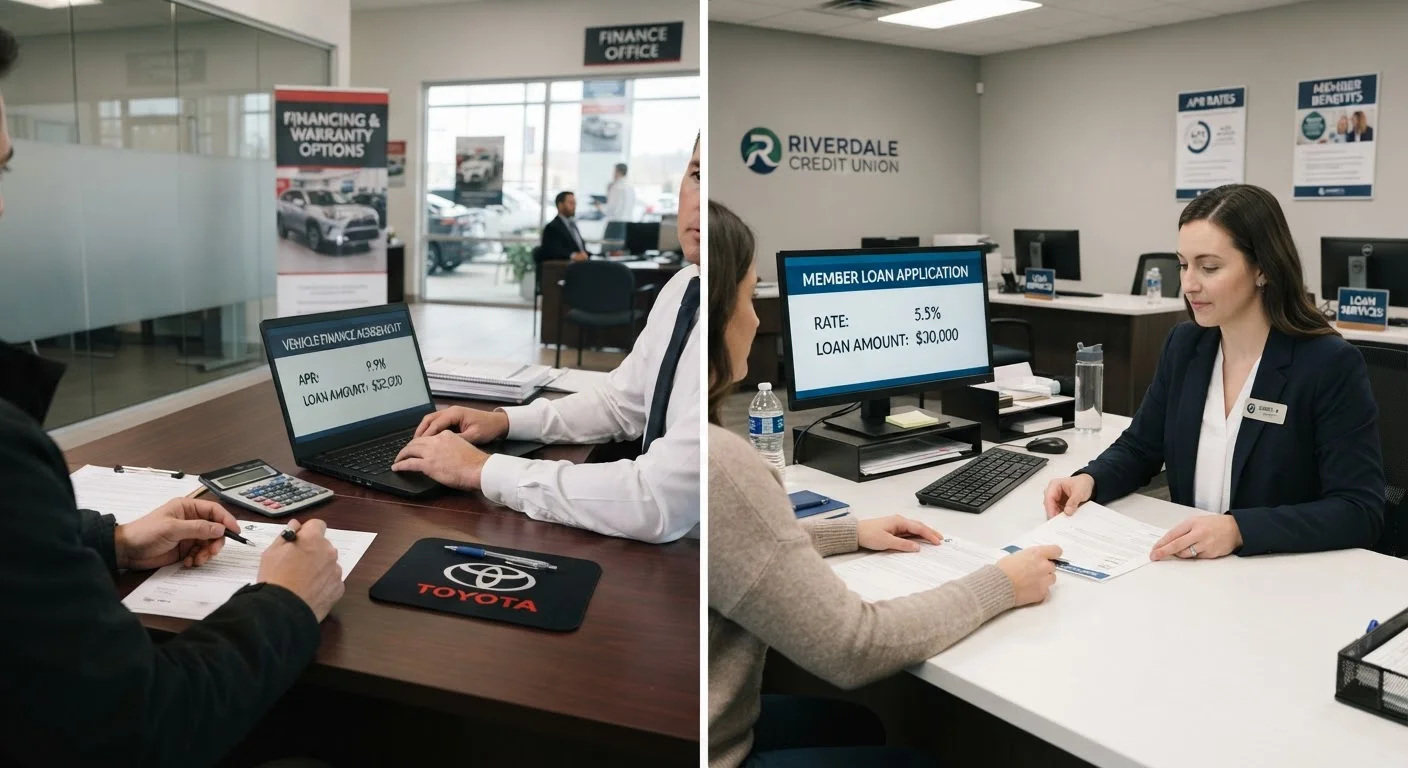
Dealer financing means the dealership acts as a middleman. Its finance and insurance (F&I) office submits your credit application to a network of lenders - banks, captive lenders (the automaker's own financing arm), and specialty auto lenders - then presents you with loan terms. Dealers are typically paid a fee or allowed to mark up the interest rate above what the lender actually requires, a practice sometimes called a "dealer reserve."
Bank or credit union loans mean you go directly to the institution, apply for an auto loan, and receive a pre-approval or commitment before you shop. You bring that offer to the dealership like a check, and it becomes your baseline. Credit unions, as member-owned nonprofits, often quote rates below those of commercial banks, though this varies by institution and applicant.
See also: Financing vs. Paying Cash for a Car for a broader look at whether borrowing makes sense for your situation.
The Rate Reality: What You're Actually Being Quoted
Interest rate transparency is the sharpest difference between these two paths. When a lender approves you at, say, 6.5% APR, a dealer may have the contractual right to present you a 7.5% or 8% rate and keep the spread. This is legal and widespread, though some manufacturers' captive lenders prohibit or cap the markup on promotional deals.
Outside lenders give you a direct rate - what you qualify for is what you pay. That clarity makes it easier to compare offers and negotiate effectively. Walking into a dealership with a pre-approval at a known rate forces the dealer's finance office to beat or match it, rather than anchor the conversation around a payment figure.
| Dealer Financing | Bank Loan | Credit Union Loan | |
|---|---|---|---|
| Rate transparency | Rate may include dealer markup | Direct rate, no middleman | Direct rate, member-owned nonprofit |
| Convenience | High - all in one visit | Moderate - apply before shopping | Moderate - apply before shopping |
| Access for lower credit scores | Often broader lender network | Varies by institution | Sometimes more flexible underwriting |
| Promotional rates available | Yes - manufacturer subsidized offers | No | No |
| Pre-approval option | Not typically | Yes | Yes |
| Negotiating leverage | Lower without outside offer | Higher - sets a baseline | Higher - sets a baseline |
One important nuance: manufacturer-subsidized rates - sometimes advertised as 0% APR or 1.9% APR for qualified buyers - are genuine and can be exceptional value. These promotions are only available through dealer financing and often require strong credit scores. However, they may require you to forgo a cash rebate, so the math isn't always automatic. Always calculate total cost under both scenarios.
For a broader perspective on borrowing structures, the secured vs. unsecured debt distinction is worth understanding - auto loans are secured debt, meaning the vehicle serves as collateral.
Convenience, Speed, and the Finance Office
Dealer financing's primary advantage is consolidation. You can select a vehicle, negotiate a price, arrange financing, and drive home in a single visit. For buyers who have done their homework on rates and know what they should qualify for, this can be genuinely efficient.
The risk is the finance office environment. After agreeing on a vehicle price, buyers often enter a separate room where add-on products - extended warranties, GAP insurance, paint protection - are presented alongside monthly payment figures. When financing is bundled with these products, it becomes harder to evaluate each cost independently. Understanding what dealers offer after you've agreed on a price can help you prepare for that conversation.
Get Pre-Approved Before You Shop
Applying for a pre-approval at your bank or credit union before visiting any dealership costs nothing and gives you a concrete rate to benchmark against. Bring the pre-approval letter with you. Even if you ultimately use dealer financing, knowing your approved rate prevents you from being anchored to a payment-first conversation. Most pre-approvals are valid for 30 to 60 days.
Bank and credit union pre-approvals shift this dynamic. When your financing is already arranged, the dealer knows you're not relying on them for the loan. That reduces one variable the finance office might otherwise use to structure a deal around an attractive monthly payment rather than total cost.
Credit Profile and Access
Your credit score and history shape which path is realistically available to you and at what cost.
Borrowers with strong credit (generally scores above 720) typically qualify for a lender's best rates directly and have the most to gain from shopping outside the dealership. Multiple credit inquiries for an auto loan within a short window - generally 14 to 45 days depending on the scoring model - are typically treated as a single inquiry, so rate-shopping doesn't significantly hurt your score.
Buyers with thin credit history or lower scores may find that dealer financing opens doors that direct bank applications don't. Dealers work with a wider network of lenders, including subprime specialists. The tradeoff is that rates in this segment can be substantially higher, and total interest paid over the loan's life deserves careful review before signing.
Credit unions often have more flexible underwriting than large commercial banks and may serve members with imperfect credit more favorably - membership eligibility varies but has broadened significantly in recent years. It's worth checking whether you qualify for a credit union before assuming a bank or dealer is your only option. The Debt & Credit resource hub covers credit fundamentals that apply here.
Making the Comparison Work for You
The most effective strategy combines both paths. Get pre-approved by your bank or credit union before you shop - this takes a day or two at most. Then, at the dealership, let the F&I office make an offer. If dealer financing comes in lower after accounting for any fees or add-ons, use it. If your pre-approval is better, use that. You haven't committed to either until you sign a contract.
When comparing offers, focus on APR (not just the interest rate), total interest paid over the full loan term, and whether any fees are rolled into the loan. Extending a loan term to lower a monthly payment increases total cost - a 72-month loan at a lower payment can cost more overall than a 48-month loan at a higher one.
If you're exploring different ways to buy a vehicle altogether, buying from a private seller vs. a dealership introduces another layer of consideration, since private sales typically require you to arrange financing entirely on your own.
This article is for general informational purposes only and does not constitute personalized financial or lending advice. Loan terms, rates, and eligibility vary by lender and individual circumstances. Consult a licensed financial professional for guidance specific to your situation.