

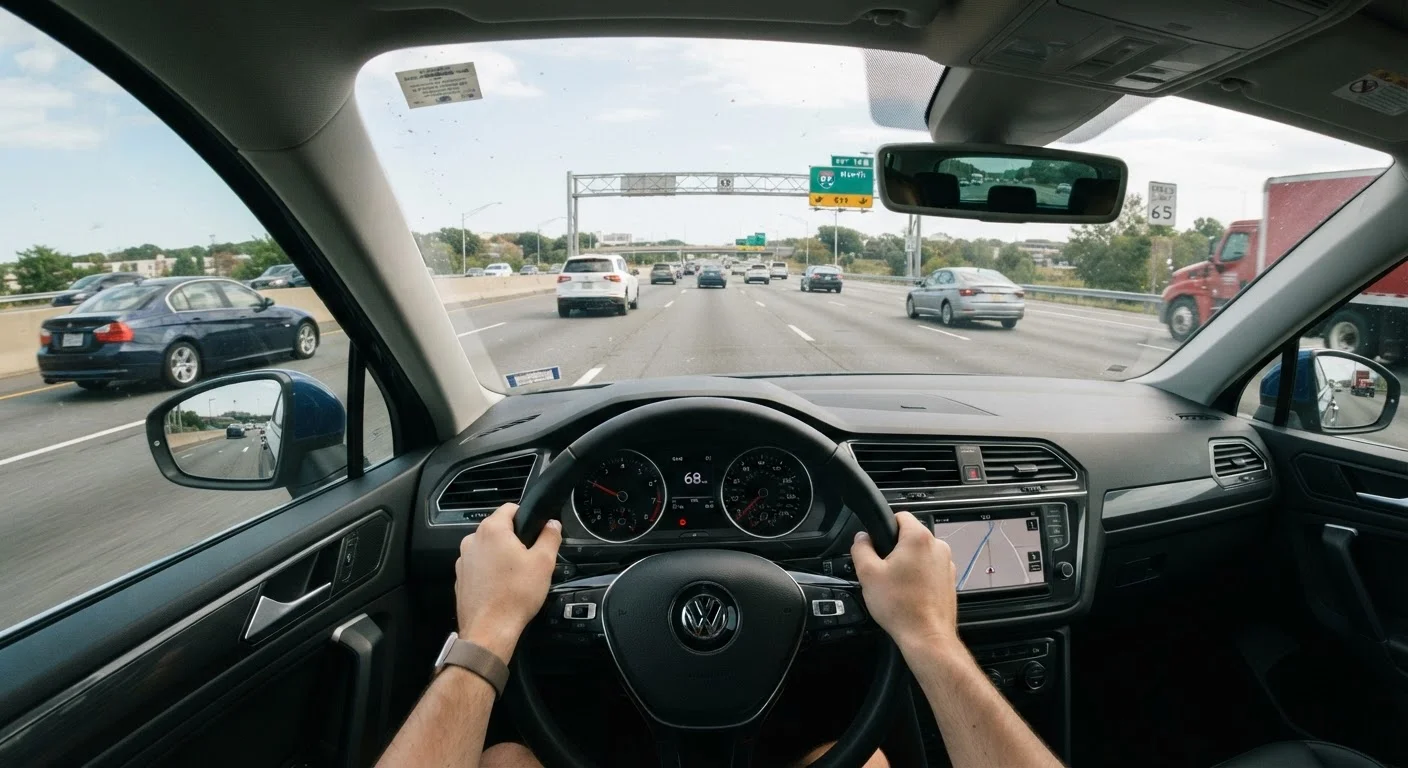
Key Takeaways
Blind Spot
A blind spot is any area around your vehicle that cannot be seen through your mirrors or your normal forward line of sight. These zones exist on both sides of the car, typically just behind and to the sides of the rear doors. A vehicle or pedestrian in your blind spot is effectively invisible to you unless you physically turn to look.
Blind spot size varies by vehicle type: SUVs, trucks, and vans have significantly larger blind zones than sedans due to body height, pillar width, and rear window geometry.
Why Mirrors Only Tell Part of the Story
Most drivers trust their mirrors more than they should. Mirrors are invaluable tools, but they cover a finite field of view - and the zones they miss are predictable, consistent, and dangerous. Understanding this gap is foundational to defensive driving.
A standard rearview mirror covers the area directly behind your vehicle. Side mirrors extend coverage further to each flank, but the angles they capture depend entirely on how they're set. The critical problem: even optimally adjusted mirrors leave two lateral zones uncovered - typically spanning from about the rear passenger door to just behind the rear bumper on each side.
At highway speeds, a motorcycle or compact car traveling in one of those zones can go from invisible to directly beside you in under two seconds. At that point, a lane change becomes a collision.
Blind Spots Vary Significantly by Vehicle Type
The physical size and shape of a vehicle's blind zones differ based on body style, seating height, pillar width, and mirror size. A compact sedan and a full-size pickup truck have very different blind spot profiles. When you drive an unfamiliar or rental vehicle, take a moment before moving to understand where the coverage gaps fall. This is especially important when driving a larger vehicle than you're accustomed to.
For a comprehensive look at how blind spots vary across different vehicle types on the road - including large trucks and motorcycles - see our guide on sharing the road with motorcycles, cyclists, and large trucks.
How to Set Your Mirrors for Maximum Coverage
One of the most common mirror mistakes American drivers make is positioning their side mirrors to show too much of their own car. It feels reassuring - you can see your own vehicle - but that view is wasted real estate. Your car's position is already known to you; what you need is more of the adjacent lane.
The Society of Automotive Engineers published guidance recommending that drivers angle side mirrors outward until their own vehicle body just barely disappears from view. This dramatically expands the lateral coverage of each mirror, narrowing the uncovered blind zone. The technique won't eliminate it entirely, but it shrinks the danger window.
Rearview mirror adjustment is simpler: it should frame the entire rear window. If your head has to move to see the full rear window, reposition the mirror - not your body.
Adjust Mirrors From Your Actual Driving Position
Always set your mirrors after you've settled into your normal driving posture - seat height, distance from the wheel, and recline angle all affect what the mirrors show. Adjusting them while sitting in an atypical position means your coverage will shift once you're actually on the road. Make this a consistent habit before every drive.
Before each drive, sit in your normal driving position before adjusting mirrors. Adjusting them while parked in an unusual posture means your road coverage will be off once you're actually moving. A pre-trip mirror check is part of the pre-trip safety walkthrough that every driver should build into their routine.
The Shoulder Check: Why It's Still Non-Negotiable
No mirror configuration eliminates blind spots entirely. This is why a physical head-check - commonly called a shoulder check - remains essential before every lane change, regardless of what your mirrors show.
A shoulder check involves briefly turning your head in the direction you intend to move and visually scanning the lane beside you. It takes less than two seconds. It covers the zone that mirrors structurally cannot. Yet research consistently shows that many drivers skip or shorten this step, particularly on familiar roads where routine breeds complacency.
The sequence matters: signal, check mirrors, perform the shoulder check, then move. Skipping the signal defeats the purpose of the check by failing to warn other drivers of your intent. And moving before the shoulder check is complete means acting on incomplete information.
~840,000
Annual U.S. crashes attributed to blind spot-related factors
The National Highway Traffic Safety Administration has associated hundreds of thousands of annual lane-change and merging crashes with failure to detect vehicles in blind zones.
2 seconds
Time a shoulder check takes to cover a blind zone
A brief head-check before a lane change takes roughly two seconds and covers the lateral zone that side mirrors structurally cannot capture.
~10 feet
Rear blind zone depth on many full-size trucks
The NHTSA has noted that rear blind zones on trucks and SUVs can extend ten feet or more behind the rear bumper, underscoring the risk to pedestrians and cyclists.
Blind spots disproportionately endanger motorcyclists and cyclists. Because of their smaller profile, they can be fully concealed within a blind zone while a full-size vehicle would be partially visible. Developing consistent shoulder check habits protects exactly the road users who are hardest to see - and this connects directly to the wider challenge of sharing the road with vulnerable road users.
Technology Assists - But Doesn't Replace - Awareness
Blind spot monitoring (BSM) systems, now standard or available on a wide range of vehicles, use radar or ultrasonic sensors to detect vehicles in adjacent lanes. When a vehicle enters the monitored zone, a visual alert - typically an icon in or near the side mirror - illuminates. Some systems also add an audible or haptic warning if you activate the turn signal while a vehicle is detected.
These systems are a meaningful safety supplement, but they have documented limitations. Sensor coverage varies by manufacturer and vehicle. Some systems underperform in heavy rain, snow, or when sensors are obscured by dirt. Most BSM systems are designed around other vehicles, and their detection reliability for cyclists and motorcycles is lower. Reaction time is also a factor: a warning that appears as you're already steering into the lane arrives too late.
Treat BSM as an additional layer of confirmation - not a substitute for mirror use and shoulder checks. When driving at night, reduced ambient contrast can make spotting objects in mirrors harder, making both BSM and diligent head-checks even more important.
The most reliable blind spot detection system remains an alert, properly positioned driver who has built consistent checking habits and understands where the danger zones are before they ever start the car. Safe lane changes are a skill - and like all driving skills, they stay sharp only through deliberate practice.