

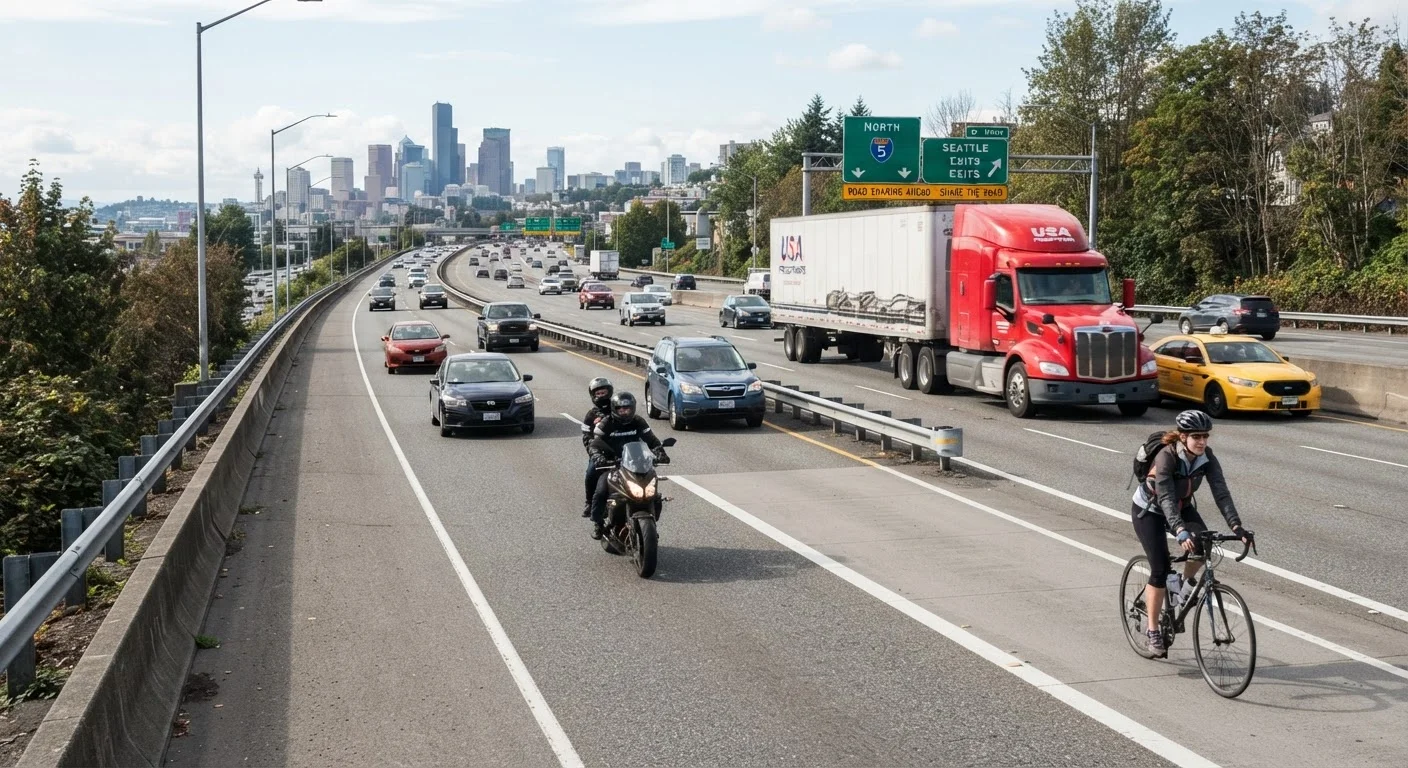
Key Takeaways
Why Different Vehicles Require Different Awareness
Most drivers develop habits calibrated around other passenger cars. But U.S. roads are shared with motorcycles, bicycles, and commercial trucks - each operating under different physics, different legal rules, and vastly different vulnerability profiles. A strategy that works fine when following another sedan can prove dangerous next to a fully loaded 18-wheeler or a cyclist navigating a narrow shoulder.
According to the Federal Highway Administration, crashes involving multiple vehicle types are disproportionately fatal for the smaller or more exposed road user. That asymmetry is exactly why car drivers carry a practical responsibility to understand the limitations and blind spots of every road user around them - not just their own. The tips below address the three categories that demand the most adjustment: motorcycles, cyclists, and large commercial trucks.
Before heading out, a structured pre-drive routine can set the right mindset. See the pre-trip safety walkthrough for a mirror and visibility checklist worth building into every drive.
Understand Where Motorcycles Can Disappear from View
A motorcycle occupies roughly one-quarter the visual footprint of a passenger car. In traffic, that narrow profile means a rider can sit entirely in your blind spot or be lost against a busy visual background. The challenge is compounded by the fact that many drivers instinctively scan for car-sized objects when checking mirrors and intersections.
Two specific habits reduce risk significantly:
- Double-check at intersections. A substantial share of motorcycle crashes involve another driver turning left across the rider's path - a scenario almost always linked to the driver not seeing the motorcycle approaching, not failing to look.
- Watch for speed changes, not just position. Motorcyclists often slow by rolling off the throttle rather than applying the brake, meaning brake lights may not illuminate even as the bike decelerates. Leave extra following distance accordingly.
Motorcyclists also move within their lane - a practice called lane positioning - to improve their visibility and avoid road debris. This is intentional and legal, not erratic driving. Do not interpret it as an invitation to share the lane.
A motorcycle's narrow profile can vanish entirely in the same blind spot that might show a portion of a car.
Give Cyclists the Legal Clearance - and Then Some
As of this writing, the majority of U.S. states have enacted laws requiring drivers to maintain at least three feet of lateral clearance when passing a cyclist. Some states mandate four feet or require moving fully into the adjacent lane when space allows. Regardless of local specifics, the underlying principle is consistent: the margin cyclists need to remain stable is larger than most drivers estimate at speed.
Key considerations when sharing roadways with cyclists:
- Anticipate wobble and obstacle avoidance. A cyclist hitting a pothole, a storm grate, or a patch of gravel may swerve suddenly into the travel lane. Adequate passing clearance is the only buffer you have.
- Check before opening your door. Dooring - opening a parked car door into a cyclist's path - is a leading cause of urban cycling injuries. Before exiting a parked vehicle, check your side mirror and physically look back.
- Yield at driveways and right turns. Cyclists traveling straight through an intersection or driveway have right-of-way in most contexts. Cutting across a bike lane to turn right without checking is one of the most common driver errors in urban environments.
For a broader look at pedestrian and vulnerable road user rights, the school zone and crosswalk rules guide covers the legal framework most drivers encounter daily.
Most states legally require at least three feet of clearance when passing a cyclist - often more than drivers instinctively allow.
Know a Large Truck's Four Blind Spots
Commercial trucks - semis, tankers, flatbeds - have four distinct no-zones where drivers of other vehicles simply cannot be seen by the truck operator. The Federal Motor Carrier Safety Administration identifies these as:
- Directly in front (approximately 20 feet ahead of the cab)
- Directly behind (approximately 30 feet behind the trailer)
- The right side (spanning multiple lanes diagonally from the cab)
- The left side (a narrower but still significant zone alongside the cab)
A useful practical rule: if you cannot see the truck driver's face in their side mirror, they cannot see you. When passing a truck, move through quickly and don't linger alongside the cab or trailer. Equally important - never cut in front of a large truck immediately after passing. A fully loaded semi can weigh up to 80,000 pounds and may need the length of two football fields to stop at highway speeds.
If you can't see the truck driver's face in their mirror, you are invisible to them - a critical rule for highway positioning.
Account for Trucks' Extended Stopping and Turning Distances
Beyond blind spots, large trucks behave differently in two ways that catch passenger car drivers off guard: stopping distance and turning radius.
Stopping distance: Loaded commercial trucks traveling at 65 mph require significantly longer stopping distances than passenger cars under similar conditions - sometimes double or more. When you merge in front of a truck or slow suddenly, the truck driver has far less ability to respond than a car driver would. Tailgating statistics and stopping distance physics are detailed in the tailgating dangers guide.
Wide right turns: Large trucks routinely need to swing left before turning right to complete the arc. A car pulling up along the right side of a truck preparing to turn right can be trapped in the squeeze between the truck and the curb - a situation truck drivers call the right-turn squeeze. Never try to pass a truck on the right when the truck is approaching an intersection.
A loaded semi at highway speed may need the length of two football fields to stop - never cut in front and slow down abruptly.
Adjust Following Distance Based on Vehicle Type
The standard three-second following distance was developed primarily as a car-to-car guideline. Around other vehicle types, that gap requires adjustment:
- Behind motorcycles: Increase to at least four seconds. Riders can decelerate faster than cars and may not activate brake lights during throttle-off slowdowns.
- Behind large trucks: Increase to six or more seconds. This extends your forward visibility (you can see around the truck) and gives you time to react if the truck's cargo shifts or a tire blows.
- Near cyclists: Following distance is less relevant than lateral clearance, but slowing significantly before passing - especially on narrow roads - gives everyone more margin.
These aren't arbitrary suggestions - they're calibrated to the actual physics of how quickly each vehicle type can change speed and direction. For a refresher on how merging and lane changes interact with following distance, the merging and right-of-way guide addresses the most commonly misapplied traffic rules in these situations.
Behind a large truck, a six-second following gap improves both your visibility ahead and your emergency reaction time.
Manage Behavior at Intersections and Lane Changes
Intersections are where road-sharing errors most often become crashes. Several habits apply specifically when smaller or less-protected road users are present:
- Scan for motorcycles and cyclists before every turn. Look twice in any direction a two-wheeled road user might be approaching. The second look accounts for the brain's tendency to miss what it isn't specifically searching for - a well-documented perceptual phenomenon often called inattentional blindness.
- Signal lane changes earlier than usual near trucks. Give truck drivers maximum warning time. Their mirrors cover wider arcs but update more slowly than the continuous peripheral vision a car driver uses.
- Never lane-change between a cyclist and the curb. Even on wide roads, cyclists may be using what appears to be an open lane. Check the bike lane and shoulder before drifting right.
Understanding right-of-way rules thoroughly is essential context here. The right-of-way concepts guide breaks down where drivers most commonly misread priority - particularly at four-way stops and unmarked intersections where motorcycles and cyclists are frequently involved.
Looking twice in each direction at intersections accounts for the brain's documented tendency to miss what it isn't searching for.
Putting It All Together on the Road
Safe road-sharing isn't about special consideration for one group - it's about recognizing that the same speed and following distance that feels comfortable in standard traffic can be genuinely dangerous next to a motorcycle, a cyclist, or a fully loaded truck. The three-second following rule most drivers know was designed for car-to-car distances; following distance science makes a strong case for extending that gap considerably around heavy vehicles.
Blind spot awareness compounds every scenario covered here. Whether you're passing a cyclist or changing lanes near a semi, understanding where your mirrors fail you is foundational. The blind spot awareness guide explains exactly where those gaps exist in most passenger vehicles and how to check them correctly.
Build a Habit of Vehicle-Specific Scanning
Before changing lanes or turning, mentally note what type of road user might be in your path - not just whether any vehicle is present. Motorcycles require a second look toward the lane's center; cyclists require a glance toward the right shoulder; trucks require a check that you're fully clear of their no-zone before moving. This small mental checklist takes less than two seconds and addresses the most common cause of multi-vehicle crashes: drivers not seeing what they weren't looking for.
Night conditions amplify every risk outlined in this article. Motorcycles and cyclists are dramatically harder to see after dark, and truck stopping distances don't improve in low-light conditions. Night driving habits worth adopting are covered in detail in our companion guide.