

Key Takeaways
Tailgating
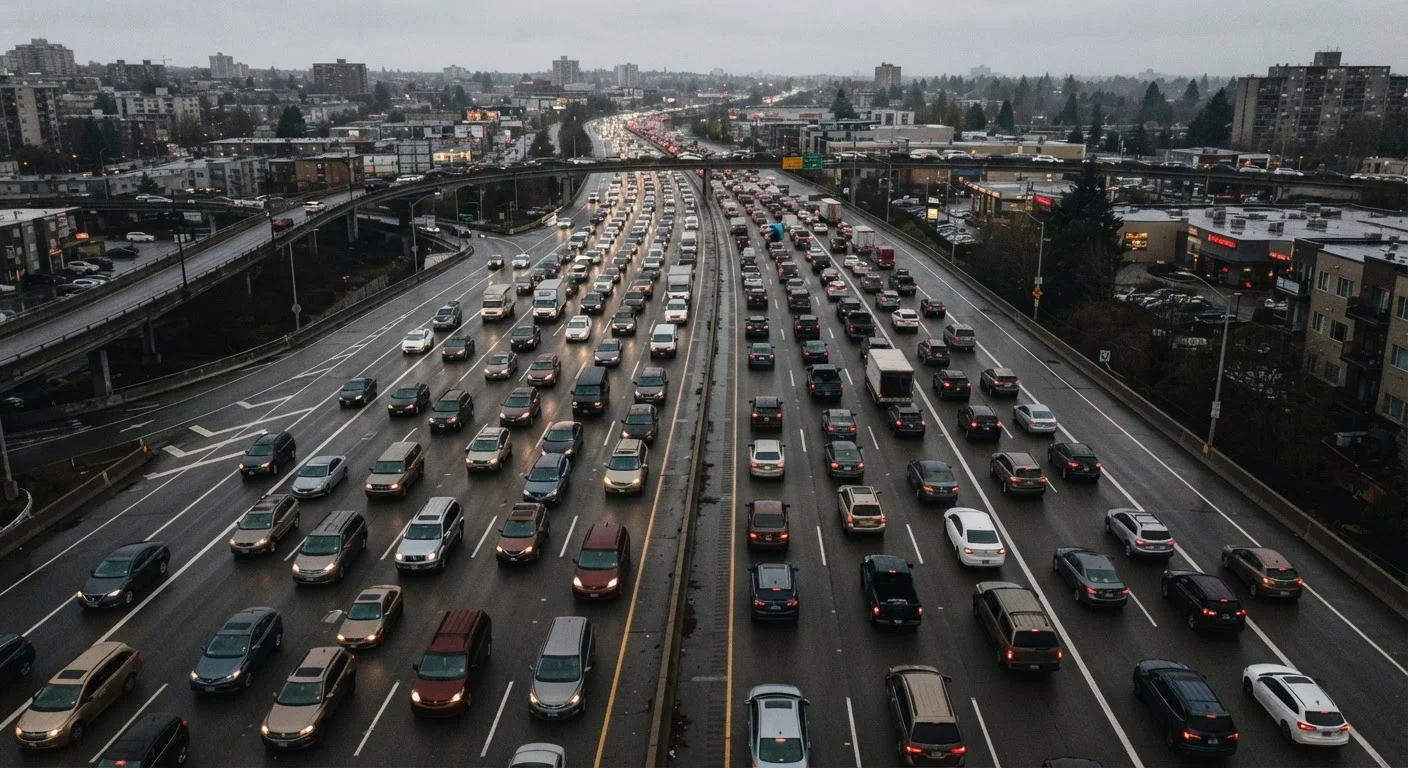
Tailgating means following another vehicle more closely than is safe given your speed, road conditions, and reaction time. It is one of the most common forms of aggressive driving and a leading cause of rear-end collisions. The danger is rooted in physics: the faster you travel, the more distance your vehicle needs to come to a full stop - and most drivers significantly underestimate that distance.
The NHTSA classifies following-too-closely as a driver-related critical reason in rear-end crash scenarios. Stopping distance is the sum of reaction distance (distance traveled while a driver perceives and responds) and braking distance (distance to halt the vehicle), both of which increase non-linearly with speed.
The Physics That Make Tailgating So Dangerous
Most drivers believe they can stop quickly if something goes wrong ahead of them. That confidence is almost always misplaced. Stopping a vehicle involves two distinct phases: the reaction phase, during which your brain processes the hazard and your foot moves to the brake pedal, and the braking phase, during which the vehicle decelerates to a halt. Both consume more distance than most people expect.
At 60 mph, a car travels roughly 88 feet per second. With an average human reaction time of 1.5 seconds, a driver covers approximately 132 feet before the brakes even engage - that's more than four car lengths. Add braking distance, and total stopping distance under ideal conditions typically exceeds 240 feet. In adverse weather or with worn brake pads, that figure climbs sharply.
Tailgating eliminates the margin that those numbers require. A driver following just one or two car lengths behind at freeway speeds has, in practical terms, almost no chance of stopping in time if the vehicle ahead brakes suddenly.
~29%
Share of U.S. crashes that are rear-end collisions
According to NHTSA data, rear-end crashes consistently represent one of the largest categories of collision type on American roads, with following-too-closely cited as a key contributing factor.
132 ft
Distance traveled during reaction time at 60 mph
With an average reaction time of 1.5 seconds, a vehicle traveling at 60 mph covers approximately 132 feet before the driver's foot even reaches the brake pedal.
4-10×
Increase in stopping distance on ice vs. dry pavement
Transportation safety research indicates that ice and packed snow can extend stopping distances to four to ten times those recorded on dry asphalt at the same speed.
The Two-Second Rule - and When It Falls Short
The two-second following rule - choosing a fixed point, then ensuring two full seconds pass between the lead vehicle and yours reaching it - is widely taught as a baseline. It provides a reasonable buffer at lower urban speeds, but it is frequently misapplied at highway speeds, where it offers inadequate margin.
Traffic safety professionals often recommend extending the gap to three seconds under normal highway conditions and four or more seconds when visibility is reduced, road surfaces are wet or icy, you are driving a heavier vehicle, or you notice your tires or brakes are not performing optimally. For large commercial trucks, which require far greater stopping distances than passenger cars, following distance is even more critical - something worth considering when sharing the road. See our guide to sharing the road with large trucks for more on how stopping distance varies by vehicle type.
Use a Fixed Marker to Check Your Gap
Pick a stationary roadside object - a sign, a shadow line, a bridge - and count the seconds from when the vehicle ahead passes it to when you do. If you reach three full seconds before passing the marker, your following distance is appropriate for normal highway conditions. If you reach the marker before counting to three, ease off the accelerator gradually until the gap opens up.
Why Drivers Tailgate - and Why the Reasoning Doesn't Hold Up
Tailgating rarely happens by conscious, calculated decision. More often, it's a product of impatience, distraction, or a genuine mismatch between how drivers perceive speed and how much danger they are actually in. Some drivers follow closely out of frustration with a slow vehicle ahead. Others simply fail to notice how much their following distance has compressed as traffic speeds up.
A common belief is that staying close to the car ahead offers an advantage in traffic flow. In reality, traffic science shows the opposite: aggressive following distance contributes to phantom traffic jams, where minor braking events ripple backward through a chain of closely-spaced vehicles and slow everyone down. The perceived time benefit of tailgating on a typical trip is minimal - often a matter of seconds - while the risk of a rear-end collision is substantially elevated.
The same pattern of overconfidence appears across other speed-related behaviors. Our analysis of speeding myths explores how drivers systematically underestimate the consequences of small increases in speed. Tailgating and speeding often occur together, compounding the danger significantly.
Conditions That Make Tailgating Even More Hazardous
Stopping distance is calculated under ideal circumstances - a fully alert driver, dry pavement, properly inflated tires, and well-maintained brakes. Real-world conditions frequently deviate from that baseline, sometimes dramatically.
- Wet pavement: Water reduces tire-to-road friction, increasing braking distance by 50% or more depending on speed and tire condition.
- Ice and snow: Stopping distances can be five to ten times longer than on dry asphalt, meaning a three-second gap may be dangerously insufficient.
- Fatigued or distracted driving: Reaction time increases substantially. A driver whose attention is divided by a phone or conversation will travel significantly farther before braking begins. For more on how phone use affects driver response, see our piece on hands-free vs. handheld phone use.
- Night driving: Reduced visibility narrows the time available to perceive a hazard. Night driving habits that account for extended following distance are an important part of safer after-dark travel.
- Worn tires or brakes: Degraded components directly extend stopping distance, sometimes significantly, without any visible warning to the driver.
Each of these factors erodes the margin that a safe following distance is designed to preserve. When multiple factors are present simultaneously - say, night driving in the rain with a tired driver - the combination can be severe.
Tailgating as Part of a Broader Safety Picture
Following distance is one element of a larger set of defensive driving habits. Defensive driving is fundamentally about building buffers - of space, time, and attention - that allow a driver to respond to the unexpected rather than be controlled by it. Maintaining adequate following distance is one of the most direct expressions of that principle.
Aggressive following behavior also tends to cluster with other risky patterns: frequent lane changes, elevated speeds, and short tempers in traffic. Our overview of road rage vs. assertive driving addresses how impatience behind the wheel can escalate from a safety issue into something more serious.
Keeping a vehicle in sound mechanical condition also plays a supporting role. Brakes, tires, and suspension components all influence stopping performance. General guidance on vehicle upkeep is available through our car maintenance resources.
This article is for general informational and educational purposes. Traffic laws, enforcement practices, and specific stopping distance figures vary by state, vehicle type, and conditions. Drivers should consult applicable state laws and qualified professionals for guidance specific to their situation.