

Key Takeaways
Option A
Assertive Driving
Confident, deliberate, and rule-governed road behavior.
Best for: Drivers who want to navigate traffic efficiently while remaining safe, legal, and respectful of others.
Option B
Road Rage
Emotionally driven aggression that endangers everyone on the road.
Best for: No one - road rage is a dangerous behavioral pattern that increases crash risk and carries serious legal consequences.
If you want to move through traffic efficiently and confidently
Assertive Driving
Assertive drivers communicate intent clearly, maintain appropriate speeds, and make decisive lane choices - all of which reduce confusion and the risk of collision.
If you find yourself frequently honking, tailgating, or feeling intense anger at other drivers
Neither - seek de-escalation techniques
These are early warning signs of road rage. Behavioral strategies, stress management, and possibly professional support can help break the pattern before it causes harm.
If you encounter an aggressive driver on the road
Assertive Driving
Stay calm, increase following distance, avoid engagement, and contact law enforcement if you feel threatened. Do not match the aggressor's behavior.
Two Very Different Things That Look Similar from the Outside
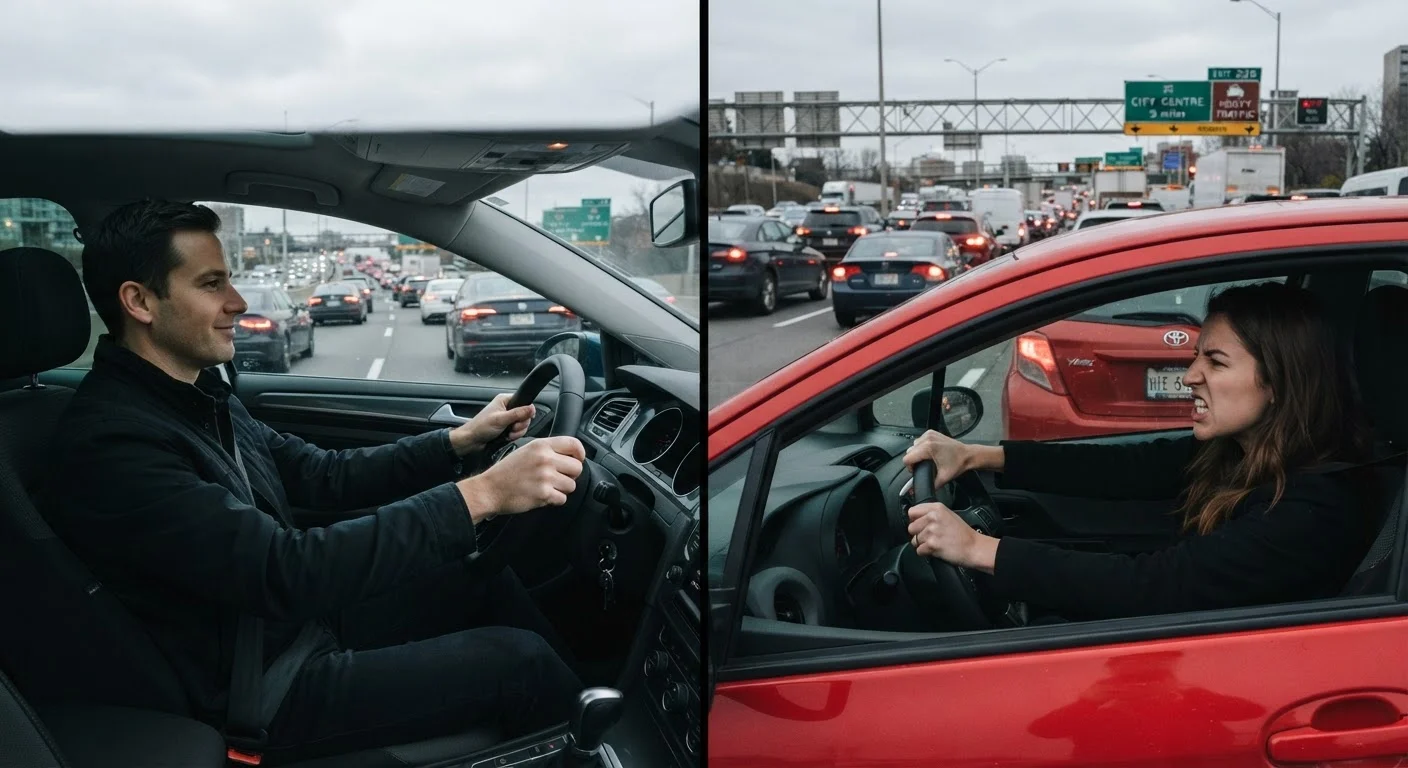
From the passenger seat - or a dashcam clip - assertive driving and road rage can appear superficially similar. Both may involve a driver moving with purpose, responding decisively to other vehicles, or using the horn. But the internal logic and the outcomes are fundamentally different.
Assertive driving is characterized by intentional, rule-governed decision-making. An assertive driver merges confidently when a gap opens, holds their lane position, uses signals consistently, and communicates with other drivers through legal, conventional means. This kind of driving reduces hesitation - a genuine hazard on fast-moving roads where delayed decisions can trigger chain reactions. For a deeper look at how right-of-way and merging decisions factor in, see our guide on merging and right-of-way.
Road rage, by contrast, is driven by emotion rather than strategy. It typically escalates in response to a perceived slight - a cut-off, a slow driver in the passing lane, a missed signal. The behavior then shifts from transportation to confrontation: aggressive tailgating, brake-checking, hostile gesturing, or even deliberate vehicle-to-vehicle contact. The National Highway Traffic Safety Administration (NHTSA) has identified aggressive driving as a contributing factor in a significant share of serious traffic crashes.
| Criterion | Assertive Driving | Road Rage |
|---|---|---|
| Primary driver | Safety and traffic efficiency | Anger or perceived disrespect |
| Decision basis | Traffic rules and situational judgment | Emotional reaction |
| Horn use | Brief alert for safety | Sustained intimidation |
| Following distance | Safe distance for speed and conditions | Intentionally close to pressure driver ahead |
| Lane changes | Deliberate, signaled, gap-based | Cutting off to punish or intimidate |
| Legal status | Fully legal | Often criminal in U.S. jurisdictions |
| Crash risk | Reduced through clear intent | Significantly elevated |
The Behavioral Dividing Line
The clearest way to identify which side of the line a behavior falls on is to ask: Is this decision serving my safety and forward progress, or is it serving my anger?
Consider tailgating. An assertive driver maintains a following distance that reflects current speed and road conditions - close enough to move with traffic, far enough to stop safely. A road-rage driver closes the gap deliberately to pressure the vehicle ahead, which dramatically increases rear-end crash risk. The physics of stopping distance make this far more dangerous than most people intuitively grasp.
Similarly, using the horn has a legitimate assertive purpose - a brief tap to alert a distracted driver who's drifting. Sustained horn use, aggressive revving, or flashing high beams repeatedly to intimidate are road-rage behaviors that serve no safety function and can legally constitute aggressive driving or harassment in many states.
80%
Drivers who admit to road rage
According to AAA Foundation for Traffic Safety research, roughly 8 in 10 U.S. drivers reported engaging in at least one aggressive driving behavior in the past year.
~56%
Aggressive driving's share in fatal crashes
NHTSA data has attributed aggressive driving behaviors as a contributing factor in more than half of all fatal traffic crashes over multiple studied years.
2x
Elevated crash risk when emotionally impaired
Driver behavior studies have found that emotional distress approximately doubles crash involvement risk, comparable in magnitude to other recognized impairments.
Other common road-rage behaviors that cross legal lines in most U.S. jurisdictions include: cutting off another driver intentionally, blocking lane changes, exiting a vehicle to confront another driver, and making threatening gestures. These acts can result in citations, license suspension, or criminal charges depending on severity.
Why Drivers Cross the Line - and How to Stay on the Right Side
Road rage rarely starts with rage. It typically begins with stress, time pressure, fatigue, or a sense of unfairness - and then builds when something on the road acts as a trigger. Research in driver behavior consistently finds that anonymity (the feeling that others can't identify you in a vehicle) and perceived disrespect are among the strongest psychological accelerants of aggressive behavior.
Practical strategies for staying on the assertive side of the line include:
- Check your emotional baseline before driving. If you're already frustrated or rushed, you're more likely to interpret neutral driving behavior as hostile.
- Build in time. Time pressure is one of the most reliable predictors of aggressive driving. Leaving earlier removes the urgency that turns minor delays into provocations.
- Create physical space. When you sense tension rising, increasing your following distance gives you both reaction time and emotional buffer.
- Avoid engagement. Do not make eye contact, gesture, or respond verbally to an aggressive driver. Engagement escalates; distance de-escalates.
- Understand the other driver's anonymity. The person who cut you off may be dealing with an emergency you're unaware of - or simply made a driving error, as every driver does.
For a broader framework on anticipating and avoiding hazards before they become confrontations, defensive driving principles offer proven techniques that complement assertive habits.
Road Rage Can Have Serious Legal Consequences
In many U.S. states, aggressive driving is a chargeable offense distinct from standard traffic violations, and road rage that results in physical contact or threats can escalate to assault or reckless endangerment charges. Some jurisdictions have enacted specific road-rage statutes with mandatory penalties. If you witness or are involved in a serious incident, contacting local law enforcement is always appropriate.
What to Do If You're the Target
Encountering a road-rage driver puts you in a reactive position, and the instinct to defend yourself can be powerful. Resisting it is critical. Matching aggression with aggression reliably makes the situation more dangerous, not less.
If another driver is behaving aggressively toward you:
- Do not brake-check, block, or retaliate in any way.
- Increase your following distance or change lanes to create separation.
- Avoid eye contact - many incidents escalate when the aggrieved driver feels acknowledged and challenged.
- If the behavior is threatening or sustained, drive to a populated, well-lit location such as a police station, fire station, or busy retail area. Do not drive home.
- Contact law enforcement when it's safe to do so. If you have a dashcam, note the time and location; footage can be valuable for a report.
Staying calm is not passivity - it is the assertive, strategic response to an irrational situation. The goal is to get where you're going safely, not to be right.