

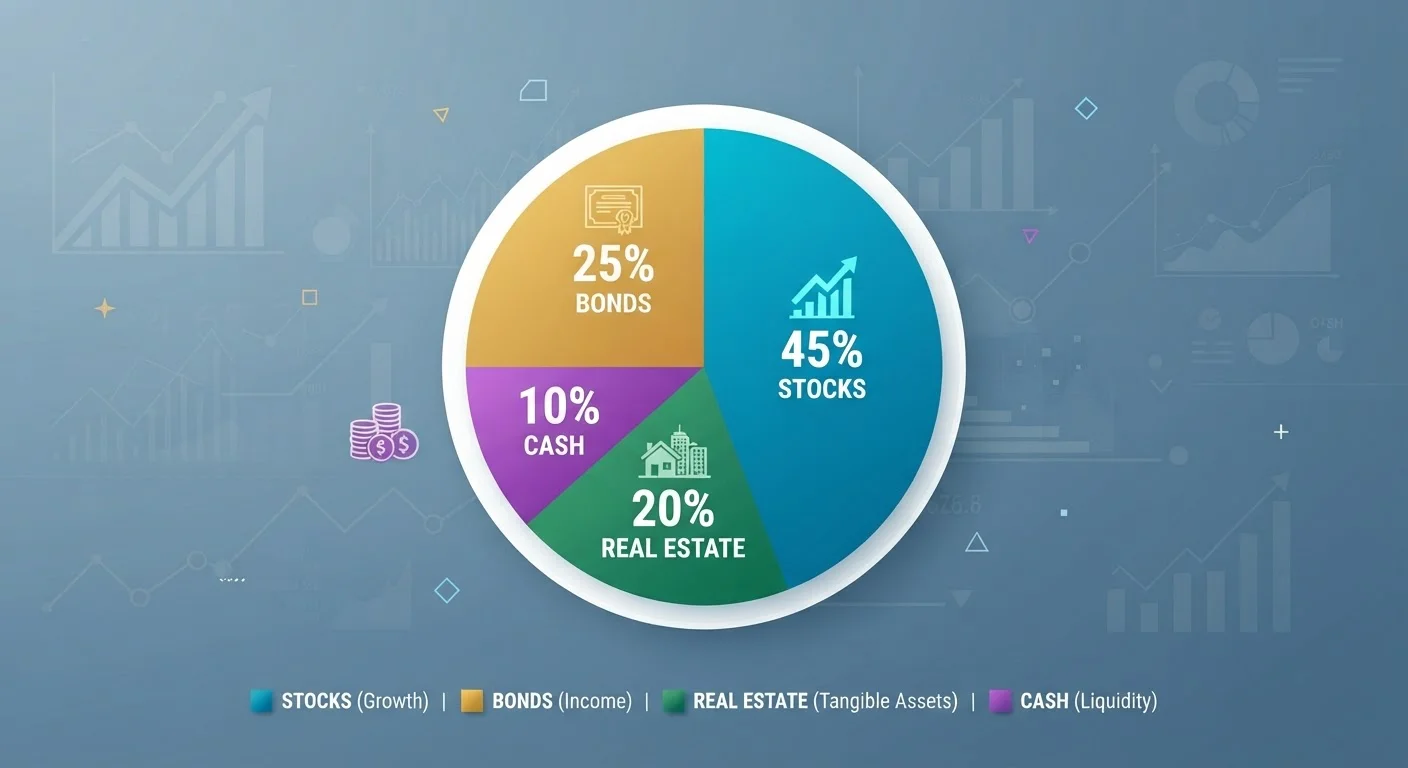
Key Takeaways
Diversification
Diversification is the practice of spreading money across different types of investments so that a loss in one area doesn't wipe out your entire portfolio. The core idea is that different assets often respond differently to the same economic conditions. By holding a mix, you reduce the chance that any single bad outcome will severely damage your overall financial position.
In portfolio theory, diversification works by combining assets with low or negative correlations - meaning when one falls in value, another may hold steady or rise, partially offsetting the loss.
Why Concentration Is the Real Risk
Most investors instinctively understand that putting all their money into a single stock is risky. But concentration risk shows up in subtler ways too - holding ten stocks all in the same industry, or keeping the bulk of savings in an employer's stock. When one sector stumbles, a concentrated portfolio stumbles with it.
Diversification addresses this by ensuring no single investment, company, or sector has an outsized influence on your financial outcome. It doesn't aim to maximize gains - it aims to prevent unnecessary, concentrated losses. That distinction matters. A well-diversified portfolio may occasionally underperform a lucky concentrated bet, but over time it is designed to deliver more consistent, sustainable results.
For a broader foundation on investing concepts, the Savings and Investing Terms Every Beginner Should Know covers key vocabulary that makes these ideas easier to navigate.
~20-30
Stocks needed to capture most diversification benefit
Academic research in portfolio theory, including foundational work by Edwin Elton and Martin Gruber, has long suggested that most company-specific risk is eliminated within a portfolio of roughly 20-30 randomly selected stocks.
~0.03%-0.20%
Typical annual expense ratio for broad index funds
According to Morningstar's annual fee study, the asset-weighted average expense ratio for passive index funds has declined significantly over the past two decades, making low-cost diversification more accessible than ever.
The Main Dimensions of Diversification
Effective diversification typically works across several layers, not just one.
- Asset classes: Stocks, bonds, cash equivalents, and real assets like real estate tend to respond differently to interest rate changes, inflation, and economic cycles. Holding a mix softens the blow when one category declines.
- Sectors and industries: Within stocks, spreading across technology, healthcare, consumer goods, energy, and financials prevents a single industry downturn from dominating your losses.
- Geography: U.S. markets and international markets don't always move in lockstep. Adding international exposure introduces different growth drivers and currency dynamics.
- Time horizons: Bonds with different maturities, for example, respond differently to interest rate changes. Mixing short-, medium-, and long-term holdings can reduce interest rate sensitivity.
Understanding how these layers interact connects directly to asset allocation - the strategic decision about how much weight to give each category based on your goals and timeline.
Practical Tools Everyday Investors Use
You don't need to build a complex portfolio from scratch to be diversified. Several widely used investment vehicles do much of the work automatically.
Index funds and ETFs track broad market benchmarks - such as the S&P 500 or the total U.S. bond market - giving investors exposure to hundreds or thousands of securities through a single purchase. Because they don't rely on stock-picking, they also tend to carry lower fees than actively managed alternatives. For a detailed look at the tradeoffs, see how index funds compare to actively managed funds.
Target-date funds automatically adjust their asset mix as a target retirement year approaches - starting stock-heavy and gradually shifting toward bonds. They're a common default in workplace retirement plans and offer built-in diversification without requiring active decisions.
Pairing a diversified investment strategy with consistent contributions over time is a combination many financial educators describe as foundational. Dollar-cost averaging - investing a fixed amount at regular intervals - fits naturally alongside a diversified portfolio strategy.
Start Simple, Then Add Complexity Gradually
Many investors do well with just two or three broad index funds covering U.S. stocks, international stocks, and bonds. Adding more funds only makes sense when it introduces genuinely different exposure - not when it simply duplicates what you already hold. Review your holdings periodically to check for overlapping positions, especially if you invest across multiple accounts.
What Diversification Cannot Do
It's important to be clear about limits. Diversification reduces unsystematic risk - the risk tied to a specific company, sector, or region. It does not eliminate systematic risk, the kind that affects the entire market, such as a global recession or a sharp rise in interest rates. In those environments, most assets can decline at the same time.
Diversification is also not a substitute for the financial groundwork that should precede investing. Before building a portfolio, most financial professionals recommend having an emergency fund, manageable debt, and a clear sense of your goals. The emergency fund vs. investment account question is worth working through before committing capital to markets.
Finally, diversification works best when it reflects your actual risk tolerance and time horizon - not a generic template. A 28-year-old saving for retirement and a 58-year-old approaching it may both hold diversified portfolios, but those portfolios will look very different in structure. Consulting a licensed financial adviser can help you determine an appropriate approach for your specific situation.
This article is for general informational and educational purposes only. It does not constitute personalized financial or investment advice. Please consult a qualified financial professional before making decisions based on your individual circumstances.