

Key Takeaways
Why Label Literacy Is a Practical Skill
Packaged food labels are regulated by the U.S. Food and Drug Administration (FDA) and are required to follow a standardized format. That consistency makes them a reliable tool - once you know how to use them. Yet surveys consistently suggest that many shoppers find labels confusing, are unsure what %DV means, or rely primarily on front-of-package marketing claims to judge a product.
Label literacy is not about becoming obsessive or eliminating any specific food. It is about understanding what you are actually purchasing and consuming, so your choices align with your own health goals and values. As you build this skill, you may also find it easier to spot patterns across your overall diet - something our article on what a balanced plate actually looks like can help you apply practically.
Labels Inform - They Don't Diagnose
Nutrition Facts panels are general education tools, not personalized medical guidance. Individual nutrient needs vary based on age, health status, activity level, and other factors. If you have a specific health condition or dietary concern, consult a registered dietitian or your healthcare provider before making significant changes to your diet.
Good intentions around food can sometimes lead to unintended consequences. For more on that, see our piece on when good nutrition intentions go wrong.
What You Will Need
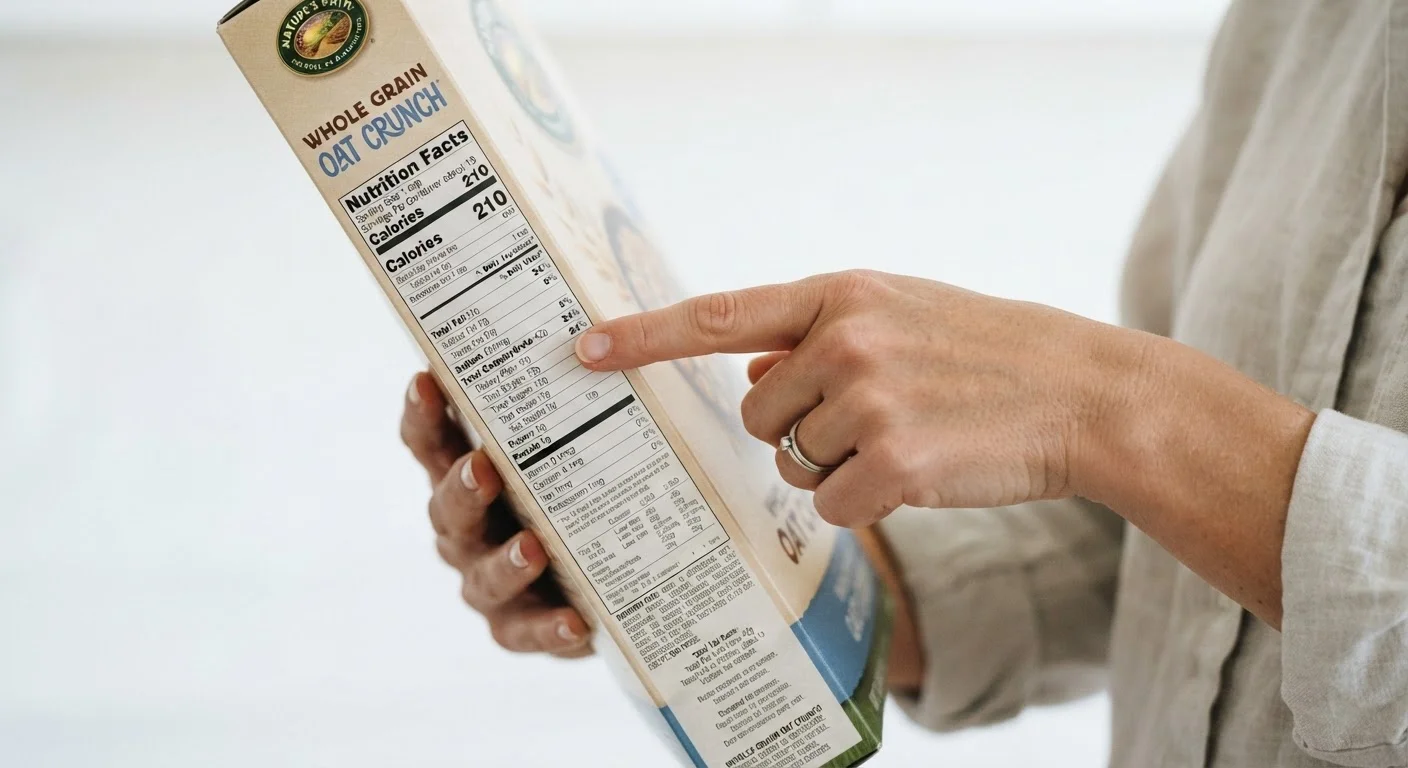
This exercise requires very little. Grab any packaged item from your pantry or refrigerator - a cereal box, a can of beans, a frozen meal, or a snack bag. Almost any product sold in the U.S. is required by law to carry a Nutrition Facts panel.
What you will need
Packaged food product
Provides the Nutrition Facts panel you will practice reading step by step.
FDA's Nutrition Facts Label interactive tool (fda.gov)
A free online reference that explains each section of the label with annotated diagrams.
Step-by-Step: Reading the Label
Work through the label from top to bottom using the steps below. The FDA updated the Nutrition Facts panel format in 2020 to make certain information - particularly added sugars and serving sizes - clearer and more prominent. Most products on store shelves now use this updated format.
Start with the serving size
The very first line below the bold "Nutrition Facts" heading states the serving size and the number of servings per container. Every calorie count, gram, and percentage on the label is calculated for one serving, not the entire package.
Check whether the package contains two, three, or more servings. A bag of chips labeled "150 calories" per serving that contains three servings actually delivers 450 calories if you eat the whole bag. Establishing this baseline prevents the most common label misreading.
Read the calorie count in context
The large, bold calorie number reflects the energy in one serving. Calories are not inherently "good" or "bad" - they are a measure of energy. Context matters: a 250-calorie snack dense with fiber and protein contributes differently to your overall diet than 250 calories of refined sugar.
Rather than fixating solely on calories, use this number as one data point alongside the broader nutrient breakdown below it.
Review the nutrients to limit
The label highlights several nutrients that many Americans tend to consume in excess. These appear near the top of the nutrient list and include:
- Saturated fat - linked in research to cardiovascular risk when consumed in large amounts over time.
- Sodium - excess intake is associated with elevated blood pressure in some individuals.
- Added sugars - the updated Nutrition Facts label (introduced by the FDA in 2020) distinguishes between naturally occurring sugars and sugars added during processing. This distinction matters: added sugar hides in unexpected places like bread, pasta sauce, and salad dressing.
Aiming for lower % Daily Values in these categories is a broadly evidence-supported approach for most people.
Identify the nutrients to get enough of
Below the nutrients to limit, the label lists nutrients that many people fall short on. These include dietary fiber, vitamin D, calcium, iron, and potassium. Higher % Daily Values for these nutrients are generally favorable.
Fiber, in particular, is worth tracking: it supports digestive health and is found in higher amounts in whole, minimally processed foods. For a deeper look at micronutrients, our plain-English guide to vitamins and minerals covers what each one does and where to find it.
Interpret % Daily Value correctly
The % Daily Value (%DV) column tells you what percentage of a recommended daily intake one serving provides, based on a 2,000-calorie reference diet established by the FDA. This reference point does not represent every person's actual needs, but it gives a consistent standard for comparison.
Use %DV to compare similar products - for example, two brands of canned soup - and to assess whether a food is a meaningful source of a given nutrient.
Read the ingredient list
Ingredients are listed in descending order by weight, meaning the first ingredient makes up the largest proportion of the product. If refined flour, sugar, or a partially hydrogenated oil appears in the first two or three positions, that tells you something significant about the product's composition.
Look for recognizable, whole-food ingredients early in the list. Be aware that sugar can appear under many names - corn syrup, dextrose, maltose, evaporated cane juice - each listed separately, which can obscure how much total sugar is present.
Use the 5% and 20% Rule as a Quick Guide
The FDA offers a helpful shortcut: a % Daily Value of 5% or less is generally considered low for a nutrient, while 20% or more is considered high. Use this to quickly assess whether a food is a significant source of, say, sodium or fiber - without needing to memorize every daily target.
Common Pitfalls and How to Avoid Them
Front-of-Package Claims Can Mislead
Terms like "natural," "multigrain," "light," or "made with real fruit" are often marketing language, not regulated nutritional standards. A product labeled "reduced fat" may compensate with added sugar. Always flip the package and read the full Nutrition Facts panel and ingredient list before drawing conclusions.
One of the most frequent mistakes is comparing a high-calorie product with a lower-calorie alternative without checking whether the serving sizes differ. Always normalize your comparison to the same serving size or to the same unit weight (e.g., per 100 grams) when evaluating two products side by side.
It is also worth keeping in mind that nutrition science continues to evolve. What labels can tell you is the composition of a food product; they cannot fully capture how a food functions within your entire dietary pattern or your individual biology. For perspective on how nutritional research should - and should not - be interpreted, see our guide on why nutrition studies seem to flip-flop.
This article is for general informational and educational purposes only and does not constitute medical or dietary advice. Individual nutritional needs vary. Consult a registered dietitian or qualified healthcare professional for guidance tailored to your health situation.