

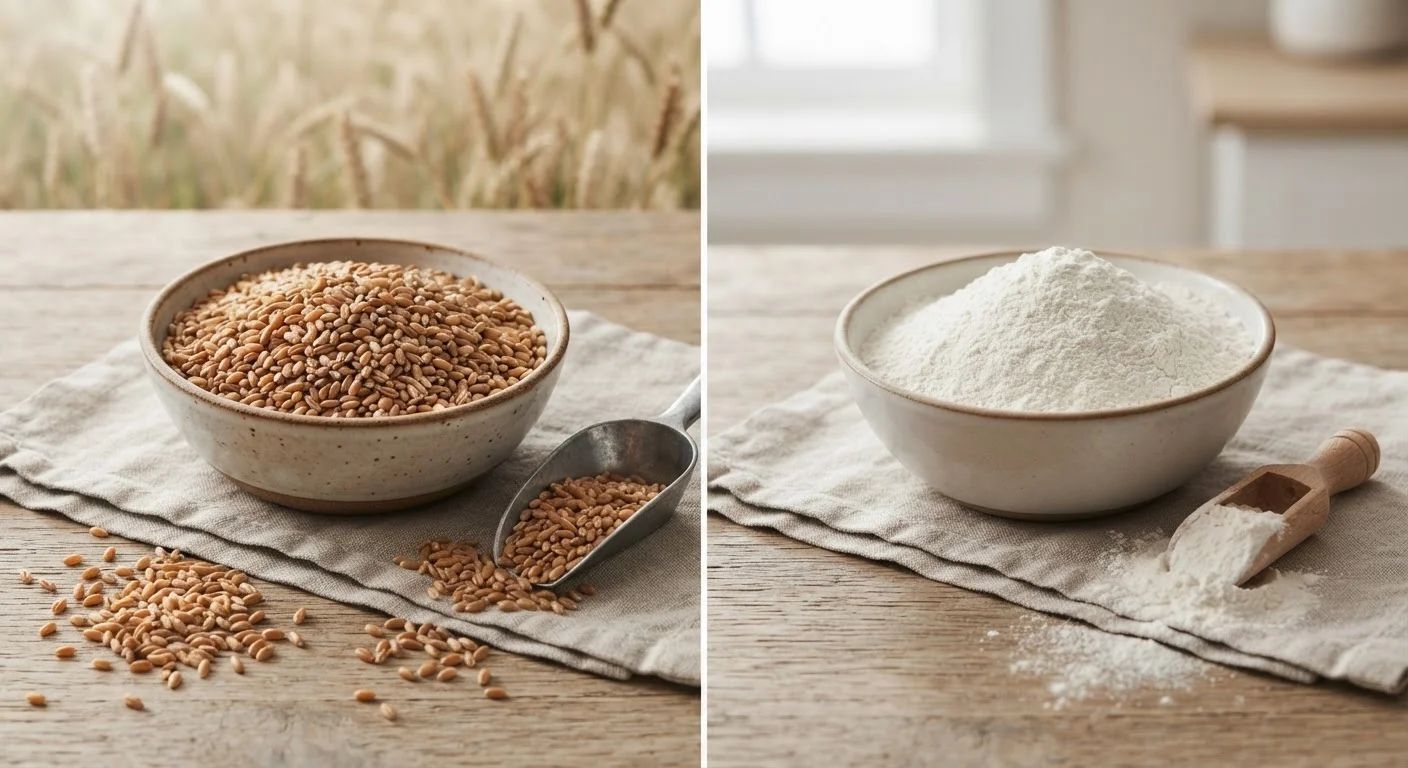
Key Takeaways
Option A
Whole Grains
The nutritionally intact, minimally processed option.
Best for: People seeking more fiber, vitamins, and minerals from everyday grain-based foods.
Option B
Refined Grains
The stripped-down, widely available processed alternative.
Best for: Longer shelf life and softer texture, though with reduced nutritional density.
If you want more fiber and micronutrients in your diet
Whole Grains
Whole grains retain the bran and germ, providing substantially more fiber, B vitamins, and minerals per serving than their refined counterparts.
If shelf life and texture are priorities in cooking or baking
Refined Grains
Removing the oil-rich germ extends shelf life significantly, and the finer texture of refined flour suits many traditional baking applications.
If you are managing blood sugar levels and want to moderate glucose spikes
Whole Grains
The fiber content in whole grains slows digestion and generally produces a more gradual rise in blood glucose compared to refined grains. Speak with your healthcare provider about dietary strategies for blood sugar management.
If you are transitioning away from refined grains gradually
Whole Grains
Blended or partially whole grain products - such as half whole wheat flour - can ease the palate adjustment while improving nutritional quality over time.
What Makes a Grain 'Whole'
A grain kernel in its natural state has three distinct layers: the bran (the fibrous outer coating), the germ (the nutrient-dense embryo), and the endosperm (the starchy inner core). A grain is considered whole when all three components remain intact in their original proportions, whether the grain has been cracked, rolled, or ground into flour.
Common whole grains include oats, brown rice, whole wheat, barley, quinoa, bulgur, and corn. When you buy a product labeled "whole grain," the label should indicate that the grain listed first in the ingredients is in its whole form - though reading the fine print matters. For guidance on decoding ingredient lists and nutrition panels, see our guide to nutrition label literacy.
What Happens During Refining
Refining - typically through milling - strips away the bran and germ, leaving mostly the endosperm. This process was originally developed to extend shelf life and produce lighter, finer-textured flour. The bran's oil and fiber can cause flour to go rancid faster, so removing it made economic and logistical sense for food producers.
The nutritional consequences, however, are substantial. The bran holds most of the grain's dietary fiber, along with antioxidants and certain minerals. The germ is rich in B vitamins (including thiamine, niacin, and folate), vitamin E, and healthy fats. When both are removed, what remains is an energy-dense food with far less nutritional complexity.
| Criterion | Whole Grains | Refined Grains |
|---|---|---|
| Bran retained | Yes | No |
| Germ retained | Yes | No |
| Dietary fiber content | High | Low |
| B vitamins (natural) | Naturally present | Mostly removed; some added back |
| Vitamin E | Present (from germ) | Largely absent |
| Shelf life | Shorter (oils in germ) | Longer |
| Glycemic impact | Generally lower | Generally higher |
| Texture in baking | Denser, earthier | Lighter, finer |
To partially offset these losses, refined grains in the United States are commonly enriched - meaning specific B vitamins (thiamine, riboflavin, niacin, folic acid) and iron are added back. Enrichment has played a meaningful public health role, helping reduce deficiencies like neural tube defects linked to low folate intake. However, enrichment does not restore fiber, and it replaces only a fraction of the micronutrients originally present.
Fiber: The Most Significant Loss
Dietary fiber is perhaps the most important nutrient lost during refining, and it is the one enrichment programs do not replace. A slice of whole wheat bread typically contains two to three times more fiber than a comparable slice of white bread. That difference accumulates meaningfully over a day's worth of meals.
Fiber supports digestive regularity, helps sustain fullness after eating, and plays a role in managing cholesterol levels. Research consistently associates higher fiber intake with reduced risk of cardiovascular disease and type 2 diabetes, among other conditions. The Dietary Guidelines for Americans note that most U.S. adults fall well short of recommended fiber intake - and heavy consumption of refined grains is a contributing factor. For a deeper look at what fiber does in the body, our article on the role of fiber in digestive and long-term health covers both soluble and insoluble types in detail.
~5%
Americans meeting whole grain recommendations
The Dietary Guidelines for Americans Advisory Committee has noted that only a small minority of U.S. adults meet the recommendation to make at least half their grains whole.
2-3×
More fiber in whole vs. refined grain bread
A standard slice of 100% whole wheat bread typically delivers two to three times the dietary fiber of a comparable slice of enriched white bread.
~25%
Reduction in cardiovascular disease risk
A meta-analysis published in the BMJ found that higher whole grain intake was associated with roughly a 20-25% lower risk of cardiovascular disease compared to low intake.
What the Research Actually Shows
Epidemiological studies - those that track dietary patterns across large populations over time - consistently find associations between higher whole grain consumption and lower rates of heart disease, type 2 diabetes, and certain digestive cancers. These associations hold even after adjusting for other lifestyle factors.
It's worth understanding, though, that much of this research is observational. It shows correlation, not definitive causation. People who eat more whole grains also tend to have other health-positive habits, which complicates isolating grain type as the sole driver. Nutrition science in general is subject to this challenge - our article on why nutrition studies seem to flip-flop explains how to read these headlines critically.
Still, public health bodies including the American Heart Association and the Dietary Guidelines Advisory Committee consider the evidence strong enough to recommend making at least half of daily grain servings whole grains.
Not All 'Wheat' Bread Is Whole Grain
Products labeled 'wheat bread' or 'multigrain' are not necessarily made primarily from whole grains. These terms refer to grain type or variety, not to whether the grain is intact. To confirm a product is truly whole grain, look for the word 'whole' before the grain name as the first ingredient on the label - such as 'whole wheat flour' or 'whole oats.' Checking the fiber content per serving on the nutrition facts panel is another useful signal.
This article provides general nutrition information and education and is not a substitute for personalized medical or dietary advice. Consult a qualified healthcare provider or registered dietitian for guidance tailored to your individual health needs.