

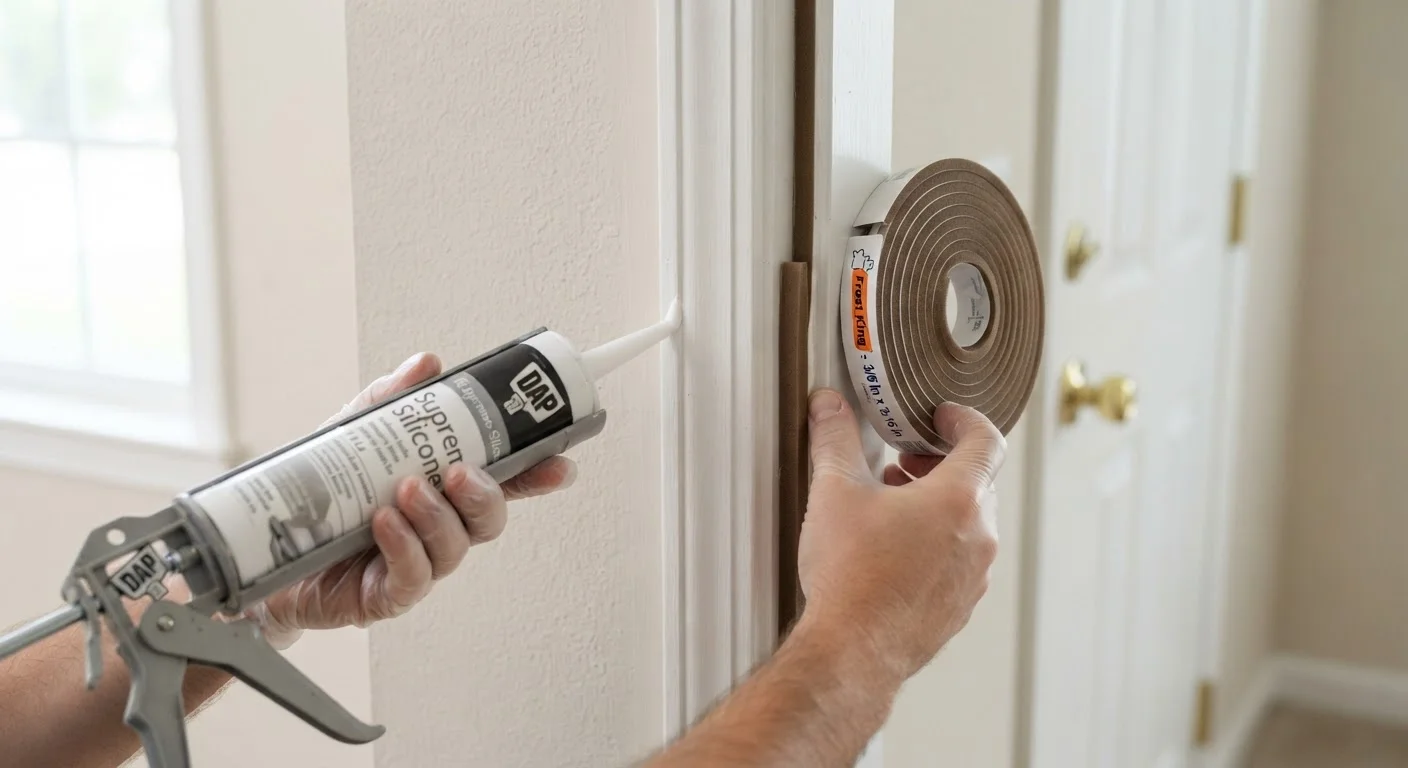
Key Takeaways
Option A
Caulk
The permanent, flexible seal for stationary gaps.
Best for: Best for filling fixed cracks and gaps along window frames, door casings, baseboards, and other surfaces that don't move.
Option B
Weatherstripping
The compressible, replaceable seal for moving parts.
Best for: Best for sealing the gaps around operable doors and windows where surfaces open, close, and flex repeatedly.
If you're sealing a crack between a window frame and exterior siding
Caulk
This joint is stationary, so caulk forms a durable, weatherproof bond without peeling or cracking from movement.
If you're stopping drafts around a frequently used exterior door
Weatherstripping
The door moves every time it opens and closes; compressible weatherstripping accommodates that motion while maintaining a tight seal.
If cold air is entering along your baseboard or door casing indoors
Caulk
Interior trim joints are fixed surfaces where a thin bead of paintable caulk fills gaps cleanly and permanently.
If your sliding or double-hung window leaks air when closed
Weatherstripping
Operable window sashes compress against weatherstripping channels; the sashes move too much for caulk to survive long-term.
If you want to address both drafts and moisture around a window unit
Caulk
Seal the perimeter of the window frame to the wall with caulk to block air and water infiltration at this fixed junction.
Why Getting This Choice Wrong Wastes Your Time and Money
Drafts account for a meaningful share of home heating and cooling losses, and most are fixable with basic materials and an afternoon of work. The trouble is that caulk and weatherstripping are often treated as interchangeable - they're not. Each product is engineered for a specific type of gap, and applying the wrong one means the seal will fail much sooner than it should.
Caulk is a flexible sealant that cures into a semi-rigid compound. It bonds to stationary surfaces and fills irregular gaps with precision. Weatherstripping, by contrast, is a compressible material - foam, felt, rubber, or vinyl - designed to be compressed and released thousands of times without losing its ability to seal. One handles stillness; the other handles motion. When you match each product to the right location, you get durable results. When you don't, you're recaulking a door frame every season or watching foam tape shred under a window sash.
For homeowners dealing with broader energy loss, it's also worth noting that drafts around doors and windows are just part of the picture - attic insulation and ventilation play an equally important role in overall comfort and energy efficiency.
Where Each Product Belongs
The single most reliable rule: if the surface moves, use weatherstripping; if it's fixed, use caulk.
Caulk: Fixed Joints and Stationary Gaps
- Around window frames where they meet exterior siding or interior drywall
- Along door casings where trim meets the wall surface
- Where baseboards meet the floor or wall
- Around pipes, conduit, or wiring that penetrate exterior walls
- Along the sill plate where the house frame sits on the foundation
Weatherstripping: Operable Surfaces
- The top, sides, and bottom of exterior door slabs (the moving door itself)
- Door thresholds, where the door bottom sweeps against the floor
- Operable window sashes - double-hung, casement, and sliding windows
- Attic access hatches and pull-down stair panels
| Criterion | Caulk | Weatherstripping |
|---|---|---|
| Best application | Stationary, fixed gaps | Moving parts (doors, operable windows) |
| Typical lifespan | 5-20 years (location-dependent) | 1-10 years (material-dependent) |
| Tolerates movement | No - cracks under flex | Yes - designed for repeated compression |
| Skill level required | Low - basic application tool | Low - peel-and-stick or screw-on |
| Common failure sign | Cracking, shrinking, or peeling away | Flattened, torn, or missing sections |
| Where NOT to use | Moving door/window surfaces | Fixed cracks in siding or trim |
A common mistake is caulking the gap between a door stop and the door frame. That joint flexes every time the door closes. Caulk here will crack within weeks. Use a compressible door seal or replace the door stop weatherstripping instead.
Caulk is also used in wet areas of the home beyond air sealing - if you're managing caulk in a bathroom context, the guide to grout and caulk in bathrooms covers when those seals need refreshing.
Choosing the Right Type Within Each Category
Not all caulk is the same, and weatherstripping comes in several formats with different durability levels.
Caulk Types
Latex or acrylic caulk is easiest to apply, cleans up with water, and takes paint well - good for interior gaps. Silicone caulk is more durable and water-resistant, making it better suited for exterior joints and areas exposed to moisture. Paintable latex with silicone blends workability with improved longevity and suits most interior door and window trim applications.
Weatherstripping Types
Foam tape (open- or closed-cell) is inexpensive and easy to install but compresses permanently over time - typically lasting one to three years. V-strip (tension seal) is a durable plastic or metal channel that springs back into shape after compression; it works especially well on the sides of double-hung windows and door frames. Door sweeps and automatic door bottoms address the gap at the threshold, where significant cold air enters. Bulb or tubular rubber gaskets offer a longer service life around exterior door stops and are more resistant to temperature extremes than foam.
Temperature Affects Caulk Application
Most caulks should be applied when temperatures are between 40°F and 80°F. Applying caulk in very cold conditions can prevent it from curing properly, leading to poor adhesion and early failure. Check the product label for the manufacturer's temperature range, and avoid sealing on days with rain or frost in the forecast.
How to Inspect Your Home and Prioritize
Before buying materials, do a quick walk-through on a cold or windy day. Hold your hand near the edges of exterior doors and windows - a perceptible breeze or temperature difference identifies a gap worth sealing. A candle or incense stick held near the frame (away from flammable materials) can reveal subtle air movement through smoke drift.
Check these locations in order of typical air-loss impact:
- Exterior door bottoms and thresholds - often the largest single gap in a home
- Door side and top stops - check for daylight or worn weatherstripping
- Window frames meeting exterior siding - caulk gaps here if you can see deteriorated or missing sealant
- Basement rim joists and sill plates - significant air entry points that caulk or spray foam can address
- Interior trim and baseboard gaps - smaller but cumulatively meaningful
If windows themselves are the underlying problem - old single-pane units with failing seals - sealing around the frame helps, but may not be enough. The trade-offs involved in replacing windows in an older home are worth understanding before committing to a larger project.