

Key Takeaways
5G (Fifth Generation Wireless)
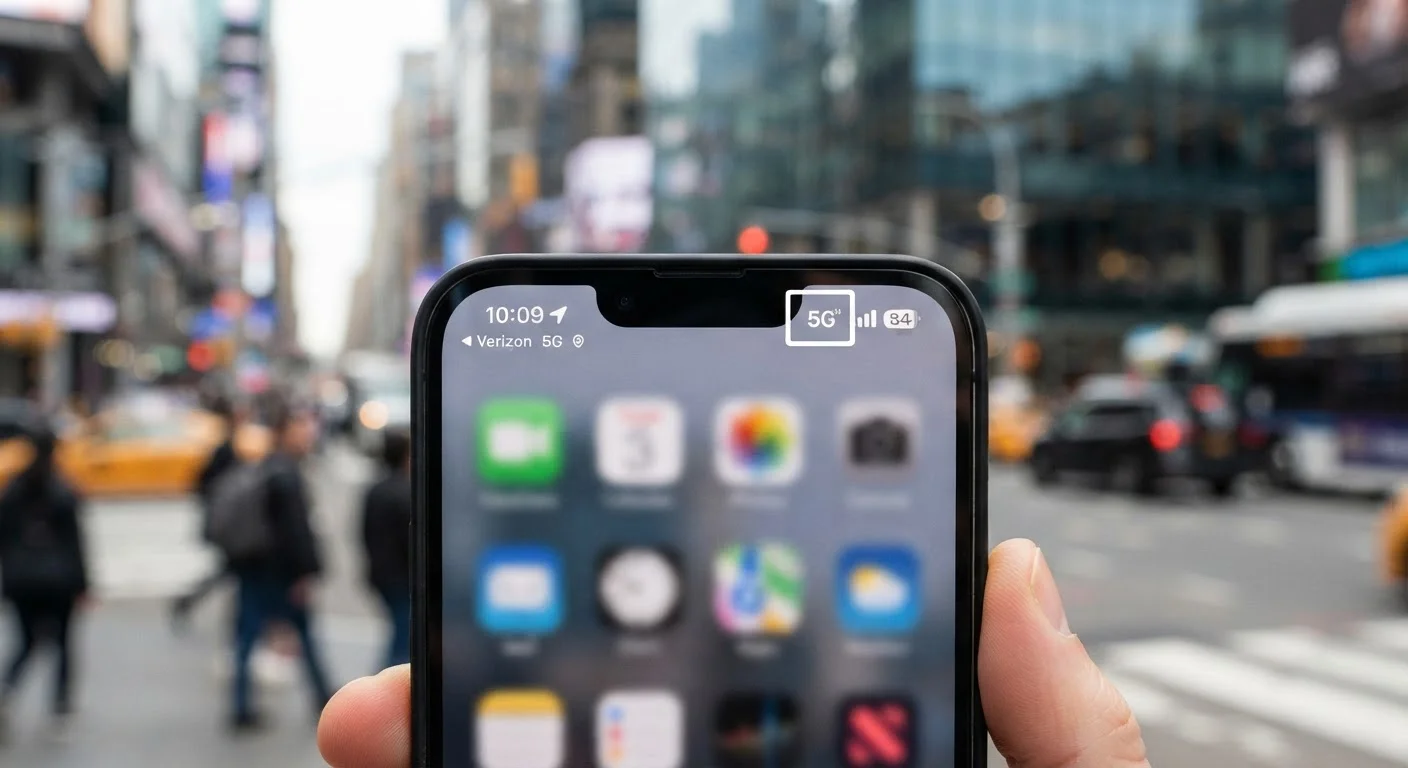
5G is the fifth generation of cellular network technology, designed to deliver faster data speeds, lower latency, and greater network capacity than 4G LTE. When your phone displays a "5G" icon in the status bar, it means your device has connected to a 5G-compatible cell tower. However, not all 5G connections offer the same performance - the experience varies significantly depending on which frequency band your carrier is using in that location.
5G operates across three primary spectrum categories - low-band (sub-1 GHz), mid-band (1-6 GHz), and millimeter wave (mmWave, 24 GHz and above) - each with distinct trade-offs between coverage range and peak data throughput.
The Icon Is a Signal Type, Not a Speed Guarantee
When your phone shows "5G" in the status bar, it's telling you which generation of wireless technology you're connected to - not how fast your connection actually is. Think of it less like a speedometer and more like a road sign that says "highway." Highways vary enormously; so does 5G.
This distinction matters because many users upgrade to 5G-capable phones expecting a dramatic leap in everyday speed, only to notice little difference in practice. The reason almost always comes down to which type of 5G their carrier is broadcasting at that location. For a broader look at how spectrum and terrain shape the signal you receive, see how carriers determine coverage.
~80%
U.S. population covered by low-band 5G
Industry analysts have estimated that low-band 5G reaches the vast majority of the U.S. population, making it the most common 5G tier most users actually connect to.
30-250 Mbps
Typical low-band 5G download speed range
Real-world speed testing data from organizations such as Ookla and network analysis firms consistently places low-band 5G speeds in this range under normal conditions.
500+ Mbps
Mid-band 5G typical peak download speeds
Mid-band deployments routinely deliver speeds several times faster than low-band in real-world testing, representing a meaningful improvement in user experience.
The Three Flavors of 5G You're Actually Getting
5G is deployed across three distinct spectrum bands, each with different physical properties that create real-world trade-offs:
- Low-band 5G (below 1 GHz): This is the most widely deployed form of 5G in the United States. Low-band signals travel long distances and penetrate buildings well, making them ideal for broad geographic coverage. The trade-off is speed - low-band 5G often delivers peak speeds only modestly above what a solid 4G LTE connection achieves, typically in the 30-250 Mbps range depending on conditions.
- Mid-band 5G (1-6 GHz): Often described as the "sweet spot" of 5G, mid-band offers a meaningful improvement in both speed and capacity compared to low-band, while maintaining reasonable coverage range. Speeds can reach several hundred Mbps to over 1 Gbps in favorable conditions. Mid-band deployment has expanded significantly in recent years and is now the primary driver of noticeably faster 5G experiences for most Americans.
- mmWave 5G (24 GHz and above): Millimeter wave delivers headline-grabbing multi-gigabit speeds - but only in very specific conditions. Its signals travel short distances, are blocked by walls and even rain, and are typically found only in dense urban corridors, stadiums, airports, and convention centers. Most users rarely connect to mmWave 5G in daily use.
For a deeper dive into what the 5G upgrade means in practical terms, our full 5G explainer covers the network shift in detail.
Your Phone Hardware Also Matters
Not every 5G phone supports all three spectrum bands. Some entry-level 5G devices are designed only for low-band or mid-band connectivity and cannot access mmWave networks even when coverage is available. Before assuming your phone will access the fastest 5G tier, check the device's technical specifications for supported 5G bands. This information is typically listed in the device's product page or the manufacturer's technical documentation.
Why Carriers Use Different 5G Labels
To help users distinguish between tiers of 5G performance, some carriers have introduced modified status bar icons. You may have seen "5G UC" (T-Mobile's Ultra Capacity label) or "5G UW" (Verizon's Ultra Wideband designation) on certain devices. These labels generally indicate that your phone has connected to mid-band or mmWave 5G rather than the slower low-band variety.
Not all phones display these indicators, and the labels are proprietary - each carrier uses its own naming convention. If your phone simply shows "5G" without a modifier, you're most likely on low-band coverage, though this isn't a universal rule. Understanding these labels is part of the broader vocabulary of wireless service. The plain-English wireless glossary explains common carrier terms in clear, jargon-free language.
“The 5G icon tells you what generation of network you're on - it doesn't tell you anything about the frequency band, the local infrastructure, or how fast your connection actually is. Those are entirely separate questions.”
— FCC Consumer Guide on 5G Technology, Federal Communications Commission consumer education resource
What This Means for Your Day-to-Day Phone Use
For most everyday tasks - streaming video, loading web pages, sending messages, using navigation - even low-band 5G provides a perfectly adequate connection. The practical difference between a strong 4G LTE signal and low-band 5G is often imperceptible during routine use.
Where mid-band and mmWave 5G genuinely shine is in high-demand scenarios: downloading large files quickly, using mobile hotspot in crowded venues, or sustaining fast speeds when many users are on the same network simultaneously. If those use cases matter to you, it's worth checking your carrier's coverage maps for mid-band availability in the areas you frequent most.
Your phone plan also plays a role. Some plans deprioritize data speeds after a usage threshold, which can affect your experience regardless of which 5G band you're on. For more on how plan structure shapes your data access, see what your phone plan actually includes.
The bottom line: the 5G icon is a useful signal about network generation, but reading it alongside your carrier's band deployment in your area gives you a far more accurate picture of what to expect.