

Key Takeaways
Lower per-line cost at three or more lines
Carriers tier group pricing so each added line reduces the average monthly cost per person, making family plans genuinely cheaper for larger households.
Single consolidated bill for the household
One payment covers all lines, simplifying budgeting and reducing the number of accounts any one person needs to manage.
Shared data pools can benefit uneven users
If some household members use little data, their unused allocation can buffer heavier users, potentially avoiding overage situations.
Centralized parental controls and visibility
Most carriers allow the primary account holder to set usage limits, content filters, and data caps per line - a meaningful feature for families with younger users.
Account dependency on the primary holder
All lines are tied to one account. If the primary holder's payment lapses or they close the account, every member's service is at risk.
Limited individual control for non-primary members
Secondary line holders often cannot make significant account changes - such as upgrading a plan or porting their number out - without the primary account holder's involvement.
Shared data creates conflict over heavy usage
When one member consistently uses a disproportionate share of a shared data pool, it can generate friction or force an upgrade that benefits only one user.
Harder to leave without coordination
Separating a line from a family plan typically requires the primary account holder's cooperation, which can be complicated if relationships change.
Carrier lock-in applies to the whole group
Switching carriers means convincing all members to move at once, or accepting that the remaining lines pay a higher per-line rate after departure.
Our Verdict
Family plans deliver meaningful savings per line for households of three or more people who are comfortable sharing an account, but they trade away flexibility and independence. Individual lines cost more on a per-line basis yet give each user complete autonomy over their plan, carrier, and billing. The right structure depends on how many people are involved, how much each person values independence, and whether all parties trust the account holder.
Family plans suit stable households of three or more people who want to simplify billing and reduce per-line costs, while individual lines are better for people who move frequently, have variable needs, or simply prefer to manage their own account.
How Family Plans and Individual Lines Actually Work
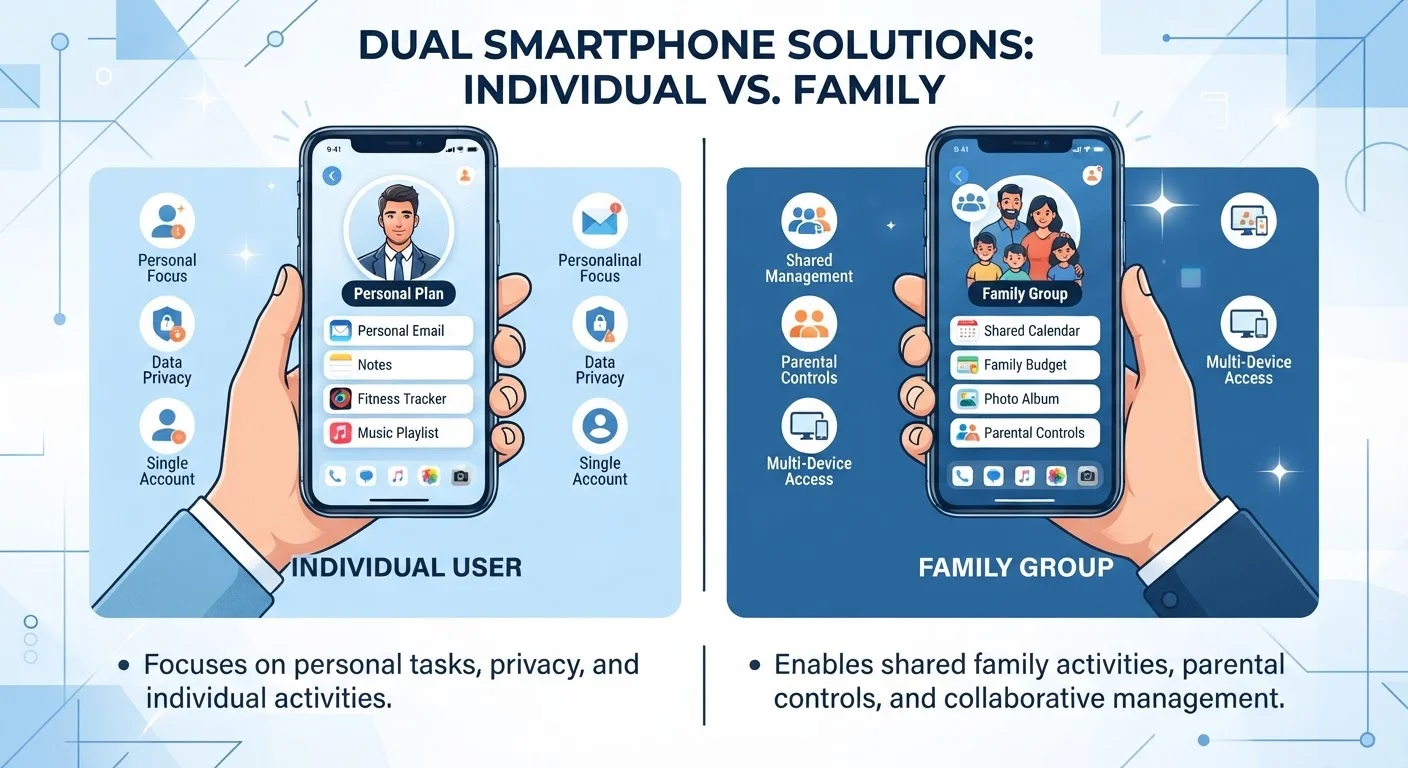
A family plan - sometimes called a group or multi-line plan - puts two or more phone lines under a single billing account, typically managed by one primary account holder. Carriers price these plans on a per-line basis that decreases as more lines are added, so the per-person cost tends to fall with each additional member.
An individual line is a single-user account with no shared billing relationship. Each person negotiates with the carrier independently, controls their own data tier, and receives their own bill.
These two structures are not just pricing variations - they reflect genuinely different relationships between users, carriers, and each other. Before comparing costs, it helps to understand what each arrangement actually commits you to. For a framework to compare specific plan details side by side, see our plan comparison guide.
Advantages of Family Plans
The most concrete benefit of a family plan is cost reduction per line. Carriers structure their group pricing so that adding lines lowers the per-person monthly rate - a discount that typically becomes meaningful at three or more lines.
Lower per-line cost at three or more lines
Carriers tier group pricing so each added line reduces the average monthly cost per person, making family plans genuinely cheaper for larger households.
Single consolidated bill for the household
One payment covers all lines, simplifying budgeting and reducing the number of accounts any one person needs to manage.
Shared data pools can benefit uneven users
If some household members use little data, their unused allocation can buffer heavier users, potentially avoiding overage situations.
Centralized parental controls and visibility
Most carriers allow the primary account holder to set usage limits, content filters, and data caps per line - a meaningful feature for families with younger users.
Beyond the bill, family plans often simplify household administration. One account means one payment date, one customer service relationship, and - for parents - centralized visibility into data usage across devices.
Disadvantages of Family Plans
Shared accounts come with real trade-offs that cost savings alone don't offset.
Account dependency on the primary holder
All lines are tied to one account. If the primary holder's payment lapses or they close the account, every member's service is at risk.
Limited individual control for non-primary members
Secondary line holders often cannot make significant account changes - such as upgrading a plan or porting their number out - without the primary account holder's involvement.
Shared data creates conflict over heavy usage
When one member consistently uses a disproportionate share of a shared data pool, it can generate friction or force an upgrade that benefits only one user.
Harder to leave without coordination
Separating a line from a family plan typically requires the primary account holder's cooperation, which can be complicated if relationships change.
Carrier lock-in applies to the whole group
Switching carriers means convincing all members to move at once, or accepting that the remaining lines pay a higher per-line rate after departure.
Account dependency is perhaps the most underappreciated drawback. If the primary account holder misses a payment, every line on the account can be affected. Non-primary members often have limited ability to make account changes - including switching plans or leaving the group - without the primary holder's authorization.
Shared finances on a phone bill can also create the same friction as any shared financial arrangement. If you're thinking through how to align on shared financial responsibilities, budgeting as a couple explores communication approaches that can help.
The Case for Individual Lines
Individual lines work best for people who value autonomy and flexibility above per-line savings. Each user is the sole decision-maker on their account - free to switch carriers, change plan tiers, or cancel without coordinating with anyone else.
~40%
Potential per-line savings on a 4-line family plan vs. four individual lines
Industry analyses of major U.S. carrier pricing structures consistently show per-line costs declining significantly as group lines increase, with four-line plans often 35-45% cheaper per line than equivalent individual accounts.
3+
Lines needed for family plan savings to become meaningful
Two-line family plans offer moderate savings, but the per-line price advantage tends to become most significant once a third line is added, based on standard U.S. carrier pricing tiers.
Individual lines also allow each person to match their plan precisely to their own usage. Someone who streams video daily may need a high-data plan, while a light user might be well served by a budget option. Bundling these different profiles into one family plan can mean everyone pays for a tier that only one member actually needs.
For people who travel frequently or live in different geographic areas - where different carriers may have stronger coverage - individual accounts allow each person to choose accordingly. Once you've settled on a plan structure, getting the most from your current plan can help you use what you have more effectively.
Prepaid Individual Plans: A Middle Ground
Prepaid individual plans - where you pay in advance with no contract - offer the autonomy of an individual line without a long-term commitment. They typically cost more per line than family plan rates but less than postpaid individual plans, and they carry no credit check requirement. For people who want flexibility without joining a group account, prepaid options are worth evaluating alongside postpaid alternatives.
Factors That Should Drive Your Decision
No formula reliably determines which structure is right for every household. Instead, consider the following variables:
- Household size: The per-line savings on family plans typically become substantial at three or more lines. Smaller groups may see limited benefit.
- Usage patterns: If members have wildly different data needs, a shared pool can feel inequitable and may cost more than separate, appropriately sized individual plans.
- Relationship stability: Family plans are straightforward to join but can be awkward to leave. Consider whether the people involved are likely to remain in the same living arrangement or financial relationship long-term.
- Account control preferences: Anyone uncomfortable with a third party having administrative authority over their phone service should weigh that carefully before joining a group plan.
Evaluating a plan - whether individual or family - also means scrutinizing what's included beyond the headline price. Promotional pricing, autopay discounts, and data throttling thresholds can all affect the real value of any plan.