

Key Takeaways
Our Verdict
No single plan structure is objectively superior - the right choice depends on your usage habits, coverage needs, and household situation. By comparing plans against the same criteria rather than relying on headline pricing, you put yourself in control of the decision. Applying a consistent framework is what separates an informed choice from a reactive one.
| Best for | Recommended |
|---|---|
| Heavy data users who stream and work on the go | Unlimited plans with clearly defined premium data thresholds |
| Light users with predictable, low monthly data needs | Capped or tiered data plans with lower base pricing |
| Households sharing multiple lines | Multi-line plans with per-line pricing that scales down with additional lines |
| Frequent travelers or those in rural areas | Plans on networks with verified coverage maps matching your regular locations |
Why Plan Marketing Obscures Apples-to-Apples Comparison
Carrier plan pages are built around attention-grabbing headlines: "Unlimited," "5G Included," "No Annual Contract." These claims are not false, but they are strategically incomplete. Two plans advertising identical features can differ meaningfully in practice - one may throttle video to 480p while the other streams at full resolution; one may include 15 GB of mobile hotspot while the other provides none.
The problem is structural. Each carrier chooses which metrics to highlight and which to bury in fine print. Without a consistent framework for comparison, you end up weighing the features each carrier chose to promote rather than the factors that actually affect your experience. Understanding what your plan actually includes - beyond the marketing - is the essential first step before any side-by-side evaluation.
The Core Comparison Categories
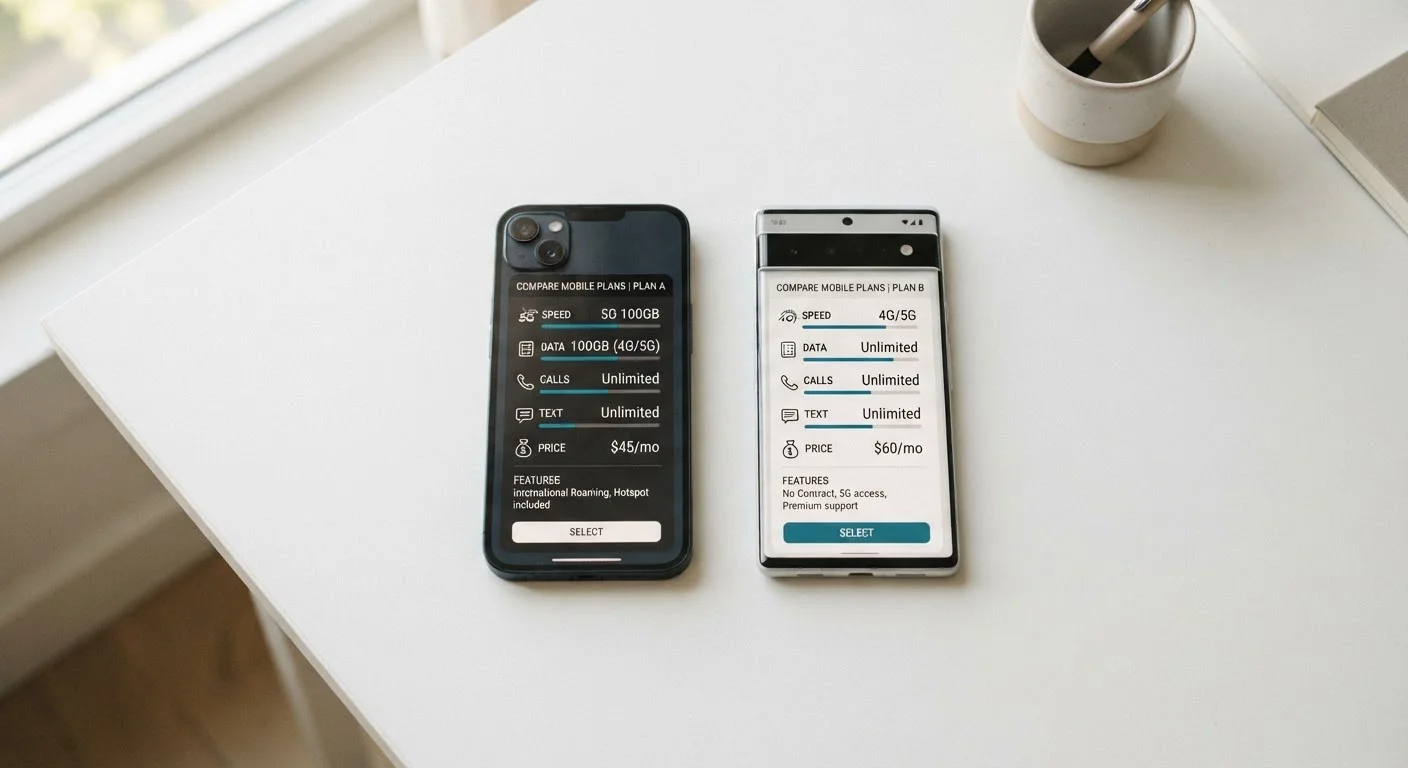
A fair comparison requires lining up every plan across the same set of dimensions. Focus on these categories:
- True monthly cost: Calculate the all-in price - base rate minus any autopay or paperless billing discount, plus estimated taxes and regulatory fees. These additions commonly add $5-$15 per line per month.
- Data structure: "Unlimited" plans almost always carry a premium data threshold - a point at which speeds are reduced during network congestion. Know the specific gigabyte cutoff for each plan, not just whether it says unlimited.
- Hotspot allowance: Mobile hotspot (tethering) is frequently capped separately from phone data. Compare the hotspot gigabyte allocation and the speed it drops to once depleted.
- Video and streaming quality: Many plans cap streaming resolution. Check whether a plan streams at SD (480p), HD (720p), or full HD/4K, and whether you can pay to upgrade.
- International coverage: If you travel outside the U.S., compare whether basic international calling and data are included, and at what speed or rate.
- Network and coverage: Plans may run on different underlying networks. Verify actual coverage in the specific areas where you use your phone most - home, work, and frequent travel routes.
| Comparison Factor | Why It Matters | What to Look For | |
|---|---|---|---|
| True Monthly Cost | Advertised price differs from actual bill | Base rate + taxes + fees − discounts | |
| Premium Data Threshold | Speed may drop after a set GB amount | Specific GB cutoff before deprioritization | |
| Hotspot Allowance | Often capped separately from phone data | GB included and speed after cap | |
| Streaming Quality | Resolution limits vary widely by plan | SD, HD, or full HD; upgrade options | |
| International Coverage | Varies from full inclusion to pay-per-use | Countries covered, speeds, call rates | |
| Network Coverage | Underlying network differs by carrier | Coverage in your home, work, travel areas |
Normalizing Cost Before You Compare
Headline pricing is almost never what you pay. Most carriers require autopay enrollment to unlock their advertised per-line rate, meaning the price shown assumes a billing behavior. Multi-line households also need to account for per-line discounts that only apply when multiple lines are active - a four-line rate is not the same as four individual lines.
To normalize costs across plans, build a simple monthly cost estimate for your exact situation: number of lines, expected payment method, and your state's average wireless tax rate (which varies but often falls between 10-25% of the base rate depending on location). Compare that normalized number, not the advertised figure. If you're evaluating options for multiple people, our look at family plans vs. individual lines walks through how per-line pricing shifts with household size.
Build Your Own Comparison Sheet
Create a simple spreadsheet with one column per plan and one row per comparison category. Fill in actual values - not marketing descriptions - for each cell. This forces every plan onto equal footing and makes trade-offs immediately visible. Even a basic side-by-side layout reveals mismatches that a quick web browse will not.
Matching the Plan to Your Usage Profile
A framework only works when it's anchored to your actual habits. Start by reviewing your last two to three months of data usage - most carriers provide this in your account dashboard. If you consistently use under 5 GB per month, a plan's 50 GB premium data threshold is irrelevant to your decision. If you rely on hotspot to work remotely, hotspot allocation becomes a primary criterion, not a secondary one.
Consider your coverage environment as seriously as your data needs. A plan with a strong urban network may be far less useful if you regularly travel through rural corridors with limited tower density. Coverage maps are a starting point, but they are generalized; firsthand accounts from people in your area can provide ground-level accuracy that maps cannot.
If you're new to evaluating plans independently, a structured first-timer's guide covers the foundational concepts before you apply a comparison framework. And once you've chosen a plan, getting the most from your existing plan helps you use it efficiently from day one.