

Key Takeaways
Our Verdict
Roundabouts offer measurable safety advantages over both four-way stops and uncontrolled intersections, particularly in reducing fatal crashes, because they lower vehicle speeds and eliminate the most dangerous conflict points. Four-way stops perform better than uncontrolled intersections when all drivers follow the rules correctly. Uncontrolled intersections demand the highest level of driver judgment and carry the greatest risk when that judgment fails.
| Best for | Recommended |
|---|---|
| High-traffic locations where safety and throughput are priorities | Roundabout |
| Lower-volume intersections where a structured rule helps drivers negotiate order | Four-Way Stop |
| Very low-speed, low-traffic residential or rural settings with cautious drivers | Uncontrolled Intersection |
Why Intersection Type Matters for Safety
Intersections are among the most dangerous points on any road network. According to the Federal Highway Administration, intersections account for roughly 40 percent of all traffic fatalities in the United States. How an intersection is designed and controlled directly influences the speed, angle, and frequency of potential vehicle conflicts - and that translates into real differences in crash outcomes.
Three intersection types appear most commonly across American roads: roundabouts, four-way stops, and uncontrolled intersections. Each asks something different of drivers. Understanding what those demands are - and where each design succeeds or struggles - is a core part of driver education.
~37%
Reduction in overall crashes at roundabouts
The Insurance Institute for Highway Safety (IIHS) has reported that converting intersections to roundabouts can reduce all crashes by roughly 37 percent.
~75%
Reduction in injury crashes at roundabouts
IIHS data indicate injury crashes drop by approximately 75 percent when traditional intersections are converted to roundabouts.
40%
Share of traffic fatalities at intersections
The Federal Highway Administration has noted that intersections account for roughly 40 percent of all traffic fatalities in the United States.
How Each Intersection Type Works
Roundabouts
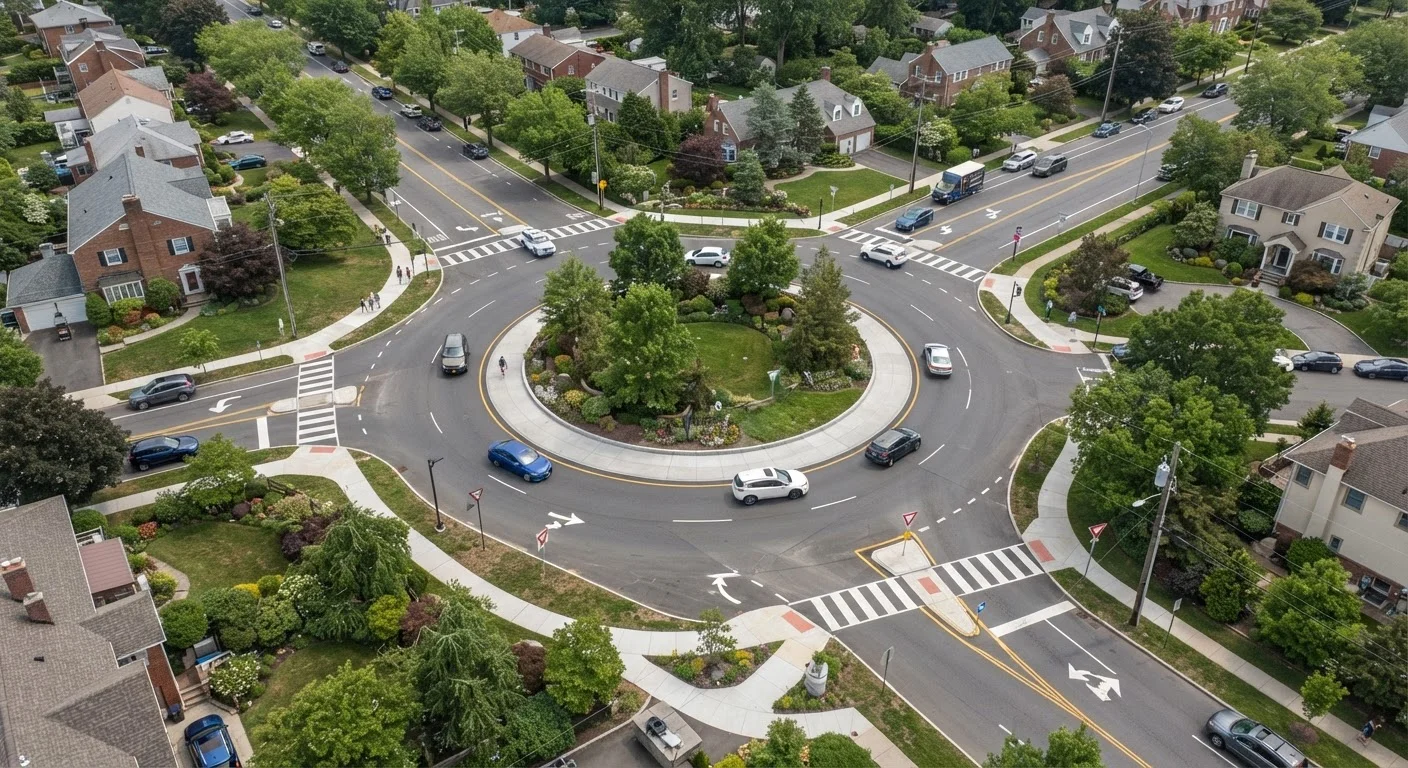
A roundabout routes all traffic in a single counter-clockwise direction around a central island. Entering drivers yield to vehicles already circulating. Because all traffic moves in the same direction, the most dangerous conflict types - head-on and high-speed right-angle collisions - are effectively eliminated. Approach speeds typically fall to 15-25 mph, which dramatically reduces the energy involved in any crash that does occur.
Four-Way Stops
At a four-way stop, all approaching vehicles must come to a complete stop. The right-of-way sequence generally follows arrival order; when two vehicles arrive simultaneously, the vehicle on the left yields to the one on the right. This system works well when all drivers are familiar with the rules. Confusion about priority - a topic covered in detail in our guide on right-of-way rules - is the most common source of errors at these intersections.
Uncontrolled Intersections
An uncontrolled intersection has no stop signs, traffic signals, or yield signs. The legal rule in most U.S. states is that the driver on the left yields to the driver on the right, but this rule is applied inconsistently. These intersections rely entirely on driver awareness, speed management, and mutual cooperation.
| Roundabout | Four-Way Stop | Uncontrolled Intersection | |
|---|---|---|---|
| Right-of-way rule | Yield to circulating traffic | First-arrived or right-of-way to the right | Right-of-way to the right; driver judgment required |
| Typical approach speed | 15-25 mph | Slow or stop | No enforced reduction |
| Fatal crash risk | Significantly lower | Moderate | Higher due to full reliance on driver |
| Pedestrian handling | Designated crosswalks outside circle | Crossing during stopped traffic | No dedicated crossing phase |
| Driver confusion potential | Moderate (unfamiliarity factor) | Low when rules are followed | High-no external guidance |
| Traffic throughput | High; continuous flow | Moderate; sequential stops | Variable; dependent on driver behavior |
Safety Performance: What the Data Suggests
Roundabouts have the strongest safety record among the three types. The Insurance Institute for Highway Safety (IIHS) has found that converting traditional intersections to roundabouts reduces injury crashes by approximately 75 percent and overall crashes by around 37 percent. The geometry of the roundabout does much of the work: lower speeds and same-direction flow mean fewer severe conflict points.
Four-way stops perform reasonably well under normal conditions but depend heavily on driver compliance and understanding of right-of-way. They can become problematic in high-traffic settings, where long queues and driver impatience increase the likelihood of errors. Rear-end crashes approaching a stop line are also a documented risk - a concern closely related to the dangers of following too closely, as discussed in our article on tailgating and stopping distance.
Uncontrolled intersections carry the highest inherent risk precisely because no external control exists. In low-speed residential areas with minimal traffic, the risk may be manageable. On faster roads or at intersections with limited sight lines, the absence of any guidance can be genuinely dangerous.
Navigating Roundabouts Correctly
When approaching a roundabout, slow down and yield to vehicles already in the circle - do not stop unless traffic requires it. Signal your exit before leaving the roundabout to help pedestrians and other drivers anticipate your path. Trucks and buses may need to use the full width of the lane, so give large vehicles extra space.
Pedestrians, Cyclists, and Vulnerable Road Users
Each intersection type creates a different environment for pedestrians and cyclists. Roundabouts include marked crosswalks positioned outside the circulating lane, where pedestrians cross one direction of traffic at a time and vehicles are moving at low speed. Research generally supports roundabouts as safer for pedestrians than signalized intersections, though the circular path can be disorienting for visually impaired users.
At four-way stops, pedestrians typically cross while vehicles are stationary, which provides a predictable window - but drivers may roll through stops or fail to check for pedestrians before accelerating. At uncontrolled intersections, pedestrians have no protected crossing phase at all, placing them entirely at the mercy of driver attentiveness. For a broader look at how different road users interact, see our guide on sharing the road with motorcycles, cyclists, and large trucks. Drivers should also review pedestrian right-of-way laws to understand their legal obligations at crosswalks near any intersection type.
Uncontrolled Intersections Demand Full Attention
At an intersection with no signs or signals, the legal default in most U.S. states is to yield to the vehicle on your right - but not all drivers know or apply this rule consistently. Never assume another driver will yield. Reduce speed well before the intersection and make eye contact or wait for clear confirmation before proceeding.