

Key Takeaways
What Companion Planting Actually Means
Companion planting is the practice of growing two or more plant species near each other for a mutual or one-sided benefit - whether that's improved growth, pest management, pollinator attraction, or efficient use of space. The concept has roots in Indigenous agricultural traditions and centuries of folk gardening knowledge, and it has experienced a strong revival among home gardeners seeking more sustainable growing methods.
The challenge is that garden lore spreads fast, and not every pairing that gets repeated in books or on seed packets has been put through rigorous testing. Some combinations perform well in controlled studies; others show inconsistent results that depend heavily on local soil, climate, and pest pressure. Understanding the difference helps you garden more effectively - and avoid wasting bed space on pairings that don't deliver.
For a broader look at building a garden that supports natural ecosystems, see our sustainable yard practices guide.
Myth
Planting basil next to tomatoes repels pests and dramatically improves tomato flavor.
Fact
There is limited scientific evidence that basil meaningfully repels pests or improves tomato flavor when grown nearby.
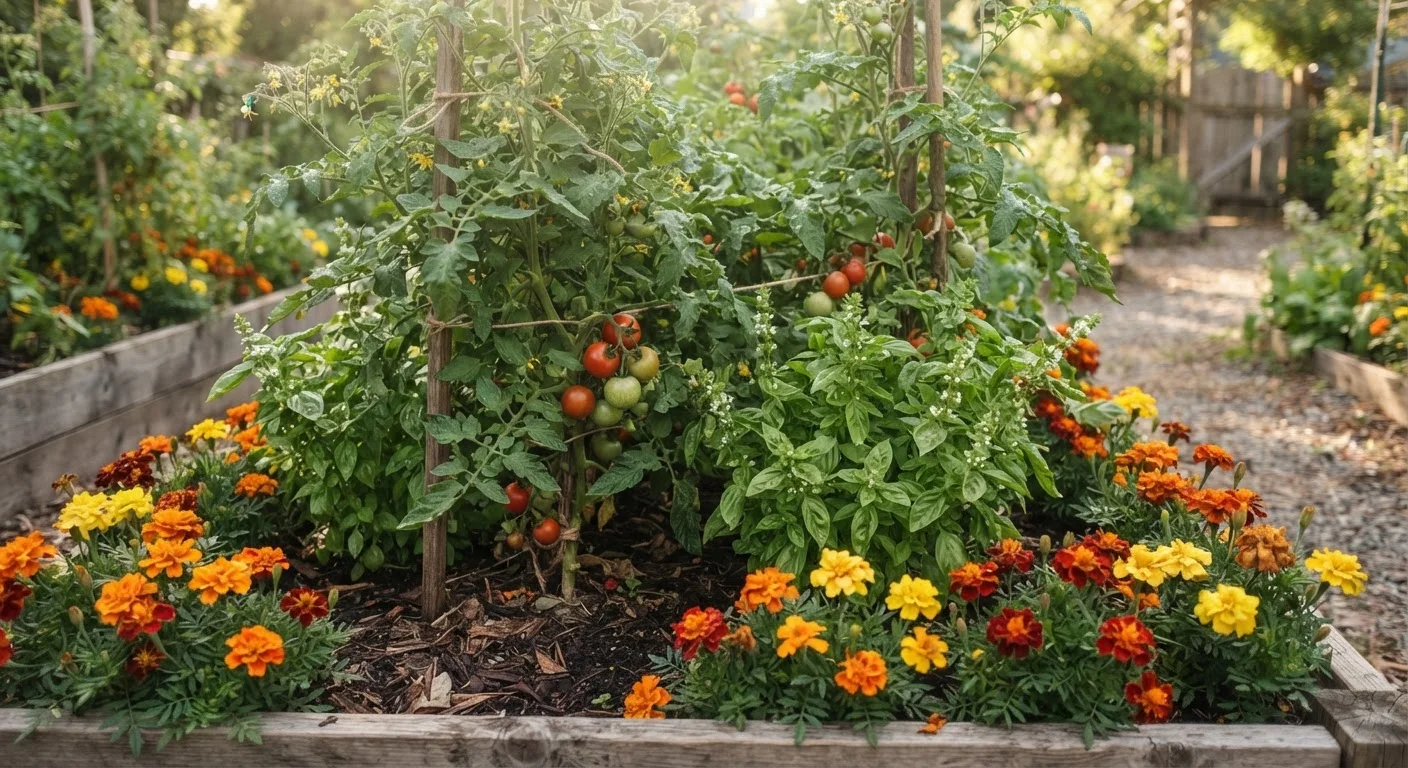
The tomato-basil pairing is one of the most cited in companion planting circles, but controlled studies have not consistently shown that basil repels aphids, whiteflies, or other common tomato pests at garden scale. Flavor improvement is anecdotal. The pairing does make practical sense for space efficiency and culinary convenience, and basil's flowers can attract some beneficial insects - but the pest-repelling claims go well beyond what research supports.
Myth
Marigolds planted anywhere in the garden will keep all pests away.
Fact
French marigolds can suppress specific soil-dwelling nematodes, but their effect on most above-ground pests is modest and highly variable.
French marigolds (Tagetes patula) produce a root exudate that has been shown in multiple studies to reduce populations of root-knot nematodes - a genuine and useful benefit for gardeners dealing with nematode damage. However, the popular claim that marigold scent repels aphids, beetles, and other above-ground insects lacks strong supporting evidence. Effectiveness depends on marigold variety, planting density, and the specific pest in question.
Myth
The Three Sisters - corn, beans, and squash - is a myth with no real agricultural benefit.
Fact
The Three Sisters combination is one of the most evidence-supported companion planting strategies, offering complementary benefits across all three crops.
Developed by Indigenous peoples of North America, the Three Sisters system pairs corn (a tall structure for beans to climb), pole beans (which fix nitrogen), and squash (whose large leaves shade the soil, conserving moisture and suppressing weeds). Each plant genuinely benefits the system. Agricultural researchers have documented the nitrogen-fixing contribution of beans and the moisture-retention effect of squash leaves. This is companion planting working as intended, with a mechanism that holds up to scrutiny.
Myth
You can plant anything next to roses as long as it looks good together.
Fact
Roses have specific allelopathic tendencies and resource needs that make some plant neighbors genuinely problematic.
Roses are heavy feeders and can struggle when paired with plants that compete aggressively for nutrients or water. Some gardeners report success with garlic planted near roses as a deterrent to aphids, though evidence for this is largely anecdotal. More importantly, overcrowding roses reduces air circulation and increases fungal disease pressure - a concrete, well-understood risk. Aesthetic pairings should still account for spacing, watering needs, and root competition.
Myth
Garlic planted near any vegetable will repel insects throughout the garden.
Fact
Garlic has some documented antimicrobial properties, but its insect-repelling effect at normal garden planting densities is not reliably proven.
Garlic contains sulfur compounds that have demonstrated antimicrobial and some antifungal properties in laboratory settings. Some intercropping studies show modest reductions in certain pest populations when garlic is grown nearby. However, the idea that a few garlic plants scattered through the garden will create a pest-free zone overstates the evidence considerably. Dense plantings in close proximity may have more effect than isolated cloves, but this has not been consistently replicated across different garden contexts.
Reading the Evidence: What Science Actually Shows
Peer-reviewed research on companion planting exists, but it's narrower than popular gardening culture suggests. Studies from university extension programs and agricultural researchers have confirmed a handful of combinations with measurable benefits, particularly around nitrogen fixation, pest disruption through intercropping, and nematode suppression. However, many studies are conducted under specific conditions that may not match your backyard.
~60%
Pest reduction in diverse intercropped plots
Research reviews on intercropping systems have found that diverse plantings can reduce pest abundance by roughly 60% compared to monocultures, though results vary by crop and region.
100+ lbs
Nitrogen fixed per acre by legume cover crops
University extension programs estimate that legume cover crops can fix more than 100 pounds of nitrogen per acre annually, benefiting neighboring and subsequent plantings.
Intercropping - growing multiple crops together - has been studied extensively in small-scale farming contexts. A consistent finding is that diverse plantings can reduce pest pressure compared to monocultures, not necessarily because one specific plant repels pests, but because diversity itself creates a less predictable environment for insects. This is a meaningful distinction: the benefit may come from variety rather than one magical pairing.
If you're thinking carefully about which plants to bring into your garden, the native plants vs. ornamental hybrids guide can help you weigh ecological value alongside aesthetics.
Pairings That Can Actually Hurt Your Garden
Allelopathy - the process by which one plant releases chemicals that inhibit the growth of another - is well-documented in botanical science. Black walnut trees, for example, produce juglone, a compound toxic to tomatoes, peppers, and many other common garden plants. Planting susceptible vegetables within the root zone of a black walnut is a mistake that will show up clearly in stunted, yellowing plants.
Fennel is another frequent offender. It's notorious for suppressing nearly everything planted beside it, including tomatoes, peppers, and beans. Many gardeners treat fennel as a garden loner - useful in its own container or isolated bed. For those growing in tight quarters, see our container gardening guide for ideas on keeping incompatible plants separated.
Fennel Suppresses Most Garden Neighbors
Fennel releases allelopathic compounds that inhibit the germination and growth of many common vegetables and herbs, including tomatoes, peppers, beans, and basil. It is generally best grown in a separate bed or container well away from your main vegetable garden. If you value fennel for culinary use, plan its placement carefully before the season begins.
Competition for resources is another underappreciated issue. Tall, aggressive plants can shade out shorter neighbors, and heavy feeders planted together will compete for the same soil nutrients. These resource conflicts often matter more than any chemical interaction.
Building a Garden That Benefits from Good Pairings
The most practical approach to companion planting combines the best-supported combinations with general biodiversity principles. Incorporate flowering plants that attract beneficial insects - this is one of the most consistently effective strategies backed by research. Umbellifer flowers like dill and cilantro attract parasitic wasps that prey on common garden pests. Our pollinator garden guide goes deeper on this approach.
Legumes - beans, peas, clover - fix atmospheric nitrogen through a symbiotic relationship with soil bacteria, genuinely improving soil fertility for neighboring plants. This is one of the clearest mechanisms in companion planting science. Interplanting nitrogen-fixers with heavy feeders like corn or squash has a strong rationale.
Finally, keep records. Because results vary by location, tracking what works in your specific soil and microclimate over several seasons is the most reliable path to a productive companion planting strategy. Gardening with evidence - including your own - is always more reliable than tradition alone.