

Key Takeaways
Soil Health
Soil health refers to the ongoing capacity of soil to function as a living ecosystem - supporting plant growth, filtering water, cycling nutrients, and sustaining a web of organisms from bacteria to earthworms. Healthy soil is not just dirt; it's a complex, living medium that feeds your plants from the ground up. The difference between thriving plants and struggling ones often begins well below the surface.
Soil scientists often evaluate health through indicators like microbial biomass, aggregate stability, organic matter percentage, and available water capacity - all of which interact to determine how well soil supports plant life.
Why Soil Is More Than Just Dirt
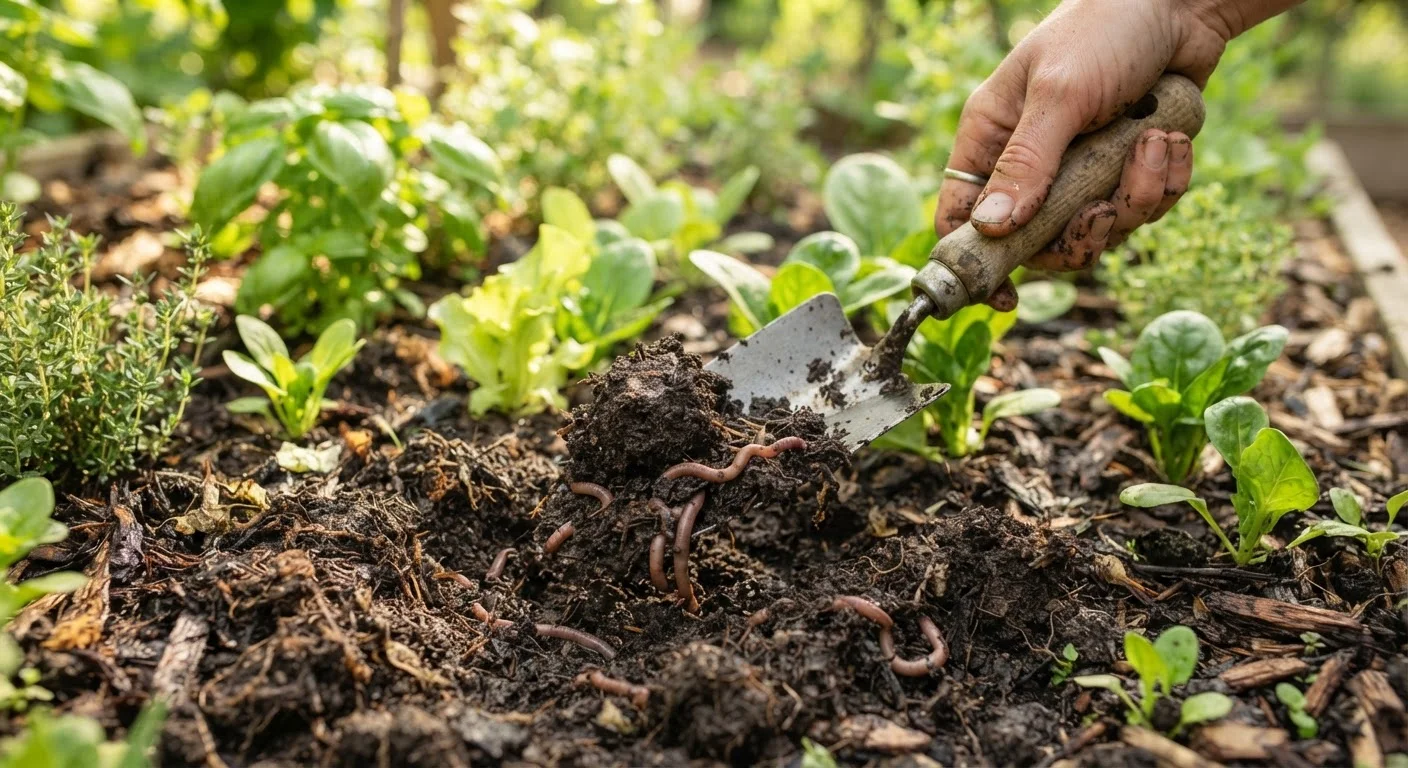
Most gardeners focus on what they put into the ground - seeds, transplants, fertilizers. But what the ground itself is made of determines whether any of those inputs actually work. Soil is a living system hosting billions of bacteria, fungi, protozoa, and invertebrates in every handful. These organisms break down organic matter, release nutrients in plant-available forms, and even communicate chemically with plant roots.
When that living system is functioning well, plants get what they need with far less intervention. When it's damaged - through compaction, chemical overuse, or neglect - even expensive fertilizers can't fully compensate. Understanding soil health means shifting your attention downward, before you ever put a plant in the ground.
“Essentially, all life depends upon the soil. There can be no life without soil and no soil without life; they have evolved together.”
— Charles E. Kellogg, Former Chief of the U.S. Soil Survey, USDA
The Three Pillars: Biology, Chemistry, and Structure
Soil health rests on three interconnected dimensions:
- Biology: The living community of microbes, fungi, earthworms, and insects that drive nutrient cycling and decomposition. Mycorrhizal fungi, for example, extend plant root systems dramatically, improving water and phosphorus uptake.
- Chemistry: The pH level and nutrient availability. Soil pH - measured on a scale of 1 to 14 - controls which nutrients plants can actually absorb. At a pH that's too high or too low, nutrients already present in the soil become chemically locked out.
- Structure: How soil particles - sand, silt, and clay - clump together into aggregates. Good structure creates pore spaces for air and water movement and allows roots to penetrate freely. Compacted soil, by contrast, restricts drainage and suffocates roots.
These three pillars reinforce each other. Biological activity produces the glue-like compounds that hold aggregates together. Good structure protects the microbial communities living within it. Chemistry influences which organisms thrive. You can't meaningfully improve one without attending to the others.
Testing Your Soil Before You Amend It
Guessing at what your soil needs and reaching for fertilizer bags is one of the most common - and costly - gardening mistakes. A basic soil test, available through most cooperative extension services and many garden centers, reveals your pH, macro-nutrient levels (nitrogen, phosphorus, potassium), and often organic matter content. Results typically come with specific amendment recommendations based on your goals.
Send Samples to Your Local Extension Service
Many university cooperative extension services offer soil testing for a modest fee and provide region-specific amendment recommendations. This is often more reliable than at-home test kits for pH and nutrient accuracy. Search for your state's land-grant university extension program to find a local testing option.
Collect soil samples from several spots in your garden at a depth of four to six inches, mix them together, and send the combined sample for testing. This gives a more representative picture than a single spot. Test every two to three years, or any time your plants show unusual symptoms or growth patterns.
If you're planning a new planting area - whether in-ground or a raised setup - testing before you build is especially valuable. For a comparison of how soil management differs between approaches, see raised beds vs. in-ground planting.
Building Soil Health Over Time
The most reliable path to healthy soil is consistent addition of organic matter. Compost is the gold standard - it improves structure in both sandy and clay soils, feeds microbial life, and supplies a slow release of nutrients. Learn more about making your own in our guide to composting at home.
~1 billion
Bacteria per teaspoon of healthy soil
USDA Natural Resources Conservation Service estimates suggest a single teaspoon of healthy soil can contain roughly one billion bacteria alongside thousands of fungal species.
5%
Organic matter in ideal garden soil
Many soil scientists suggest garden soils perform best with organic matter in the range of 3-5%, though most American suburban soils fall well below this threshold.
6.0-7.0
Optimal pH range for most vegetables
Within this range, the broadest spectrum of plant-essential nutrients remains chemically available for root uptake, according to established horticultural guidance.
Beyond compost, a few practices protect the soil structure you've worked to build:
- Minimize tillage. Every time you deeply till, you disrupt fungal networks and expose stored organic matter to rapid decomposition. Work amendments into the top few inches rather than turning beds over each season.
- Keep soil covered. Bare soil erodes, compacts under rain, and loses organic matter faster. Organic mulches protect the surface and gradually feed the soil as they break down. Our guide to garden mulch covers which types suit different situations.
- Avoid soil compaction. Stay off wet beds, use permanent pathways, and avoid heavy foot traffic on planting areas.
For a full seasonal approach to getting your soil ready, see our spring garden prep checklist. Soil-building also pairs naturally with sustainable yard practices that reduce inputs and support a healthier outdoor environment overall.