

Key Takeaways
What Gutters Actually Do
Rain gutters perform a deceptively simple job: they collect water that runs off your roof and channel it through downspouts to a discharge point safely away from your home's foundation. Without them, every rainstorm would send a concentrated sheet of water - called a drip line - cascading straight down your exterior walls and pooling against your foundation.
A well-functioning gutter system has three core components: the channel (the horizontal trough attached to the fascia board), the downspout (the vertical pipe that carries water to ground level), and the extension or splash block that directs water away from the structure. Each part depends on the others. A clean channel with a blocked downspout is nearly as useless as no gutter at all.
Gutters also protect your landscaping. Uncontrolled roof runoff strips topsoil and creates erosion channels in planting beds. If you've worked hard to build healthy soil structure in your yard, understanding why soil health matters makes proper drainage even more compelling.
How Gutter Failures Damage Your Home
The consequences of neglected gutters extend far beyond a little overflow during a storm. Water that pools against your foundation exerts hydrostatic pressure - the force of saturated soil pressing against concrete or masonry. Over time, this contributes to cracks, shifting, and basement moisture intrusion. For a deeper look at what happens next, see our guide on keeping your basement dry.
Overflowing gutters also saturate the fascia boards - the wooden trim directly behind the gutter channel - leading to rot that can spread to roof decking and rafters. This mirrors the same escalating water damage described in why small roof leaks become big structural problems.
Additional documented damage patterns include:
- Siding staining and rot from water splashing back off a clogged trough
- Basement or crawl space flooding when downspout discharge lands too close to the foundation
- Ice dams in cold climates, where backed-up debris traps melting snow at the eave
- Pest harborage - standing water and wet debris attract mosquitoes and provide nesting material for birds and rodents
Foundation Damage Is Expensive and Largely Preventable
Water pooling against a foundation is one of the leading causes of basement flooding and structural shifting in residential homes. In many cases, correcting gutter pitch and extending downspout discharge is enough to stop the problem before it reaches the foundation. If you're already seeing basement moisture, address your gutter system first before investing in interior waterproofing solutions - the gutter fix may resolve the root cause.
Common Reasons Gutters Fail
Most gutter problems fall into a handful of predictable categories:
- Clogs
- Leaves, seed pods, shingle granules, and roof debris accumulate in the channel and block water flow. This is the most common failure mode.
- Improper pitch
- Gutters must slope slightly toward downspouts - typically about a quarter-inch of drop per 10 feet of run. A flat or reverse-pitched section allows water to pond and debris to settle.
- Loose or missing hangers
- The brackets that attach gutters to the fascia can pull away over time, causing sections to sag or detach entirely.
- Joint separation
- Sectional gutters are joined with sealant that degrades over years of expansion and contraction. Separated joints leak directly down the fascia.
- Undersized system
- A gutter channel that's too narrow or a downspout with too small a diameter simply cannot handle the volume of runoff from a steep or large roof during heavy rain.
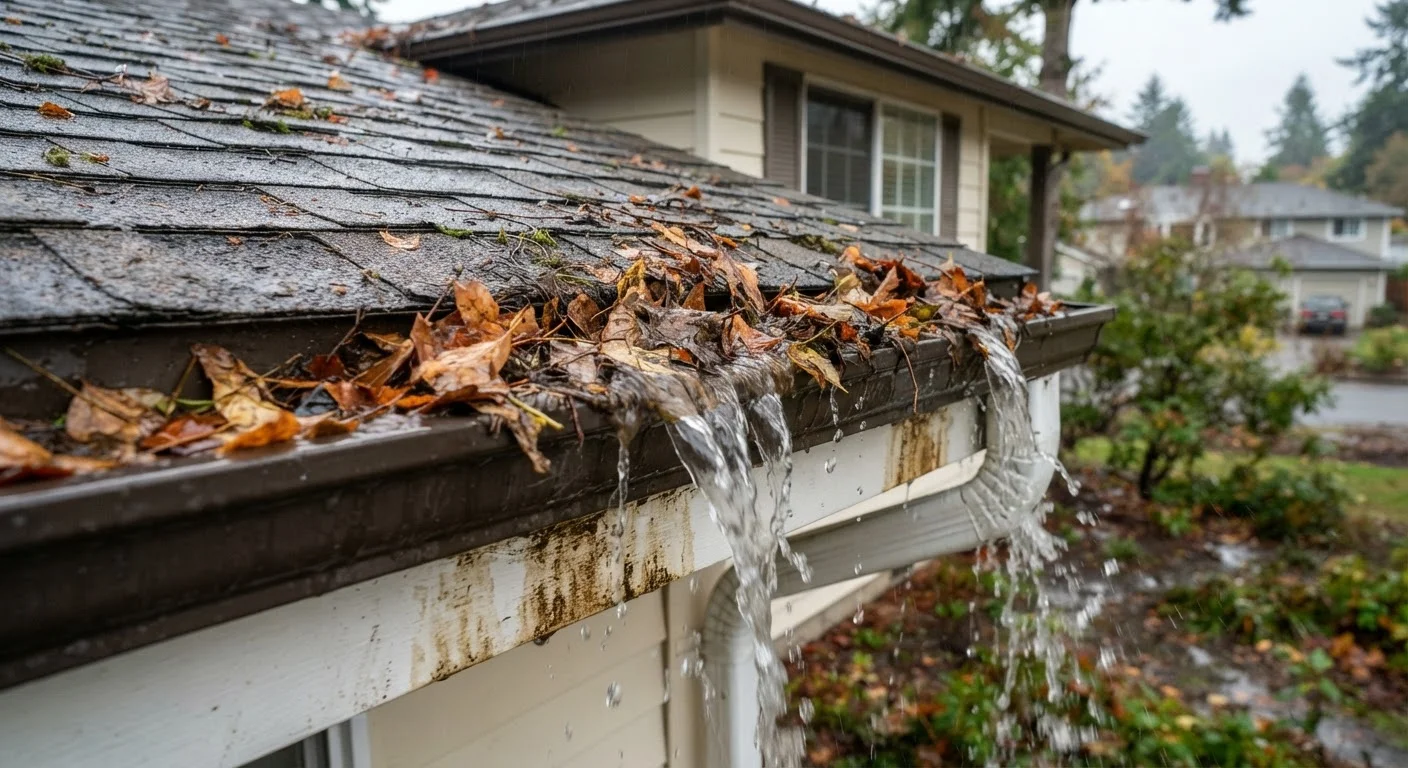
When inspecting gutters after a rain, look for water marks or 'tiger stripes' running down the outside of the channel - these indicate chronic overflow that's been happening long enough to stain the metal, even if the gutter appears functional when dry.
Overflow stains are a reliable diagnostic sign that the system is undersized, pitched incorrectly, or partially blocked - and they're visible without climbing a ladder.
Before adding a gutter guard, flush the existing gutter thoroughly and repair any sagging sections - guards installed over a poorly pitched trough trap debris in exactly the spot where it causes the most damage.
Gutter guards work best as a maintenance-reduction tool on a correctly functioning system, not as a fix for underlying structural problems.
How to Clean and Inspect Your Gutters
Routine cleaning is a task most homeowners can handle safely with the right preparation. Before climbing a ladder, review ladder safety guidelines and never work on a wet or windy day.
- Clear the channel. Working from a stable ladder, remove leaves and debris by hand or with a small plastic scoop. Work toward the downspout opening, not away from it.
- Flush with water. Use a garden hose to rinse the channel toward the downspout. This reveals any remaining blockages and lets you check flow rate and pitch.
- Clear downspouts. If water doesn't drain freely, insert the hose at the top and run it at full pressure. A plumber's auger can dislodge stubborn clogs.
- Inspect for damage. While the gutter is wet, look for standing water (indicating flat pitch), rust spots, holes, separated joints, and loose hangers.
- Check the discharge point. Water should exit at least 4-6 feet from the foundation. Adjust or add downspout extensions as needed.
For siding that shows staining from past overflow, pressure-washing guidance can help you clean safely without forcing moisture behind the cladding.
Seasonal Maintenance Schedule
A twice-yearly cleaning covers most homes, but the timing matters as much as the frequency.
| Season | Task | Why It Matters |
|---|---|---|
| Late Fall | Full clean after leaves have dropped | Removes the heaviest debris load before winter rains and freeze cycles |
| Early Spring | Clean and inspect for winter damage | Ice expansion can separate joints and loosen hangers |
| After Major Storms | Quick visual check and debris removal | Wind-driven debris can create sudden blockages |
| Summer | Check downspout extensions; clear seed debris | Maple seeds and cottonwood fluff can compact into dense plugs |
Homes surrounded by pine trees or dense deciduous canopy may need cleaning three to four times per year. Gutter guards (mesh screens or surface-tension covers) can reduce cleaning frequency but do not eliminate it - fine debris and shingle granules still accumulate over guards and inside them.
Mark Your Calendar, Not Your Memory
Set two recurring calendar reminders - one in late November and one in early April - for gutter inspection and cleaning. Pairing the task with another seasonal habit (like swapping storm windows or checking smoke detector batteries) makes it easier to stay consistent. Consistency matters more than perfection: a quick annual cleaning beats a thorough one every three years.
When to Call a Professional
Many gutter tasks are DIY-friendly on a single-story home with safe ladder access. However, some situations call for a licensed contractor:
- Multi-story or steep-roof homes where ladder work poses a significant fall risk
- Fascia board rot that requires carpentry repair before new gutter installation
- Full gutter replacement, particularly with seamless aluminum systems that require a roll-forming machine
- Persistent basement water intrusion that may require grading, French drains, or interior waterproofing beyond what gutters alone can solve - see interior vs. exterior waterproofing methods for what those approaches address
- Homes in wet climates with basements may also benefit from understanding sump pump basics as a complementary line of defense
When getting estimates for gutter work, ask contractors to assess pitch, hanger spacing, and downspout capacity - not just whether the channel needs cleaning. A structurally sound, correctly sized system is far more valuable than a spotless one that drains poorly.
This article is for general informational and educational purposes only. Always verify local building codes and consult a licensed contractor before undertaking structural home repairs.